While we await a few confirmations before announcing the winners of our recent Fiction Competition, there’s still time to enter our 2025 Poetry Competition. The judge this year is a talented Gareth Writer-Davies and the closing date for poems up to 40 lines long on any theme is midnight, Tuesday 22nd April. Anyone can submit poems and we look forward to reading your exciting creations.
For full competition details and to download your entry form, please head over to our Competitions page.
To inspire and keep the poetical theme going here’s a couple of poems by HWC members, Jean O’Donoghue and Emma van Woerkom. We sincerely hope you enjoy them.
CIRCUS By Jean O’Donoghue
Stretching out, the high wire is like my nerves Alert and vulnerable My eyes look out for the limit of the stretch A wobble comes. It gets bigger until its shaky parabola Signals to me that I had better get down.
Next are the garish gaudy unfunny stupid clowns One of them looks a lot like me. And then the poor dumb huge beasts Their eyes vacant with defeat.
And the ringmaster! Looking a little like my father A little like my absent husband. He Fruitlessly twitches his impotent whip. I hope that the lions revolt and eat him And that the sea lions refuse to clap
I mount the rope ladder again and face My partner on the flying trapeze. Can you trust a man wearing a spangled cod piece And spray on tights? We start slow – just a few innocuous passes. The tension mounts as we fake a stumbled catch But then it’s the major play Shall I? Can I? Will I? The safety of the net is almost irresistible ….
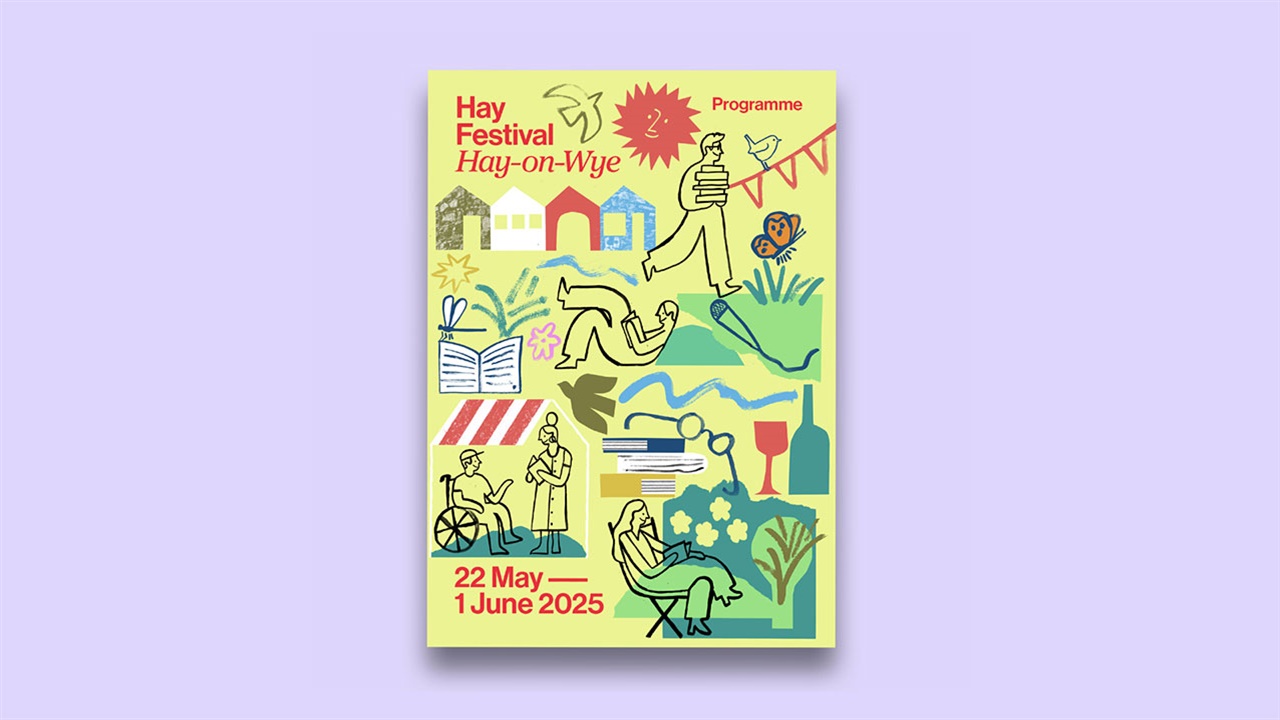
Reminder – Hay Festival 22nd May – 1st June, 2025 Tickets Now Available – CLICK HERE
The Hay Writers Live! – Event 71
Date – Saturday 24 May 2025 Time – 7pm Location – Writers at Work Hub – Hwb Awduron wrth eu Gwaith
Come and hear the writers share and discuss some of their recent work. The Hay Writers’ Circle is a dynamic group, active in Hay for more than 40 years. It offers three competitions annually for poetry, fiction and non-fiction, each of which is open to both members and non-members. There is an active work in progress group for those working on longer projects. The Circle has an ongoing, productive relationship with a local primary school.
Submissions are now invited for the annual Hay Writers’ Circle Poetry Competition, and we are delighted to announce the judge for 2025 is the remarkable, Gareth Writer-Davies. The theme this year is entirely open and we hope to receive a wide variety of poems and poetry styles for this competition.
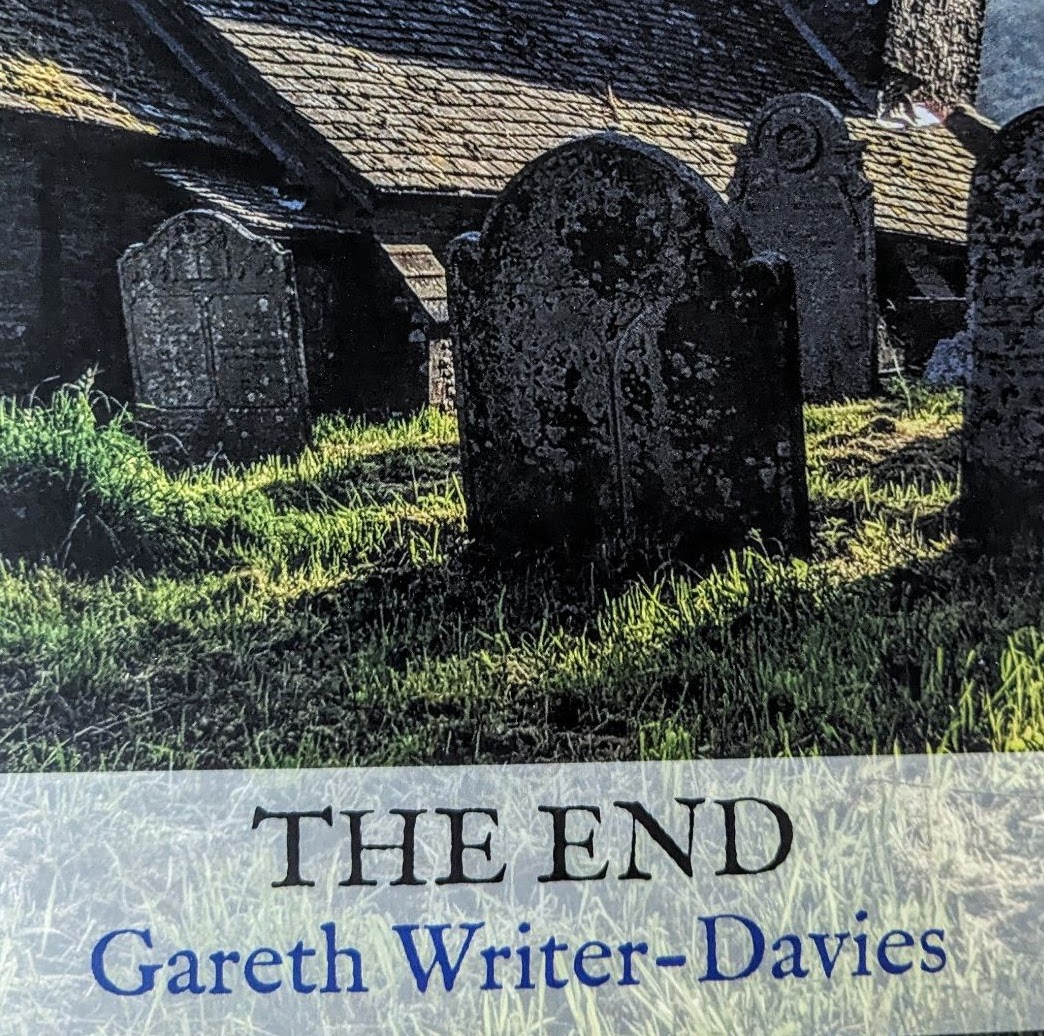
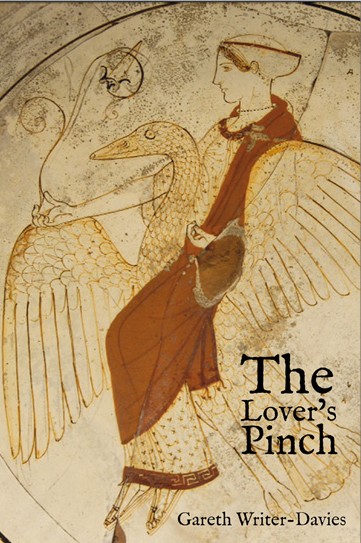
Gareth Writer-Davies lives near the Brecon Beacons (Bannau Brycheiniog) and takes his writing inspiration from the beautiful Welsh mountains and rivers of his home. His notable achievements include – Shortlisted Bridport Prize (2014, 2017, 2024), Commended Prole Laureate Competition (2015 & 2021) Prole Laureate (2017) , Welsh Poetry Competition Highly Commended (2017), Winner, Wirral Festival Poetry Competition (2023), Runner Up, Spelt Poetry Competition (2023). His publications are: “Cry Baby” (2017), “Bodies” (2015) , “Wysg” (2022) “The End” (2019) “The Lover’s Pinch” (2018). He was a Hawthornden Fellow (2019)
Gareth has written 5 collections, Bodies (2015), and Cry Baby (2017), published byIndigo Dreams.
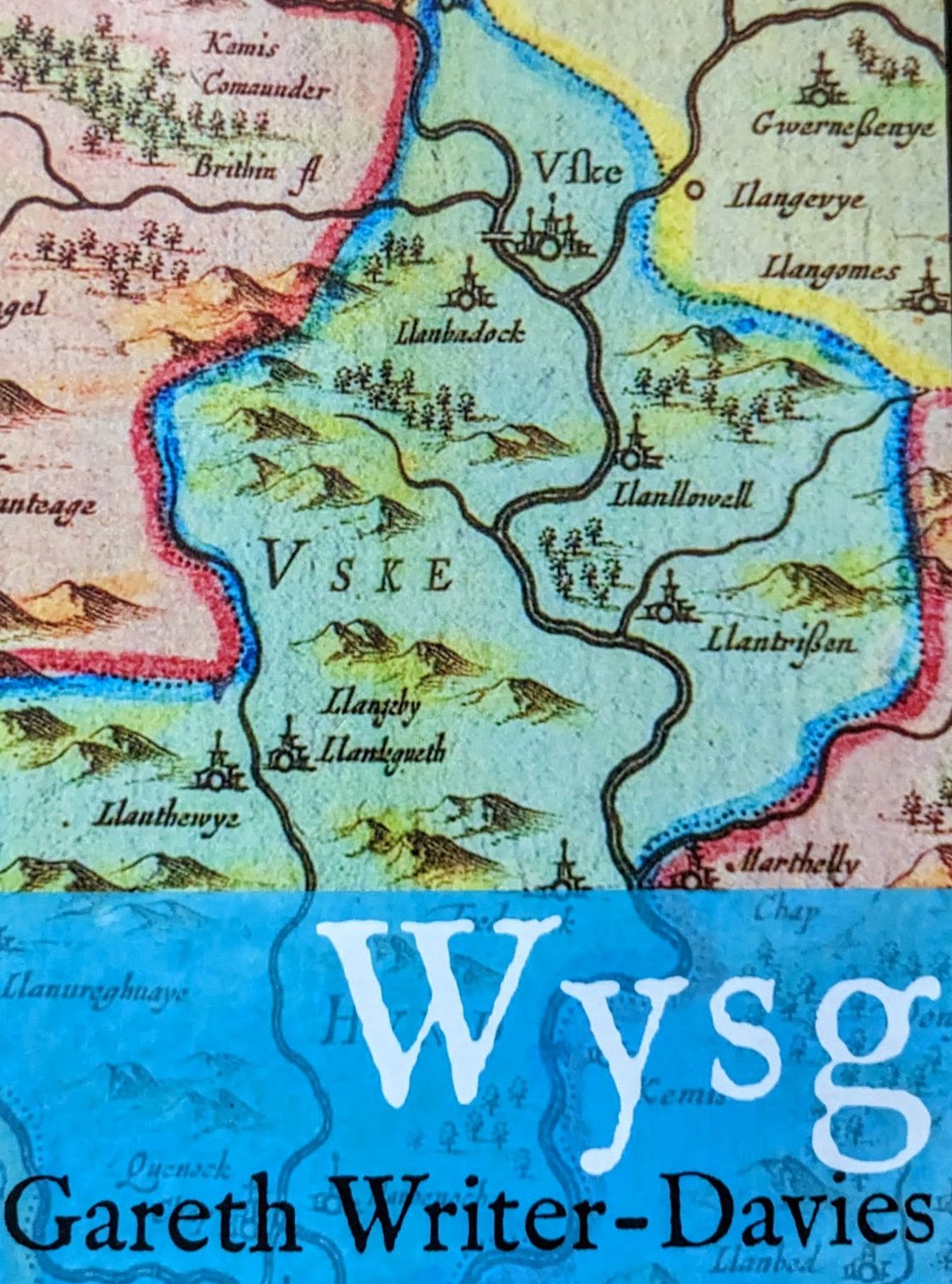
His latest book, WYSG (2022) is also published by Arenig Press.
In WYSG Gareth Writer-Davies is instantly recognisable, as he navigates the borderlands of Wales, seeking to bridge the new and the familiar; the streaming of our lives, our conflicts with nature, getting older and always, where we have been and where we are going?
“In these sharply-worked, elegant poems, Gareth Writer-Davies takes the reader on a voyage of mid Wales which invites us to see this landscape in a vivid light.” – Katherine Stansfield
– HWC POETRY COMPETITION – FIRST PRIZE £100
The Hay Writer’s Circle Poetry Competition 2025 is open to everyone.
The first prize of £100 with additional cash prizes for 2nd and 3rd placed poems.
The closing date for entries is midnight Tuesday 22nd April, 2025 Results will be announced mid May.
Original, unpublished poems of up to 40 lines maximum on any theme.
At our discretion, the winning poems will be published on the Hay Writer’s website. Publication may prevent eligibility for future competitions. All rights remain with the author.
For full competition guide lines and entry form please download the file below :
It was with great sadness that we recently learned Ann Riviere, a Hay Writers’ Circle alumni and stalwart supporter of the group had passed away.
Ann was a highly valued member for almost 2 decades and served as HWC Treasurer for many of them. In an era when the Circle sold a yearly magazine to generate funs, Ann would be out and about the town of Hay, selling magazine advertising space to many of the local businesses, (“on the streets plying her trade” as she often joked!). In her role as Treasurer she also wrote annually to Literature Wales in the hope that the group might get support, and although we never received any funding, she never gave up hoping.
Ann’s writing speciality was short stories. Her well observed people and places, dialogue and plot twists coupled with superb timing, pace and snippy interjections could only be matched by her Hay Festival performances; it was then Ann’s writing truly came alive and she delighted audiences over the years with both comic vignettes and atmospheric thrillers.
When asked where she found the ideas for her work, Anne replied that, “staring at a blank sheet of A4 and praying for inspiration usually did the trick.” Her A4 paper was always set ready for use in an aged electronic typewriter. In her mid eighties and under great duress, it was finally superseded by a laptop when failing eyesight got the better of her.
By her mid nineties, physically frail but still independent, with a mind as keen as ever, Ann enjoyed being kept up to date with all HWC news. She could often be lured down the road to former HWC Chair, Lynn Trowbridge’s House when any of the writers called. She would laugh, reminisce and generally put the world to rights!
Thank you to Emma van Woerkom for the above tribute to Ann.
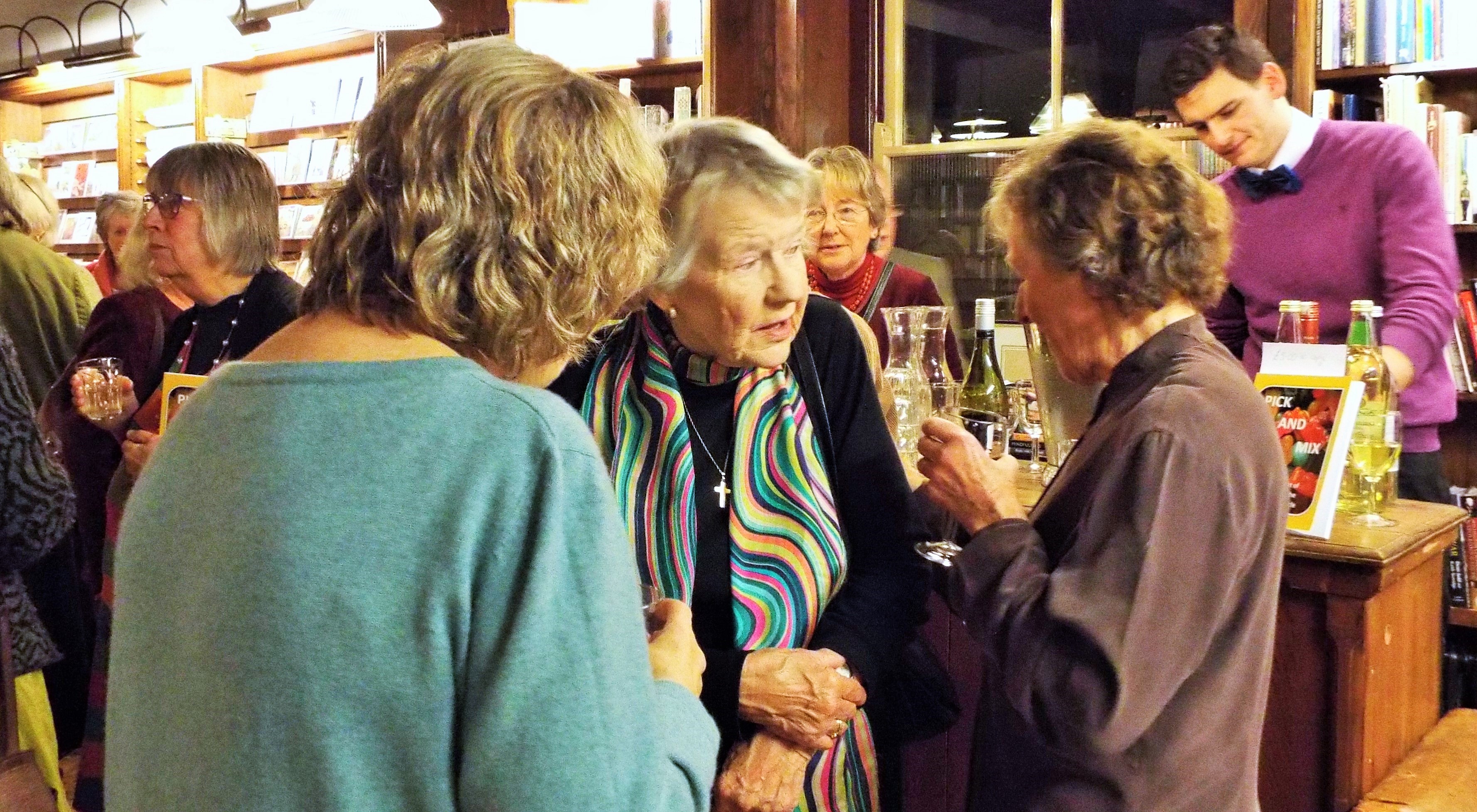
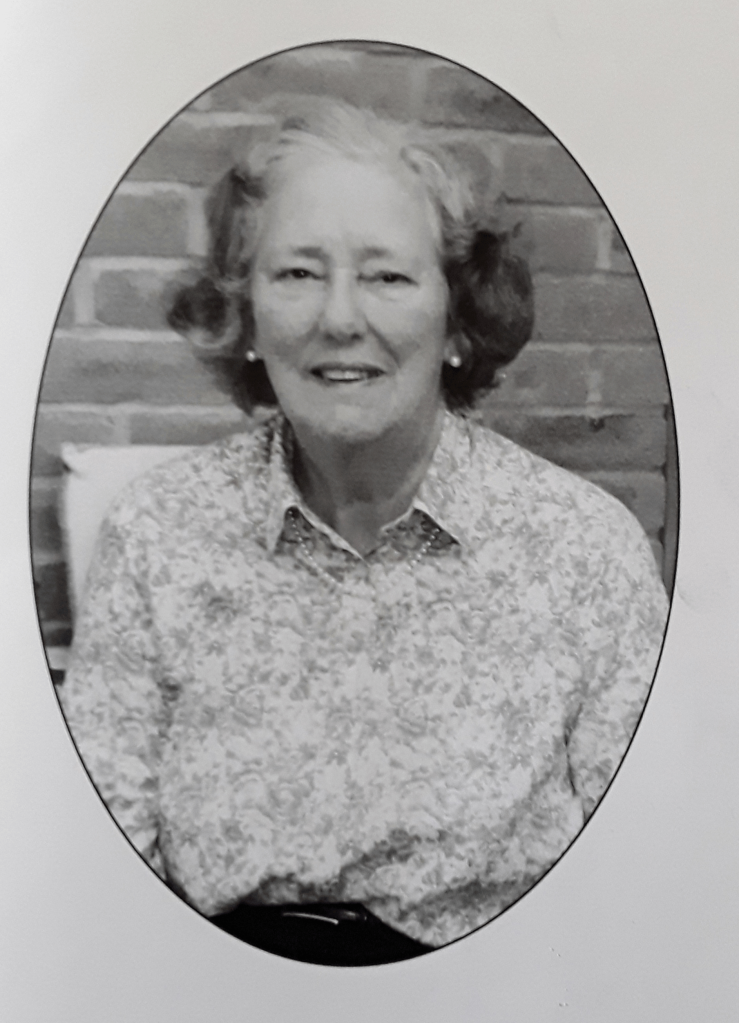
Ann Riviere – 2015 Book Launch for Pick and Mix Anthology at Booth’s Books, Hay-on-Wye.
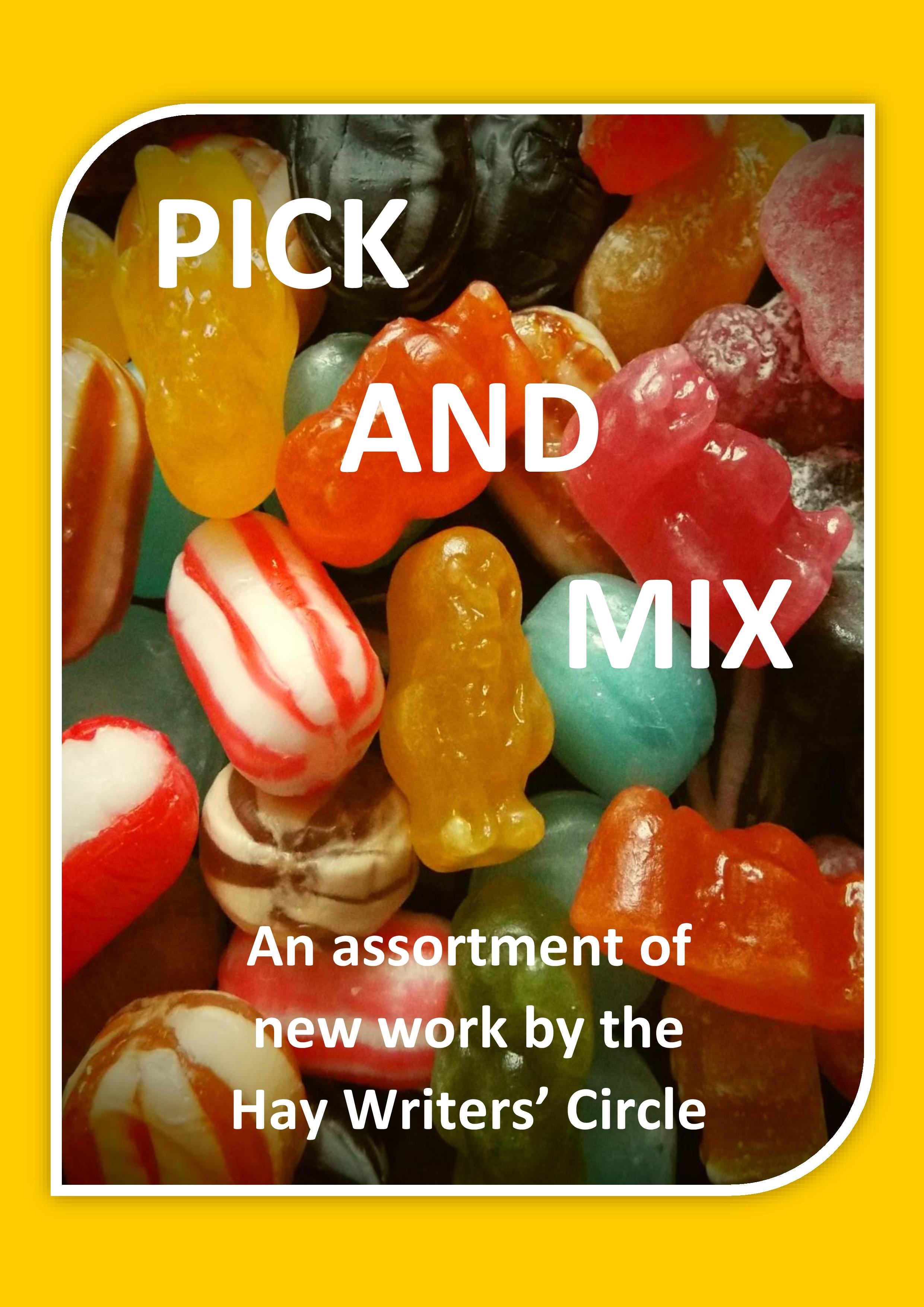
Below is one of Ann’s short stories which appeared in the 2015 anthology, Pick and Mix: An assortment of new work by the Hay Writers’ Circle.
THE ANNIVERSARY by Ann Riviere
Ursula had known for years of Robert’s infidelities. She never knew if there were a number of women or just one. His attractive Personal Assistant was a likely candidate. Hurtful though it was, apart from his philandering, he was a generous, thoughtful husband and a loving, caring father. As far as the girls were concerned, however busy he was at work, he always found time to attend school plays, sports and parents’ days. During annual holidays, when they were small, he was the perfect Daddy, making sand castles, and as they grew up, driving them to and from parties and dances. He would also sit in the freezing cold on Saturday mornings at the riding school, watching with pride as they showed off how well they could control their ponies.
Oh yes, she had been fortunate in her marriage, but he had spoilt it for her. Hard as she had tried, she could not help the stabs of jealousy each time she suspected him of being unfaithful. It would have to end. She had thought hard and long of how and when she would tell him of her decision. The time had to be right. Their 21st wedding anniversary was soon. Janie was already twenty and Georgia would be nineteen in a couple of weeks and would be off to join her sister at university. They would be two independent young women no longer needing to be mothered.
Never having forgotten their anniversaries, Robert would certainly not forget their 21st. He would bring home a huge bunch of peach-coloured roses, her favourite, and then, probably, they would go out to dinner. She would tell him then. In the meantime, she would give some thought as to what she might do after the separation. Take a cruise to some sunny spot, lie in the warmth and consider her options.
On the morning of the anniversary, as he left for the office, Robert said ‘As it’s such a special day, I’ve reserved seats for the Oscar Wilde play and booked a table at The Savoy for dinner.’
Returning home on the dot of six, armed with the roses, he was smiling happily. For a moment she wondered if she was doing the right thing.
The Importance of Being Earnest was a favourite play and the dinner afterwards was superb. Ursula drew her breath, but before she could say a word, Robert took a small box from his breast pocket. Inside was a ring of diamonds and sapphires. It was quite beautiful.
‘This is for putting up with me for all these years and for never having reproached me about anything. Whatever you may think, I want you to know that I love you more than I can say and pray you will never leave me.’
Ursula sat staring at him. You are good-looking, charming and clever. Isn’t that enough? Why do you have to be so nice as well? He slipped the ring onto her finger.
In the car on the way home, she thought as she twisted the ring round, gazing at it. Not this year. Perhaps our next anniversary would be a better time.
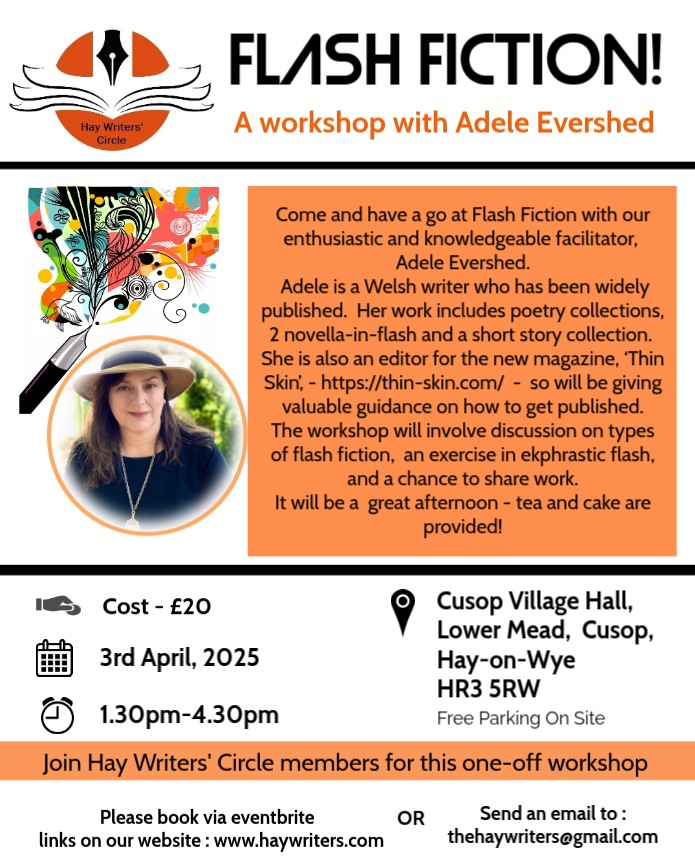
We are delighted to announce details of our forthcoming Flash Fictionworkshop with author and educator, Adele Evershed. It will be an in-person event. Anyone over 18 years of age can attend on Thursday 3rd of April, at Cusop Village Hall. Please arrive at 1pm, the workshop runs from 1.30pm-4.30pm (free parking, tea and cake provided).
Book your ticket via the eventbrite website – CLICK HERE or email HWC Secretary – thehaywriters@gmail.com
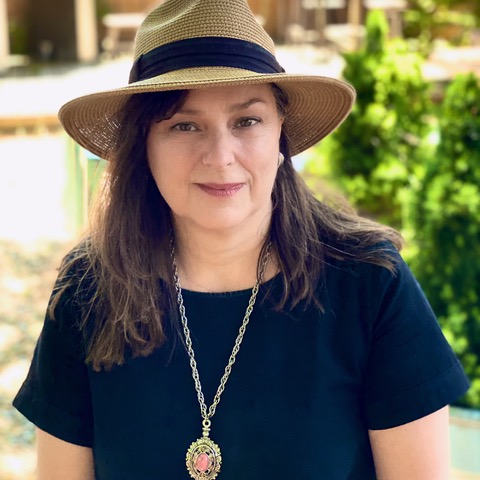
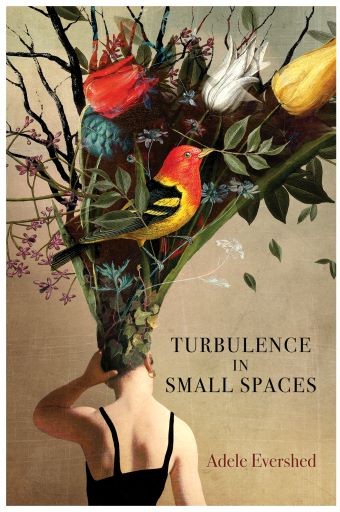
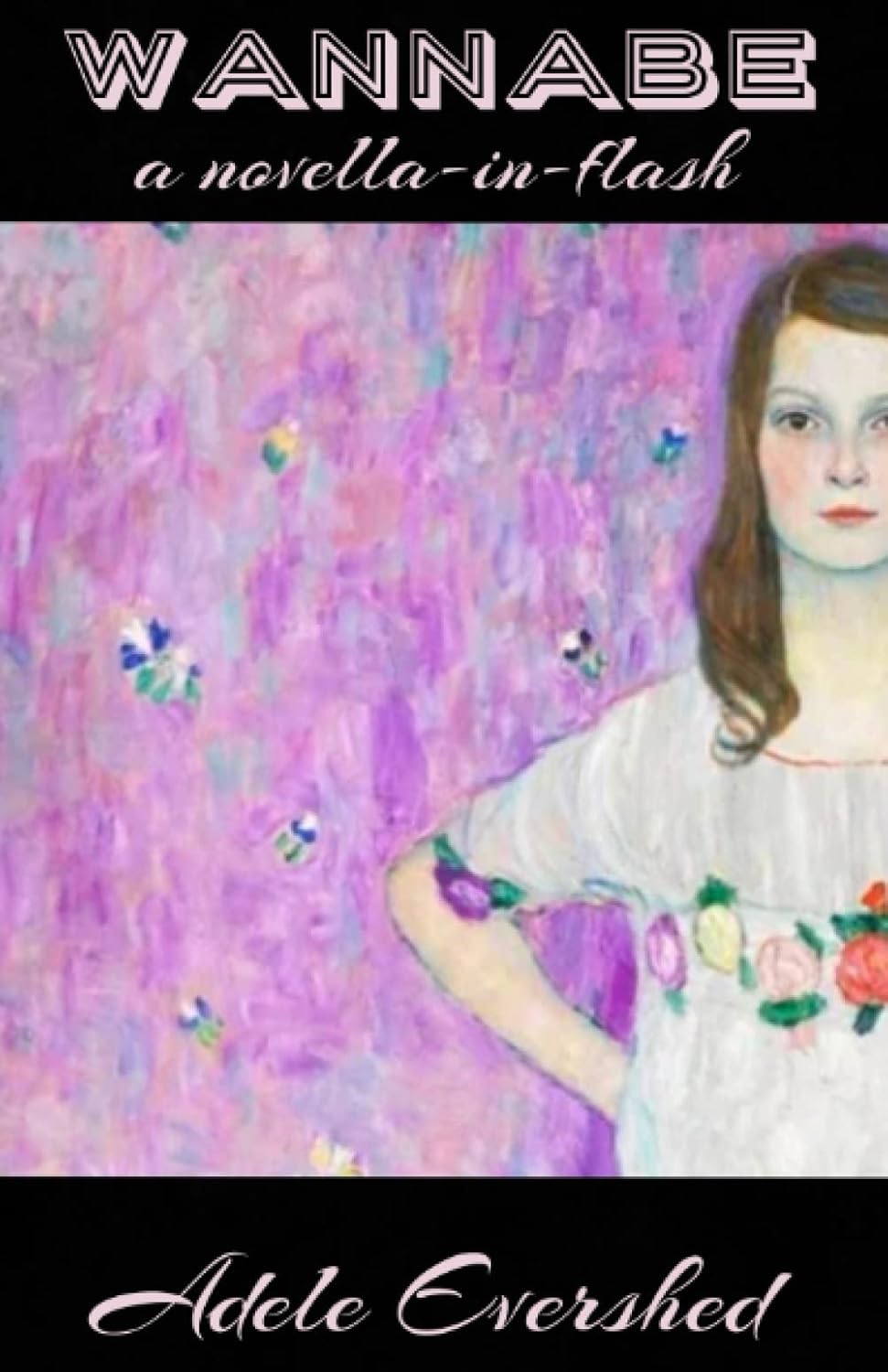
“Adele Evershed is a Welsh writer. Her work has been widely published in journals and anthologies such as Full House Literary, Grey Sparrow Journal, Free Flash Fiction, Bath Flash Fiction, Anti Heroin Chic, Gyroscope, and Janus Lit. Adele has been nominated for the Best of the Net for poetry and the Pushcart Prize for poetry and short fiction. Adele has two poetry collections, Turbulence in Small Spaces (Finishing Line Press) and The Brink of Silence (Bottlecap Press). She has two novella-in-flash published by Alien Buddha Press, Wannabe and Schooled, and her short story collection, Suffer/Rage, is available from Dark Myth Press.”
Adele is also one of the editors for a new lit mag, Thin Skin, which looks to give older writers an opportunity to be published.
To keep up to date with HWC news and events why not subscribe. Enter your email address in the box below.
We recently learned of the passing of former HWC Secretary – Jo Jones.
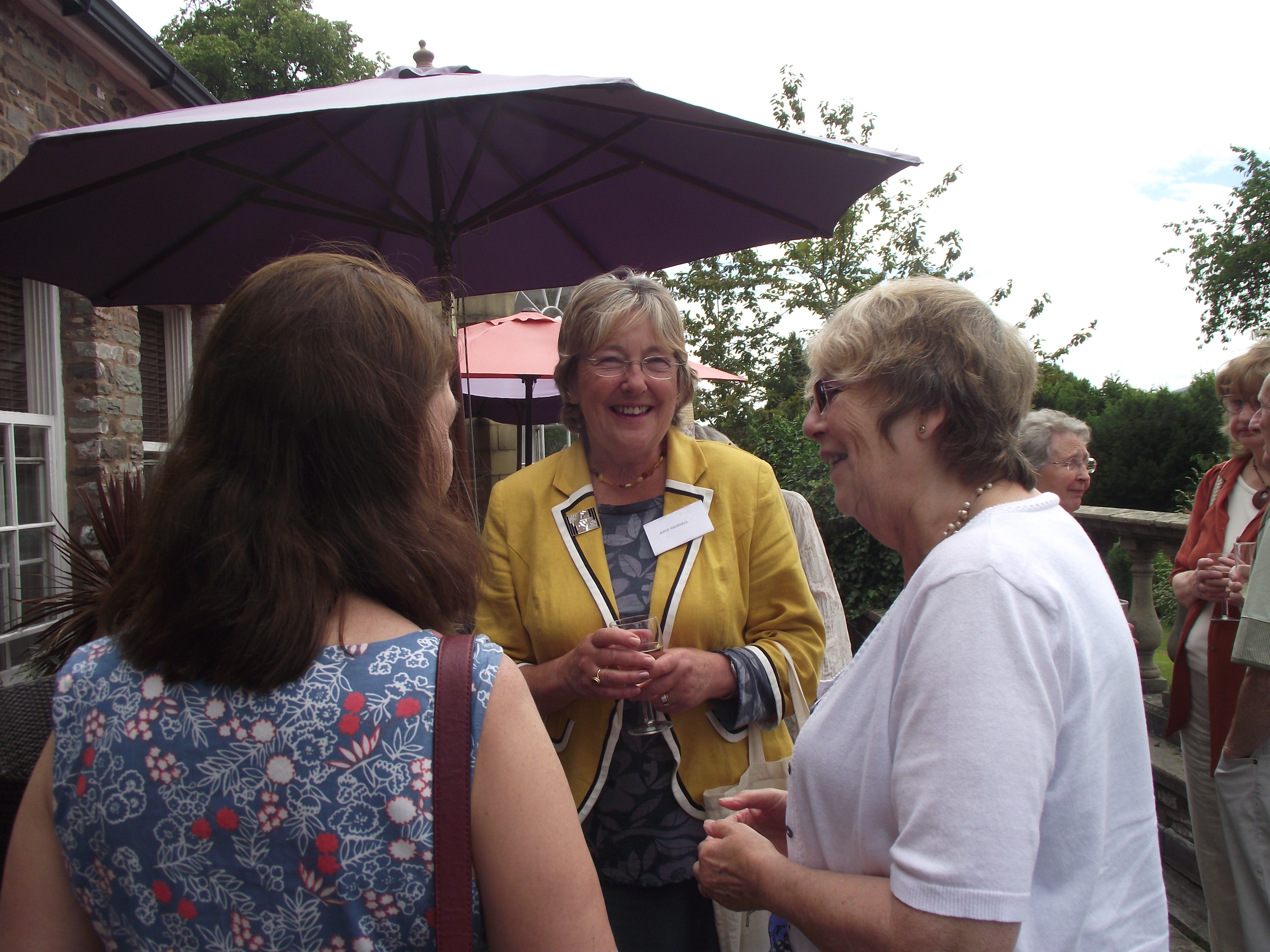
Jo Jones Ange Grunsell (C), Jo Jones (R)(L to R) Kerry Hodges, Corinne Harris, Jo Jones, Marianne Rosen, Peggyanne Stevenson
Jo Jones was a member of the Writers Circle in Hay for many years, between 2014-2017 she was the group’s Secretary. She was much valued by all the members of the Circle.
She had been a warden of a mountainside hostel in an earlier incarnation. We rated her as tough and fearless, whilst always seeing the funny side of things, compassionately.
We so much appreciated her humorous and perceptive writing. Her characterization was vivid and we felt that we knew the people and the parties taking place in the stories.
Here are two examples – In her “School Nativity Play” we appreciated her Joyce Grenfell like gentle humour. In “Jane” we heard about her part in her aunt’s do-it-yourself alternative funeral. It was both hilarious and touching. Both pieces are in the Writers’ Circle publication “Pick and Mix” along with others by Jo.
In person, she had an inimitable way of presenting the stories. Her comic timing was wonderful and her delivery was both droll and moving, and we loved it. As did the audience at the Hay Festival events in which she took part.
Last of all, no-one will forget her marvellous scones, baked at her lovely cottage in Winforton where she hosted the Circle on many occasions.
Thank you to Ange Grunsell and Jean O’Donoghue for the above tribute to Jo.
Below is one of Jo’s short stories which appeared in HWC anthology, “Pick n’ Mix”.
JANE by Jo Jones
A question that is rarely heard in an undertaker’s office is ‘Have you anything cheaper?’ We have to be seen to be giving the dearly departed the best that money can buy. Clients are shown glossy catalogues displaying various coffins, ranging from basic pine to superb, ornate, glass topped, luxuriously lined specimens. The better the coffin, the better the package. Bewildered clients may be thinking how horrendously expensive it all looks but never feel able to voice their opinion.
There are a few exceptions to this rule and my aunt Jane was a shining example of someone who thought funerals were a complete rip-off. She did not just think it; she voiced her opinion frequently and even wrote a book about it.
Her lately departed husband, who was a conservation fanatic, made it known that when he died he wanted to be thrown on the compost heap. This is not a legal option. However, having him cremated and then his ashes consigned to the compost could be arranged.
Although Jane’s husband, Nigel, was terminally ill, he and Jane discussed how a Do-It-Yourself, inexpensive funeral could be accomplished. Transporting the body to the crematorium some thirty miles away could be done using their battered old Volvo. The coffin was a little more difficult. Where do you go to buy a coffin?
Jane managed to acquire one from a small independent undertaker by pretending she needed it for a play. They decided to use the old fashioned custom of keeping the deceased in the parlour with the curtains closed until the day of the funeral. If he died in hospital he could be left in the mortuary.
It did not quite go to plan because he managed to die at home, on a very warm bank holiday Saturday, so he was kept in cold storage at the Bala police station for a few days. The route from Bala to Ruthin crematorium is over a winding mountain road, which caused the coffin to slide about in the Volvo. They had to stop and collect several large rocks from the roadside to wedge the coffin in place.
Having successfully planned and executed such a funeral, Jane started planning her own (as it happens, well in advance). With much difficulty she eventually found someone to make her a chipboard coffin. Apparently undertakers are not allowed to sell coffins to Jack Public. Most undertakers are no longer small family businesses; they have been taken over by large companies (although they keep the old family name so that people think it is a small independent firm). The last thing undertakers want is a rash of people doing their own funerals. They therefore endeavour to make it almost impossible for anyone to even contemplate such a plan.
Having bought her coffin, Jane had it put up in her loft and there it remained for the next twelve years. She then wrote a book about arranging a funeral without the services of an undertaker (which made her very unpopular with certain elements of the population). She appeared on many radio and television programmes talking about her book Undertaken With Love.
The result of all this publicity meant that when Jane eventually died I, as her next of kin and executor, would simply have to give her a Do-It Yourself job.
In March 2000 Jane had a stroke. It soon became obvious that she would not be able to cope at home any longer so had to be moved to a care home. Rather than leave her house unoccupied I put it up for sale. I now had to find a new storage place for her coffin. The piggery in my daughter’s garden became its new home. My daughter’s two young sons would bring school friends home to play and one of their favourite games was hide and seek. A much used hiding place would be inside the coffin. It also served as a temporary home for several hamsters, a resting place for an assortment of injured or dead birds and a container for windfall apples. By the time it was needed it looked pretty shabby.
Sadly, my aunt Jane died in April 2002. She was in the top bedroom on the fourth floor of an old Victorian mansion. The plan was to bring her down to the ground floor standing up wedged between two carers as the lift was only tiny. We would then manoeuvre her into my VW Campervan where she would be taken to the local hospital mortuary. We needed a couple of ‘lookouts’ to make sure no other staff or patients tried to use the lift while this descent was taking place. The management did not want several more deaths due to patients having heart failure after seeing a corpse descending to the ground floor via the lift.
When we reached the van we had to somehow post her into a dry cleaner’s garment bag which was being used as a body bag. My next hurdle was to drive through town to the local hospital. I dreaded stalling the van at the many sets of traffic lights which littered our route from the care home to the mortuary. The mere thought of some well-meaning policeman coming to my assistance and discovering a body lying on the bed area filled me with horror.
I need not have worried, the van performed wonderfully and we made it to the mortuary without incident. However, the mortician was a real jobsworth. Nothing had been done correctly; no identification label attached to her toe, no paperwork and no proper body bag. It was amazing what a couple of crisp twenty pound notes managed to put right. It was not difficult to arrange two post mortems or to book the crematorium. I had placed the obituaries (written in advance by Jane herself) in the Telegraph and Observer and notified all her friends. Her funeral was to be a very small affair since, at her request, I was to organise a celebration of her life, in London, a couple of months after her death.
Since Jane was an atheist, the committal was to be along Humanist lines. For the handful of people who were able to attend I told them her life story; how she had been given away at birth, how she eventually traced her real parents when she was in her forties, her life as an actress and, in later years, a writer. She had chosen two pieces of music to be played during the proceedings; one was Is That All There Is? sung by Peggy Lee and the other (to be played as the coffin slid into the warm room) was The Best of Times is Now.
A couple of months later, some friends and I bought a lilac tree, dug a deep hole in my garden and attempted to tip her ashes into the hole before planting the tree. Unfortunately a sudden gust of wind caught the ashes and blew them all over us. Since our jackets were soaking wet due to out digging in the pouring rain (well, we were in Wales) she stuck to us. We can never forget her.
Thanks in no small part to Jane’s campaigning, things have now improved. There is a large store, rather like a garden centre, where you can buy everything you need for a burial. There are woven willow, cardboard, and hand-decorated coffins – all easily found on internet sites.
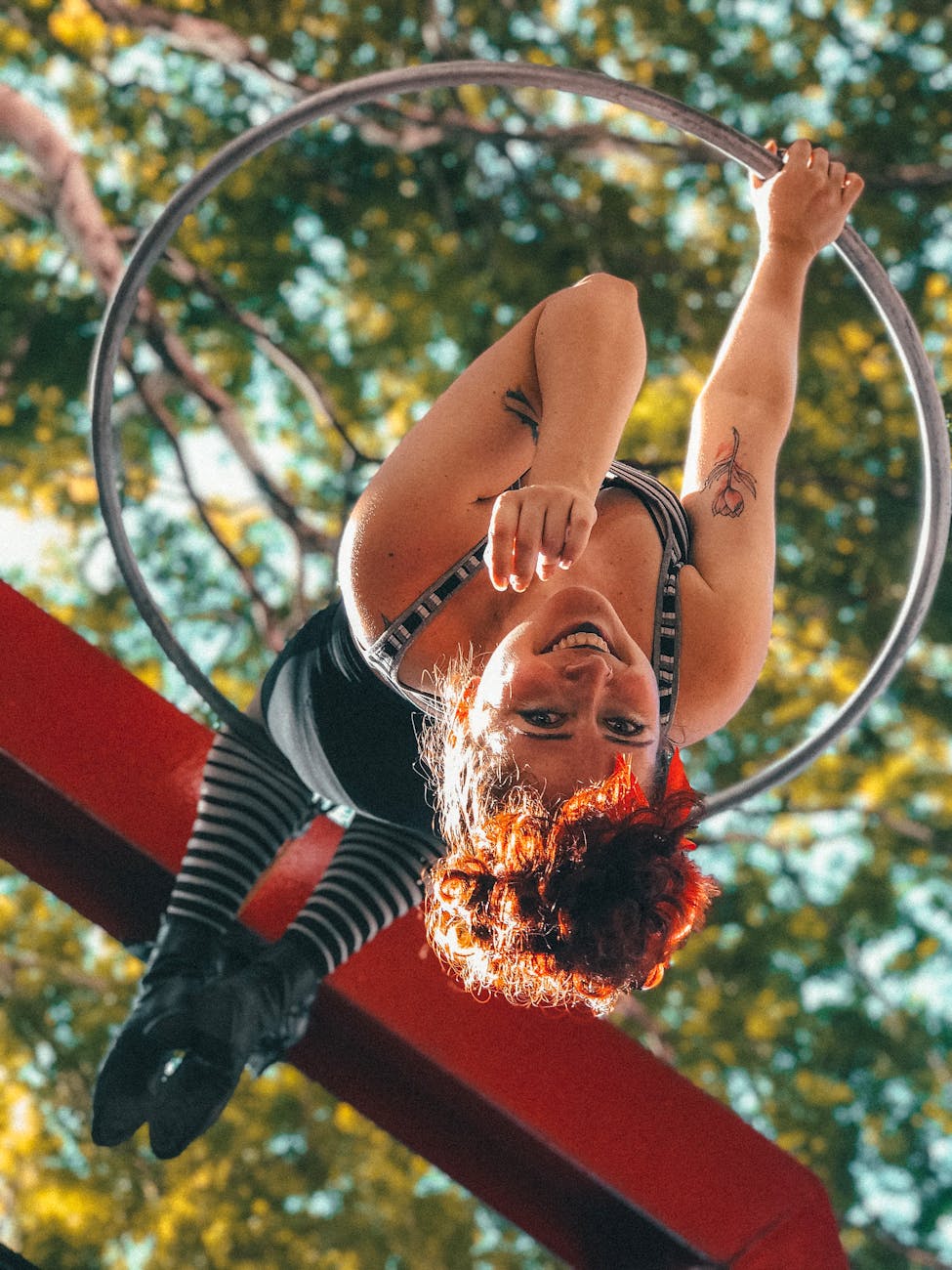
Photo by Susanne Jutzeler, suju-foto on Pexels.com
Suddenly we are 5 days into 2025, and perhaps considering our New Year Writing Resolutions. One of them should be entering a short story to the Frances Copping Prize Fiction Competition.
The competition is open to everyone, members of Hay Writers’ Circle and non-members too. Pieces of 500-1500 words on any fiction theme are accepted. Closing date for entries is Tuesday 7th January 2025. Prizes are awarded for first, second and third place.
This year we are delighted that Adele Evershed is our judge.
The entry form and full competition details can be found on our Competitions page – CLICK HERE.
Let it Snow …
With a seasonal turn in the weather, what better way to feel inspired than to read “A Fireside Tale” by Hay Writers’ Circle member, Michael Eisele.
Thank you to Michael for sharing this piece for everyone to enjoy here.
A Fireside Tale By Michael Eisele
I wouldn’t blame you for not believin’ me. Maybe my clothes come out of a dumpster and I ain’t been washing too regular, what’s that to you? Lots of other fellas is on the bum. Living like this, sleeping rough like we do, it probably don’t seem like much of a life, but there’s boooze when you can get it and even in the Winter a bunch of us huddle together around an old oil barrel and burn stuff to keep from freezing to death.
So it was that kinda night, snow coming down heavy and all you know. It was me, Joey, Davey and old Mark, and we was around the can arguing about whose turn it was to scrape up some more wood, when this guy come out of the night with this big dog. I’m talking Big! A couple of us, Joey and Davey, had dogs for company, like, but them mutts took one look at this one and whined and hid behind us. Which was funny ’cause this guy was no giant, maybe some shorter than me even.
‘Name’s Luke,’ he says without waitin’ to be asked. ‘Could we maybe join you fellas for a bit? ‘
‘You wouldn’t have a load of firewood, would you, ‘ says old Mark, not the friendliest guy at the best of times, ‘I prefers oak but I’ll take anything, night like this.’ Sacastic like, you know?
That got a laugh and right in the middle of it this guy Luke says, ‘Got something better.’ He made like throwin’ an’ I swear there was nothing in his hand but that ol’ fire burned up hotter than I ever seen it before, I mean it like lit up the whole lot and that oil can turned cherry red. Talk about warm!’
So we made him some room, and that big dog just hunkered down next to him in the snow and went to sleep. After a bit Luke looks around and says, like to himself, ‘Yep, this is the place.’
‘Place for what?’ I says, ’cause it was just some old abandoned railroad yard.
‘You’ll see,’ says Luke.
Then old Mark says, ‘Well Mr. Luke,’ sarcastic like always, ‘we thanks you for the fire, could it be you got some booze on you as well?’
Luke he didn’t turn a hair. ‘Got something better.’ he says, and reaches into his pocket and pulls out this funny lookin’ bottle.’ Try some of this, boys.’ he says and hands it to me ’cause I was nearest.
Well, booze is booze, no matter what it come out of, so I tipped back my head and took a swig. Next minute my eyes was waterin’ and I was near choked. Seemed like the world was spinnin’ for a minute and then like this wonderful feeling come over me, an’ I weren’t cold no more.
We passed that little bottle around, an’ ever one had a taste, an’ here’s the thing. It was like no one could drink it dry. Allus seemed to be more, and when it come round again, Luke put the stopper in and put it away. Then he looks down and says, ‘Looks like your firewood is getting’ all wet,’ and picks up some sticks from beside the can, which I swear wasn’t there before. ‘Here, fellas,’ he says, each of you take one to keep it dry.’ Which made a sort of sense so we done that.
Just then I seen something moving way back in the snow and before I could say anything three of the biggest guys I ever seen in my life come out of that snowstorm. I mean to say they was huge, and all covered with frost, beards and all. One of them grins kinda nasty and says in a voice like it come out of the ground, ‘Well, well, if it ain’t the great Lukey himself. What you doin here?’
Way he talked sounded foreign but somehow I could understand him. It was kinda
like my old Grandpa used to talk, him that come over from Iceland originally.
‘Come to stop you. ,’ Luke says, in the same way. Well them three guys acted like that was a funniest joke in the world. Haw haw haw they went.
Then the first one points to us and says,” I suppose these is your heroes? You come down in the world since Assgard, Lukey.’ Dunno what he meant by that.
Anyway, Luke he didn’t seem bothered, just snaps his fingers like a pistol goin’ off.
‘Stand up, men, and show who you are.’ he says, or something like that. I looks around at the bunch of us and they was lookin’ back like what the hell is this? But I got to my feet anyway and all the rest did the same.
Then Luke, he looks around at us four bums and he says, ‘Now show what swords you bear.’
I went first ’cause I was nearest, and I didn’t know what else to do but I held up my stick and so help me I was holdin’ this big old sword, shinin’ in the light from the fire! ‘This is Scofnung,’ Luke says,, pointing at me, ‘ He who is cut by it can never heal. ‘
The three big guys went sort of bug eyed and went back a step. Then Luke pointed at Joey, and as soon as he done that Joey had a big old sword also. ‘This is Damsjiel, blade of heroes,’ he said, and then he went round to all of us and we all had swords in our hands, and he named each one in turn. ‘Gram, bane of evil’, he says pointing at Davey, and then he points at old Mark who’s standin’ there holding this sword like he can’t believe what he’s doin’, ‘This is Angurvahel, who bears it can never fall in battle.’
S’pose you’re thinkin’, how can he be rememberin’ all this? Let me tell you, mister, if you’da been there you wouldn’t have never forgot it either.
Now them three big guys by now is all huddled together, lookin’ worried and talkin’ amongst themselves. Finally the biggest one says, ‘This was just a friendly visit, Lukey, we didn’t mean no harm. ‘ Or somthin’ like that.
Then Luke he says, ‘And I suppose Fenrir, Aegir and the rest ain’t waitin’ back yonder till you calls them?’
The big guy sort of puffed himself up and says, ‘Well and if they was, do you think your guys can handle them, no matter what swords they bears?’
Luke looks around at us standing there like dumbells with our swords in the air, and he sorta purses his mouth like he’s thinkin’ it over. I dunno about the rest but I was startin’ to feel a little nervous. I mean those three guys was huge, and they had swords too and big sharp lookin’ axes in their belts. Then Luke says, kinda casual like, ‘I forgot to mention, I didn’t come alone. My dog come with me.’
Then the three guys all went ‘haw haw haw’ again, and one of ’em says, ‘ You really expect us to worry about some Dog? Bring him on!’
Now, all this time that big dog of Luke’s was just laying there sleepin’ in the snow and the way it was comin’ down, by then all you could see was this mound with his ears stickin’ out. The biggest of the guys says, ‘You was allus all talk, Lukey. ‘ And he pulls this big axe out of his belt and takes a step forward, and the two others done the same.
Luke he didn’t budge an inch, just lookin’ around casual like he forgot somethin’. Then he nods like he suddenly remembers what it is, and snaps his fingers again. ‘Fenris’ he says, quiet like. And this big dog a’ his gets up and shakes off the snow, an’ by God if I ‘da thought he was a size before that wasn’t nothin’ to how he looked in front of those three frosty guys.
Suddenly they didn’t look so big any more, and the first one says, ‘Aw come on, Lukey, no need to get all het up, we was just fooliin’, wasn’t we boys?’ An’ the other two nodded sort of nervous and said ‘Sure, we didn’t mean nothin”
Then this Fenris rumbles deep in his chest like thunder an’ his eyes light up with the firelight an the fur on his neck stands up till he looks half again as big. Luke says, ‘Go back where you come from, Hrunnir, and take your boys with you. Don’t ever set foot in this world again.’ Fenris takes a step forward, growling , I mean you could feel it shake the ground.
The three frosty guys step back then, step by careful step, all the time their eyes was on Fenris and I swear they was lookin’ smaller and smaller the whole time. The one Luke called Hrunnir shoves his axe back in his belt and then they all turn and go back the way they come, an’ the snow was comin’ down thick an’ fast and they just seemed to melt into it an’ fade away.
Next minute all three was gone, and call me a liar but we no more than turned around but Luke and that dog a’ his was gone as well. Maybe back to that Assgard place for all I know. We looked around, the four of us, and there we were standin’ like donkeys with nothin’ in our hands but some old sticks., and the fire was burning low so we throws them in.
Well that was what happened, true as I’m sitting here. Say, you couldn’t spare a couple of bucks for a fella down on his luck, could you?
The End
And Finally
Happy New Year from Hay Writers’ Circle.
May the year ahead be filled with writing dreams fulfilled.
Submissions are now invited for our annual Fiction Competition, The Frances Copping Memorial Prize 2024, named in fond remembrance of our Lifetime President who sadly passed away in 2020.
The competition is open to everyone, members of Hay Writers’ Circle and non-members too. Pieces of 500-1500 words on any fiction theme are accepted. Closing date for entries is Tuesday 7th January 2025. Prizes are awarded for first, second and third place.
This year we are delighted to announce that our judge is the wonderful Adele Evershed.
Frances Copping Adele Evershed
Adele Evershed is a Welsh writer. Her work has been widely published in journals and anthologies such as Full House Literary, Grey Sparrow Journal, Free Flash Fiction, Bath Flash Fiction, Anti Heroin Chic, Gyroscope, and Janus Lit. Adele has been nominated for the Best of the Net for poetry and the Pushcart Prize for poetry and short fiction. Adele has two poetry collections, Turbulence in Small Spaces (Finishing Line Press) and The Brink of Silence (Bottlecap Press). She has two novella-in-flash published by Alien Buddha Press, Wannabe and Schooled, and her short story collection, Suffer/Rage, is available from Dark Myth Press.
Adele is also one of the editors for a new lit mag, Thin Skin, which looks to give older writers an opportunity to be published.
Please follow the guidelines listed on our COMPETITIONS page if you would like to enter.
You can contact writers4haycomp@gmail.com if you have any questions or queries.
Click of the following highlighted link to download the entry form :
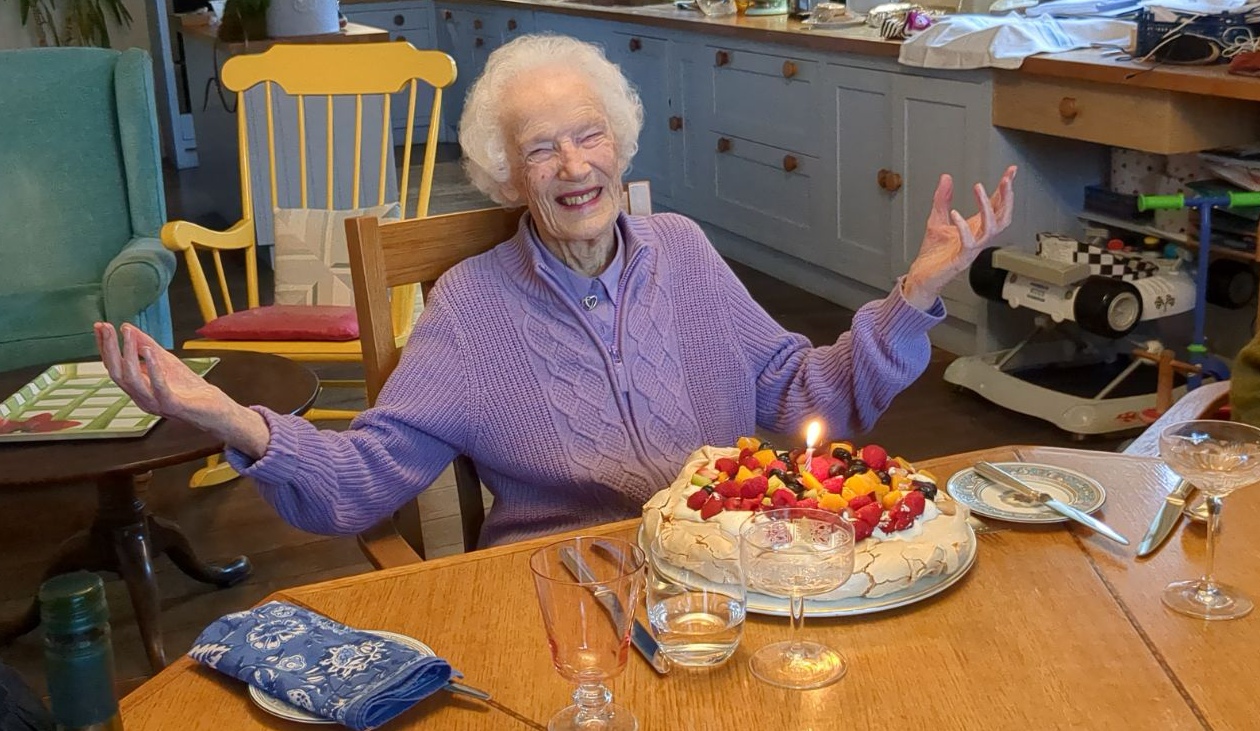
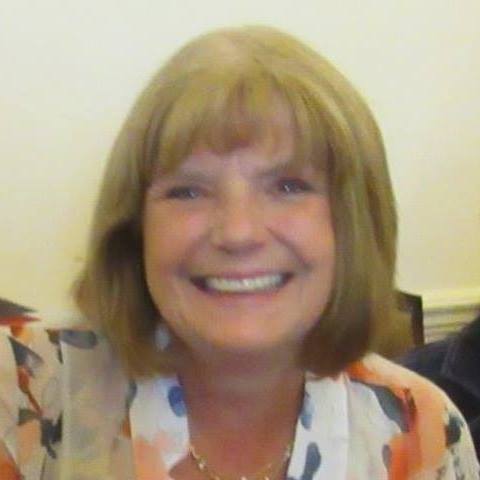
This week would not be compete without celebrating the 101st birthday of former HWC Chairperson, Lynn Trowbridge.
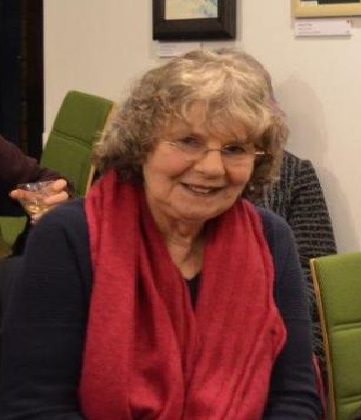
A remarkable and inspirational person in every sense of the word, Lynn, looking lovely in lilac, continues to enjoy life to the full.
Lynn Trowbridge at 101 years – Photo Credit Catherine Hughes 2024
Emma writes, “She was our HWC Chairperson for well over a decade, keeping the group writing and moving forward under her guidance. Of course, a decade ago Hay & District Writers’ Circle was very different; much smaller in number, meeting at member’s homes, publishing yearly magazines which were sold locally and just dipping our tentative online toe in the waters of the world wide web.
Our immense gratitude to Lynn and all those who shaped the HWC in the past cannot be overstated and we thank them for all their incredible efforts. “
The Hay Writers’ Circle journey certainly continues – onwards and upwards!
Don’t forget to subscribe with your email address in the box below.
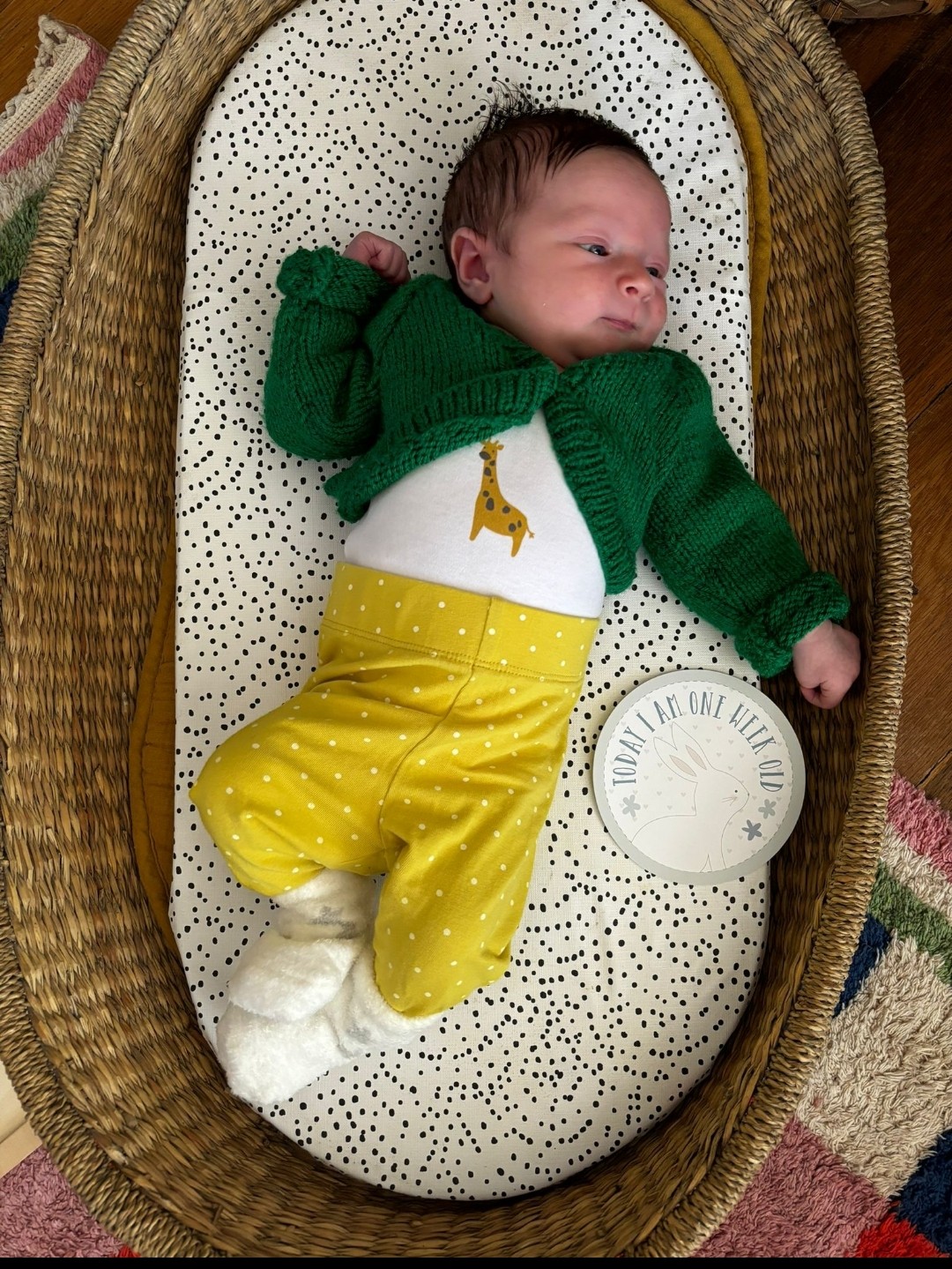
We are all delighted to announce the welcome arrival of baby Zephyr!
Many congratulations to his HWC mum, Lily, and all the family. xxx (Cheers and rapturous applause!)
ZephyrLily Rose King – Photo Credit: Billie Charity
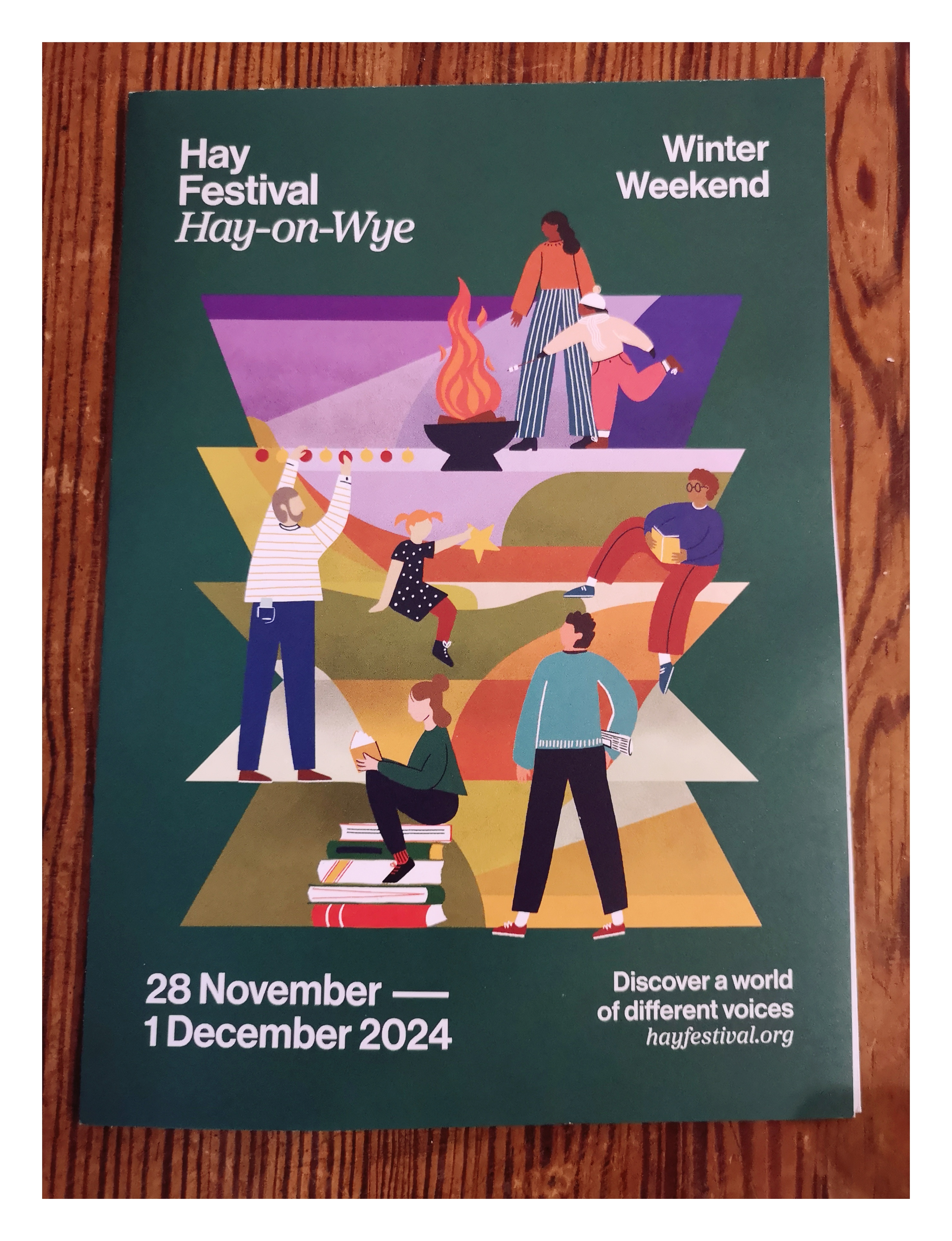
Hay Festival Winter Weekend
It’s less than a month to go before Hay Festival welcomes us all to it’s Winter Weekend, 28th November – 1st December 2024. It’s definitely something to brighten the darkening days and place us firmly on the road to seasonal celebrations ahead.
If you haven’t booked your tickets yet, please check out their website – CLICK HERE If getting to Hay is not possible, then there’s a great selection of digital events which you can access from the comfort of your laptop.
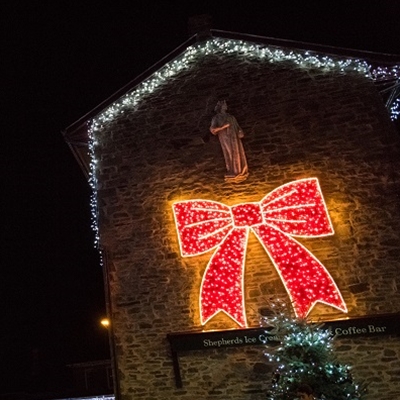
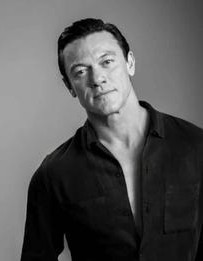
Those who can make the journey, don’t forget the Christmas Lights will be switched on by wonderful Welsh Actor and Singer, Luke Evans along with our soon to be announced Citizen Of The Year. Join the party atmosphere in the town square on Friday 29th November.
Luke Evans – photo credit : B&R 2024
More From The Richard Booth Prize for Non-Fiction 2024
Following on from our recent articles containing Dr Alwyn Marriage’s judge’s comments, coupled with the 1st, 2nd and 3rd prize winning pieces, we are delighted to share the Highly Commended entry from Ange Grunsell.
An Ethiopian Journey
It was hot: very hot. We had been travelling all day on the bus from Axum to Gondar in Ethiopia. It was 1970. The mountain scenery was spectacular in its scale and grandeur. The young driver of the ramshackle vehicle pulled slowly up each set of hairpin bends, swinging out over bottomless drops at each corner and hauling back up the steep incline, before holding hard down into the next precipitous section with great. We hung out over a mountain wilderness reaching to the distant skyline. The glare of the sun made it shimmer.
It was so hot: so hot. Eyefuls of dust blew in through the open windows of the sticky vehicle. There were three of us, each in different parts of the bus: Martin in his sunglasses and jeans, Rob in crumpled linen trousers and sweat stained white shirt and me, in sleeveless, knee length cotton dress and sandals, worn with the impervious arrogance of European women travellers of the time. A rucksack that held our combined possessions was squeezed between Rob’s knees. Rob dozed fitfully, his head lolling onto the shoulder of the man next to him. Smells of women’s hair oil mingled with sweat both stale and fresh: the sweat that trickles down backs and soaks underarms. For many miles I had been sitting next to a tall countryman who sat bolt upright, his staff between his legs, knees wide apart. Locks escaped from under the headdress wound round his head. He wore brown faded tunic and baggy shorts. He swung into me at each bend, thrown by its force. We didn’t speak. We had no shared language.
In the overwhelming heat, it was hard to keep awake, despite speakers blaring out Ethiopian pop music. Some passengers dozed, others talked or argued loudly, twice, blows were struck and once swords were drawn, by two men wobbling around in the centre aisle. The atmosphere was certainly an uneasy one and we were ignorant outsiders. In Asmara there had been stories of rebel violence, machine gunnings, even of buses thrown down hillsides, their passengers left stranded. Despite two of us having witnessed a bloody sword attack at close quarters and the third being far too unwell to embark on arduous travels, we had embarked with naive confidence on a foolhardy journey.
As we skirted the edge of ravines far below and wound our way between walls of cliff, twice, in one short stretch of road, the bus was stopped by army units. It only became clear later, that our journey had taken us through the active war zone, rumoured in Asmara, and that we had crossed the front line. We had been searched first by the Eritrean Liberation Front and then by the Ethiopian Army.
Every so often, apparently in the middle of nowhere, the bus would stop. Women and baskets of vegetables or firmly grasped chickens, even two goats, clambered on or off the crowded deck. But the sight of a youth grabbing an old man by the beard and violently shaking him, apparently just to take his place on the bus, increased our feelings of insecurity.
We stopped for part of the night in the hilltop village of Adi Arkay where we were put up in cubicles in a cluster of huts that only catered for bus passengers. A supper of injera and watt was ladled out for everyone. But Rob, still suffering from hepatitis, was unable to eat anything.
Back in the bus before dawn, from time to time bad tempered quarrels broke out between passengers and at one point there was a standing face – off with drawn knives as the bus lurched. Leaving the mountains behind, we travelled down through slopes covered with eucalyptus and pine. As we neared Gondar, coffee plantations bordered the road.
At last the bus rattled down the final long descent into the midday marketplace of Gondar. We climbed out and looked around us. Gathering our possessions, we discussed finding somewhere to stay. Some horses and carts were parked in the shade. Rob was too weak to walk any distance and so we gestured to the nearest driver who beckoned Rob to climb up beside him. Martin and I hoisted our rucksacks into the back and set off walking behind the cart. After half a mile or so the cart stopped outside a bar which evidently fronted a hotel. Inside the owner showed us two rooms up a short flight of stairs. We put Rob to bed, leaving him a portion of injera bread at his bedside. Over a coca cola Martin and I discussed what to do next. We had very little money left and Addis was still miles away, probably more than two days by bus. Although we were out of any war zone, Rob, who had been recovering from hepatitis before the journey, was clearly too weak to continue safely by road. What to do?
We had come to Gondar to visit the picturesque medieval churches shown in the guide books and indeed Gondar was well enough known on the tourist trail to boast a colonial hotel: a glimpse of cool white buildings, set amongst a green garden and watered shrubs, confirmed this. To get there from almost opposite our lodgings, a long flight of steps rose above a gate. Martin and I decided on a plan. Gondar had an airport. I had a classy English accent and a cheque book in the rucksack. I would walk up to the hotel and see whether I could find anyone prepared to give us enough cash to fly from Gondar to Addis on the strength of an untested UK bank account.
I climbed up to the hotel: it was a parallel universe, an altogether cooler planet. There, various English- speaking couples were sitting around sipping after lunch coffee in a comfortable lounge, its tall open windows showing a vista of garden and hills. I approached several groups with my request. One after the other, looked the other way or turned me down flat, politely. I had forgotten how westerners react in their reactions to uninvited demands.
Eventually at the end of the room, a couple let me tell the whole story of why we needed money, how Rob had been seriously ill in Asmara and was once again alarmingly weak, making further bus travel risky. Gloriously, these people had met my brother-in-law at Makerere hospital in Kampala a few years before. But still I was not home and dry. A little wary, they agreed to accept my English cheque and provide some money, if I could bring Rob up to the hotel to substantiate the story.
So I descended to our shabby lodgings once again. By now it was late afternoon. Along the corridor outside our bedroom door was a long queue of men who eyed me lazily. They were waiting to visit the upstairs rooms in the brothel where we were lodging. Worse as I walked into Rob’s room, a rat spotted the injera, jumped onto the floor beside his bed and flung itself out of the window.
Our good Samaritans trustingly gave us enough cash to cover a flight to Addis and the next morning fly we did. Gondar airport turned out to be a grass airstrip that came to an abrupt end where the mountainside dropped away, edged by a raised hillock to help bounce aircraft into the air. Our DC8 laboured up over each peak, sickeningly close to rocky outcrops. Rob observed oil trickling down the wing close to his window. But we arrived safely in Addis Ababa, a town of high-rise conference centres and international hotels, hot water and comfortable beds.
Coming soon …
Details of our Short Story Competition!
Don’t forget to subscribe for all our latest updates! Enter your email address in the box below.
Our October 2024 AGM brought a few changes to our Hay Writers’ Circle Committee. For the last two years Chairperson, Katharine Stones has steadfastly guided us. She has enabled the group to modernise, thrive and write well, and our current capacity membership is a testament to her hard work. Katy has bolstered our artistic confidence too, with regular writing workshops from guest authors and academics, as well as embracing new opportunities as they have arose.
As Katy steps back from being Chairperson, we extend our heartfelt gratitude for her years of hard work and service to the group.
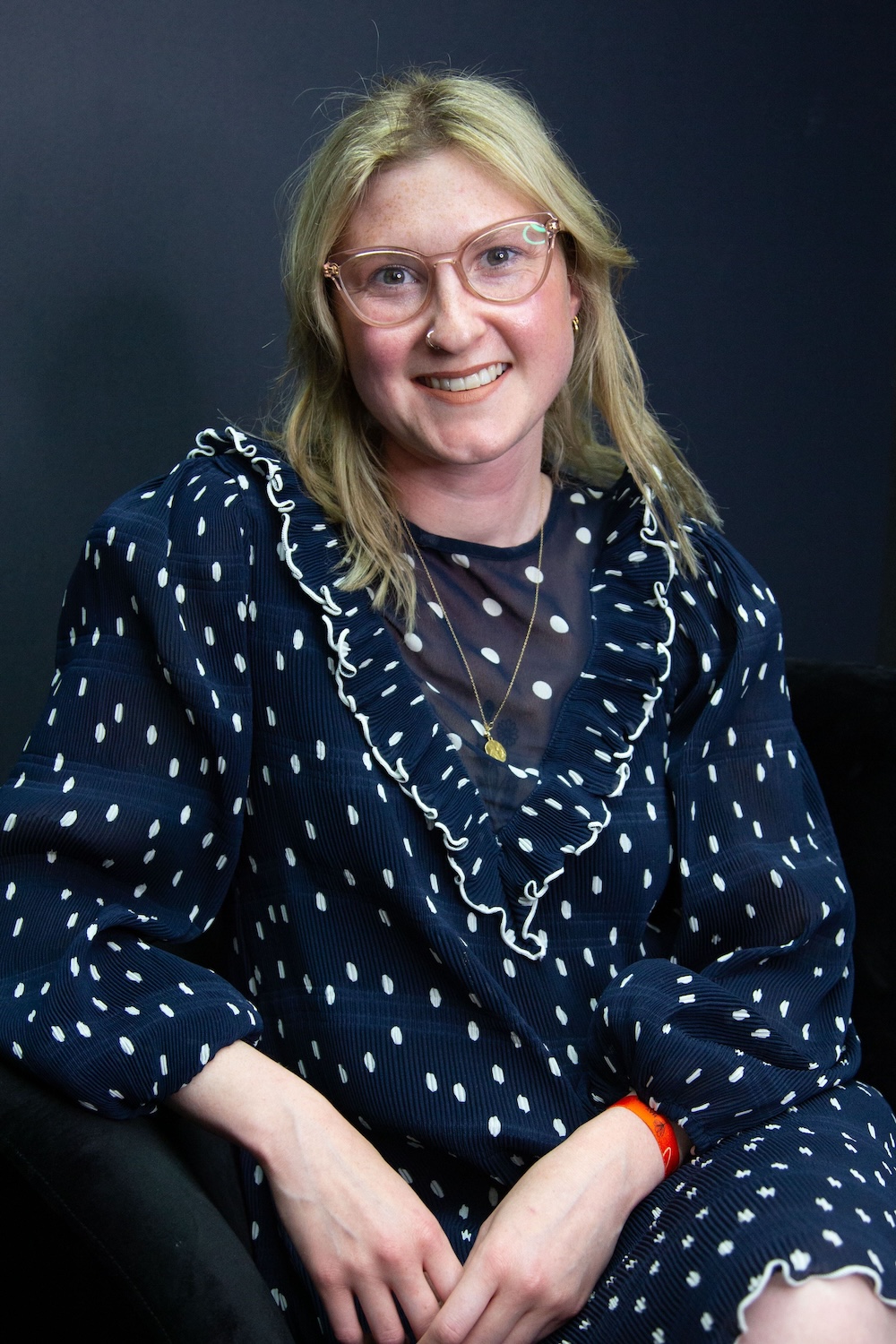
Katharine StonesLily Rose King
Also stepping down this year is Lily Rose King, who has been our Competitions Secretary for the last two years. Lily has been an absolute asset in her role, with deft organisational skills collating all the paperwork, managing correspondence and communicating with judges for all 3 of our yearly competitions. Each year our competitions have garnered more and more entries, and Lily has been absolutely fantastic. Thank you for all your hard work Lily.
Side stepping from her role as Treasurer, we welcome our newly elected Chairperson, Corinne Harris and wish her lots of good fortune and exciting opportunities over the coming years.
We also welcome Margaret Blake to the position of Competition’s Secretary and Martine Smith as Treasurer for Hay Writers’ Circle, wishing them both well in their new roles.
The other members of our committee remain the same with Helen Smith continuing in her role as Secretary, and Emma van Woerkom remaining as the Website and Social Media Manager.
Helen Smith – SecretaryEmma van Woerkom – Website and Social Media Manager
More From The Richard Booth Prize for Non-Fiction 2024
Following on from our last article containing Dr Alwyn Marriage’s judge’s comments, coupled with the 1st and 2nd prize winning pieces, we are delighted to share the 3rd prize entry from Margaret Blake.
3rd Prize – The Awakening by Margaret Blake
My eyelids fluttered open to a sea-green haze above me. I was puzzled. How come I’m underwater? I blinked. My mind cleared. Not water, but canvas, fluttered above me. I was lying on my air mattress, looking up at the roof of the tent I shared with my sister. She was still fast asleep. I waited impatiently, but there was no sign of her stirring. I wriggled uncomfortably. ‘Nature’ was calling.
I slipped out of my sleeping bag, slid carefully to the doorway and, fretting at my inept fumblings, unlaced the fastenings. (No posh zips in those days; leisure camping in 1955 was still in its infancy.) I pulled my wellies on and stepped into the new day. It was light, but I had no idea of the time. It must be very early. No one else is up yet. I headed off to the earth closet across the field. I enjoyed the feel of the long, dew-wet grass swishing against my legs as I walked towards the distant cubicle. I wrinkled my nose as I approached the planked shed. No wonder we’ve pitched camp well away from it. On exiting, I headed for the rusty pump in the middle of the field. The metal struck cold on my hands, but I swung on its handle with all the weight my six-year-old body could manage. It creaked and groaned before suddenly rewarding me with a gurgle of cleansing, icy water.
I looked around. What shall I do next? I was wide awake by now and eager for the day to begin. I wandered across the field to the stony lane that led to the lake. On either side, green trees soared skyward, with a multitude of birds fluttering and twittering amongst their leafy branches. The stones crunched under my feet, the air felt soft on my face, and I relished my aloneness. Before long, I saw the lakeside restaurant ahead: a simple, low structure. Across the yard, a huge glass-fronted tank reared above me; I paused to pay homage to the fish swimming around inside. Snatched from the lake, I knew that they were destined for customers’ dinner plates. The poor things. My heart went out to them. A pair of eels swam into view, their bodies undulating with their movements. I shuddered. Too much like snakes for me! I turned and continued swiftly along the lane.
I rounded a bend, and there it was: my favourite lake. I approached its sandy shore and stood, marvelling at its vast expanse. A wooden jetty stretched out into the water. The hire boats, held captive for the night with chains, bobbed peaceably on the rippling waters. Maybe, if I ask nicely, dad will take me sailing again today. I always thrilled to feel the movement of the boat through the water, the sound of little wavelets splashing against its side, and the wind blowing on my face. Most of all, I enjoyed those special moments with my father. Just him and me – no siblings wanting attention, no mother fretting over me. I loved it.
I strolled along the jetty, my wellie-clad feet sounding heavy on the rough planks. Still, no one was in sight. The world was mine alone. I smiled to myself as shoals of minnows, disturbed by the noise, darted out on either side of me. I moved slowly but, eventually, reached the end of the jetty. Now what? There’s nowhere else to go. I sat down, swinging my legs above the clear water, idly watching the fish below.
Gradually, I became aware of a subtle change in the light and looked up. First a shimmer, then a silvery glow, spread across the horizon. I watched entranced. I had never seen anything like it before. The sky became multi-coloured; red, orange, and yellow hues danced across the scene before me. As I watched, these were all subsumed into one glorious light as the sun appeared over the distant skyline. As it rose higher, increasing in size, it spilt rays of liquid gold across the surface of the lake. As they reached me, I felt warmth soak into my body. Stillness surrounded me. I felt at one with nature. Creation claimed me as one of its own.
I have no idea how long I sat there bewitched by the scene. Time seemed to still its relentless ticking. At length, however, my stomach reminded me of more mundane matters. Breakfast would be good. Even now, no one else was in sight. I wandered slowly back down the jetty, along the lane, and into the campsite, hugging that treasured moment to myself.
As I approached our little cluster of tents, my mother emerged from the tent next to mine. She gave me a surprised look. “What are you doing up so early?” I greeted her with a smile and mumbled something about needing to go to the toilet. I said nothing about my experience. It was far too precious to share with anyone else. While the world slept, I had encountered the beauty of the universe. It was a golden nugget I would treasure within me for the rest of my life.
I had experienced a great awakening. Creation spirituality had entered my soul. It would never leave me.
Coming Soon …
Details of our Short Story Competition!
Don’t forget to subscribe for all our latest updates! Enter your email address in the box below
We are delighted to showcase the top two entries as well as the judge’s comments of our most recent competition, The Richard Booth Prize for Non Fiction 2024.
Dr. Alwyn Marriage is a poet, lecturer and writer, a member of the Society of Authors, and Managing Editor of the publishing house, Oversteps Books. She is also a Research Fellow in the School of English and Languages of the University of Surrey.
Here are Dr Alwyn Marriage’s remarks.
“Thank you for inviting me to judge this competition.
I enjoyed reading all the entries. I am more used to judging poetry competitions, so had to consider what criteria would be appropriate for judging a non-fiction competition. In poetry, one has to consider both form and content; but non-fiction is also an art form, so in judging these short pieces, I was, similarly, looking for quality in both form and content.
Content
1. Interest. The piece of writing must attract attention, pique the reader’s interest. This might be either by the choice of subject matter or by the use of a striking image early on. However, while the degree of interest of the subject matter is obviously important, it is by no means the only necessary quality.
2. As part of that, the deft use of suspense can (though doesn’t necessarily) contribute to the interest. In some of these pieces, the writer played successfully with suspense (eg, Spooked, Only shaken). Suspense is fine and can be exciting, but in general it’s also good if there’s some resolution, rather than the reader being left unsatisfied or baffled at the end.
3. Description and detail. There were some very enjoyable vivid descriptions among these pieces. Sometimes I wanted a bit more. eg in Mountains I would have liked to read a little more about the writer’s time at the top of Mt Blanc. But on the other hand, too much detail can sometimes be distracting. Tiny points that excite the writer won’t necessarily appeal as much to the reader who hasn’t shared the experience. So, as ever, it’s a question of getting the balance right.
4. Good nature writing always goes down well, and there was some of that in, for example, Only shaken and in The Awakening.
Form and language
In general, people buy books for the content, but will be put off if the writing is poor, boring or careless. There are, however, books where the writing is so delightful that the content hardly matters. For example, I’m not a great fan of historical novels, but the quality of prose by someone like Maggie O’Farrell can tempt me to embark on journeys into the past with her.
1. You are aiming to produce a work of art, so attention should be paid to form and shape. as well as to content. Writing a piece like this is not just an invitation to reminisce. The first and second prizes both had pleasing shape, which pushed them up the stakes.
2. Language matters! So it’s worth taking great care over language, spelling and grammar. If necessary, get a fresh pair of eyes to look at a submission before sending it in. For example, either check spelling yourself or use a reliable (non-American) spellcheck. Micro-computer trolley was really interesting, but would have benefited from careful editing and a spellcheck. Also in Mountains, there was a surprising change of tense in the middle for no apparent reason, which stuck out like a sore thumb.
3. Awareness of tone. Aim for a consistent tone, except when you want a special effect. The winner almost got knocked off first place by one infelicitous interpolation. However, s/he was saved by the quality of the rest of writing.
4. Respect for potential readers. Avoid any hint of blasphemy, misogyny, homophobia, racism, etc.
5. Editing and polishing – Go over the piece more times than you think necessary and don’t allow any mistakes, omissions or rambling passages to survive. For a start, polish your first sentence until it shines. It’s got to grab attention and promise a satisfying read. However, having done that, it’s obviously important to maintain the initial impact right through to the last word. Speaking of which, endings can be tricky, so work at those, too. The piece shouldn’t just fade out as though you’d run out of energy or ideas.
6. What might help you to write better – It’s worth considering what the author does when embarking on a new non-fiction book (which I’ve just done!). At one level, she is keen to get her ideas out and share them with other people, so of course the content is of prime importance. But how does she also produce beautiful writing worth sharing? I think the answer to that must be by reading widely and writing regularly. I know that we are talking about prose writing, but I would also advocate that reading, enjoying and maybe occasionally writing poetry is likely to enhance enormously the quality of one’s prose writing. It will help develop a musical and graceful style which should overcome any reticence by a potential reader to engage with the subject matter.
In conclusion, thank you for entering the competition and for sharing your pieces with me. There was lots of variety in style and content, and I enjoyed reading them all.
I look forward to discovering what the gender distribution of the writers was, as I felt there were slightly more entries by men than by women. It will be interesting if I got that wrong!
Alwyn Marriage August 2024″
With the above comments in mind, here firstly, is the winning entry Five Photographs, by Jean O’Donoghue
Jean O’Donoghue – 2024 Winner
Five Photographs.
1. It’s the classic, kitschy baby photograph. I am lying on my fat little belly on a furry rug. My buttocks shine like a new moon. I am about six months old and have just conquered the art of holding myself up on my arms. My mum will later tell me that it took an hour for the photographer to get the picture. She had to spend that hour calming me down from my squealing objections to having my clothes taken off. My face betrays the fact that I am not happy, though the squealing has halted temporarily. My face is one of bemusement and disgust, a facial expression that will reappear later on in my future. I don’t remember the photo being taken!
2. Standing in front of a glittery Christmas tree. Age probably five, at Grandma’s house. My smile the widest possible, my hair caught with extravagantly large butterfly bows. My hands are holding outstretched the white bright net skirt of my fairy outfit. The photograph is black and white of course, captured by an uncle who has just mastered the skill of basic photography. Next to me is my baby brother, much smaller, wearing a cowboy suit too big for him. He smiles as well and put together we are a picture of innocence, joy and pride.
3. It is taken on a wide, wide beach in Bridlington or Scarborough or Mablethorpe. Myself, aged around eight, and my brother have created a motor boat out of the damp sand and we are seated together waving at our Dad. Our arms are getting tired as he fiddles about with an exposure meter and our faces come to look somewhat less joyful and relaxed. At last the shot is made. But there is another one from round that time of seaside holidays. It is a small, murky brown sliver of film encased in an ivory coloured cardboard frame. I remember this being taken. It was by a peripatetic photographer on the prom who promised to have the photograph produced instantly, for only ten bob. This is not the sort of thing that my parents would usually indulge in but maybe it was the whiff of invigorating ozone, or the exhilaration of holiday time that led them to say “yes”. It did seem like magic when the photographer produced the finished article and it was less brown and more decipherable then and portrayed the four of us, arms linked, advancing on the photographer with big smiles after he had chided “cheese!”
4. It is taken in our back garden at home, in colour this time! Maybe I am thirteen, and still the smile and the pride are there. I am wearing my full Girl Guides uniform and I am saluting as if at the start of the parade. We have been rehearsing for this parade for weeks. It is a big deal as Lady Olave Powell is coming. My belt is shining, as are my shoes and my guide badge has had an extra shining up as well. My sleeves are full of badges for laundress, for navigation and campfire lighting. My brother is not in the picture, but I sensed he was there just out of sight, making fun of me. He is no longer little but an impressive manlet of steely sinew. Also a persistent mocker.
5. Fifteen now, colour again. Girl Guides long gone. If it were thirty years later, I would be a Goth, but since they are not yet invented I have to content myself with a surly snarl that my baby photo presaged. I don’t want to be photographed and neither does my brother who I am holding in a not so sisterly grip around his neck. I know that he will get me back for this, and am already preparing to escape. I am wearing my grandmother’s pinstripe suit from the forties, which I had bullied my mother into customizing. On my feet are long boots from a charity shop even though this is July. On my head is a striking trilby. My mother cannot bear to be seen with me in town.
These five photographs are in a soft leather pouch that I found in her wardrobe when my mother died. I still have the trilby.
2nd Prize went to The Whole Truth, by Val Ormrod.
Val Ormrod – 2nd Place, 2024
The Whole Truth
If a writer chooses to write memoir, should we demand the whole truth and nothing but the truth? Should a reader expect a writer to reveal all in order to fully engage with the story, and does the author have any obligation to fulfil that expectation? How up close and personal does a writer have to allow the microscope?
In today’s culture where ‘no holds barred’ revelations are common and where the freedom of the internet has opened up an avenue for everyone to disclose details of their lives and express their views, however illogical, biased or even defamatory, do readers expect the same? Does a reader feels cheated if they think the narrator is withholding something from them or not being honest about their emotions? The public seem to have an almost insatiable appetite for other people’s stories, especially when they are celebrities.
In August 1929, Sigmund Freud scoffed at the notion that he would do anything as crass as write an autobiography. He maintained that a psychologically complete and honest confession of life, on the other hand, ‘would require so much indiscretion (on my part as well as on that of others) about family, friends, and enemies, most of them still alive, that it is simply out of the question. What makes all autobiographies worthless is, after all, their mendacity’.
But do some writers conceal as much as they reveal? Can anything be withheld, kept private?
This short essay does not attempt to answer any of these questions, rather it invites the reader to explore these more fully by reading this genre. Although there is insufficient space to examine them any more fully, it looks briefly at three memoirs, very different in style but all dealing with grief.
In H is for Hawk, Helen Macdonald deals with the pain from her father’s sudden death by undertaking the training of a goshawk.
In an interview prior to publication of her book, she was asked how she felt about having put so much of herself on the page. She confided that:
‘The only way I could write about grief was to be brutally honest about how it felt. I’m definitely nervous, now, about having put it all out there, but there wasn’t any other way to do it; when I tried to dissemble or hold back, the words wouldn’t come. But I’m not quite the person in the book any more, which makes it feel less exposing. I was so deep in grief back then I saw the world very differently.’
She describes the book as a depiction of ‘my own struggle with grief during the difficult process of the hawk’s taming, and my own untaming’. Her grief is never overplayed, nor is it sentimental, but is restrained and often understated – a self-awareness of what she is facing. When the book moves on to meeting the challenges of training the hawk, the author shows her vulnerability and is not afraid to admit her feelings of inadequacy.
In his memoir Do No Harm, Henry Marsh is unflinchingly honest about the emotions of the surgeon, the fear, the responsibility and the guilt when an operation is not successful, especially when a mistake has been responsible for the failure. Mistakes are made in any profession, but most do not involve the catastrophic results that neurosurgeons must face at these times. Marsh wrote the book towards the end of his career when, rather than feeling proud of his many successes, he is haunted by the failures that inevitably result from such intricate and dangerous microsurgery:
‘The more I thought about the past the more mistakes rose to the surface, like poisonous methane stirred up from a stagnant pond.’
The stated aim of the book is to reveal the conflicting qualities of detachment and compassion that a surgeon requires to be able to do their job, and the human difficulties that doctors face. He is aware of how much patients need to believe in the surgeons who are treating them, noting:
‘It is not surprising that we invest doctors with superhuman qualities as a way of overcoming our fears’.
He feels the heavy weight of that responsibility. Paradoxically, the more he needs to reassure a patient, the more anxious he becomes himself. He knows that if he dwells on the possibility of failure too much, he will not be able to do his job, because he needs to believe in himself too.
Marsh reveals himself as a sensitive man who suffers for his mistakes and is only too aware of the physical and psychological damage that can be inflicted on both patients and their families. Seeing patients that he has operated on now in a vegetative state, he is tormented by their faces:
‘the look of the damned in some medieval depiction of hell’.
In writing the book, Marsh is perhaps revealing the very things he has tried to conceal in his professional life when he needed to maintain detachment in order to carry out his surgery. In spite of his evident passion for this work, he exposes himself as a human being who suffers the same crises of confidence as any other mortal. With perhaps too much modesty he asserts:
‘I hope I am a good surgeon, but I am certainly not a great surgeon.’
The Iceberg by Marion Coutts begins with:
‘Something has happened. A piece of news. We have had a diagnosis that has the status of an event. The news makes a rupture with what went before: clean, complete.’
This passage sounds on the surface as if it is highly controlled, distanced from emotion. The contrast with what she is feeling could not be greater. The author goes on to reveal the story of the next few years with a poetic eloquence that is lyrical and intensely moving.
The scenes are presented to the reader as if through a camera lens, intense and zoomed in to the heart of the story. It is a profoundly moving depiction of the decline of art critic, Tom Lubbock and the effect this had on his wife and young son.
‘Ever so slowly we inch back to the barely functioning platform that is our life…Cancer scarcely allows you time to look at it, let alone get used to it. Tom’s is a high-speed disease with full, motorway pile-up repercussions.’
Other writers also feel the need to express their personal story but conceal it within thinly disguised ‘fiction’ and it has been suggested that many first novels by fiction writers relate closely to their own personal thoughts and experiences. This is a fine line and begs a number of further questions: What is reality anyway? How reliable is memory? How much of an experience is an individual’s own interpretation of events rather than a bald recounting of that experience?
Every time an anecdote is recalled and repeated, whether it involves an event or a conversation, there is the possibility of this being altered. This can be in subtle or obvious ways; the changes can be minor or substantial, completely altering the tone of it, like Chinese whispers. And in every one of us, no matter how honest we think we are being, there is the Russian doll syndrome – different versions of our lives that sit within us.
In conclusion, whichever way they are presented, stories continue to fascinate us. All of us who write must continue to be grateful for that.
Many congratulations to our 2024 winner, Jean O’Donoghue and our runner up, Val Ormrod for their fantastic pieces. Also, huge thanks to our judge, Dr Alwyn Marriage for her detailed comments, which I am sure we will all find useful going forward in our writing work.
Our annual Hay Writers’ Circle AGM takes place on Tuesday 1st October, a little later than usual so look out for updates in our next article, along with the 3rd prize and commended pieces from the Non Fiction competition too.
And Finally….. Hay Festival Winter Weekend!
The programme is out! Hooray!
For more information go to Hay Festival website, or if you are in Hay-on-Wye programmes are freely available at most places around town – so grab your copy today!



















 THE HAY WRITERS