Submissions are now invited for our annual Fiction Competition, The Frances Copping Memorial Prize 2026, named in fond remembrance of our Lifetime President who sadly passed away in 2020.
The competition is open to everyone, members of Hay Writers’ Circle and non-members too. Pieces of 500-1250 words on any fiction theme are accepted. Closing date for entries is Tuesday 2nd November, 2026. Prizes are awarded for first, second and third place.
Frances CoppingKathy Biggs
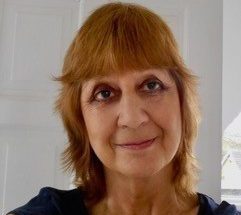
This year we are thrilled to announce that our judge this year is the wonderful Kathy Biggs.
“Kathy’s first novel, The Luck, was published by Honno Press in October 2022.
Her second novel, Scrap, was published by Honno Press in June 2023. It was Welsh Books Council book of the month in July ’23. It is currently being optioned for film.
Her third novel, Attention All Shipping, was published in hardback on May 8th 2025 by The Borough Press/Harper Collins and also in Germany by DTV Verlag. It was released in paperback on May 21st 2026.
She has recently finished a fourth novel and half way through a fifth novel.
Version 1.0.0
In addition to writing:
Kathy has been married for over forty years and has two children – her son lives locally and works as a gardener. Her daughter lives in Yorkshire and is a nurse.
She is a keen, but often overwhelmed, gardener; loves river and sea swimming; Kathys play Samba with Llanwrtyd based Small Town Samba; Kathy and her husband have recently bought a Fiat Ducato van and have converted it into a camper van.
Please follow the guidelines listed on our COMPETITIONS page if you would like to enter.
You can contact writers4haycomp@gmail.com if you have any questions or queries.
Click on the link below to download the entry form :
How quickly our writing year is up and running again! Our Annual General Meeting on 1st September in Clyro village Hall, enjoyed not only many positive reports from its Committee, but also a number of exciting plans and adaptations for the coming year ahead.
We are delighted that the following Committee Members and President have been re-appointed.
President – Ange Grunsell
Treasurer – Nick Thomas
Competition Secretary – Margaret Blake
Social Media & Website Manager – Emma van Woerkom
Newly appointed this year were candidates for the positions of Chairperson, Vice Chairperson and Secretary . We are happy to confirm that Emma van Woerkom, Catherine Smedley and Tammy Allen have kindly accepted these busy undertakings and joined our committee. Welcome aboard all.
Full HWC Committee :
Ange Grunsell – PresidentEmma van Woerkom – ChairpersonCatherine Smedley – Vice ChairTammy Allen – SecretaryNick Thomas – TreasurerMargaret Blake – Competitions Secretary
Bon Voyage!
It’s never goodbye from the Hay Writers’ Circle, just a “bon voyage” for the continuing journey of life and writing. We understand that as writers develop and move away from Hay, they cannot always stay with our group, and so this year a couple of members have left our intimate writing circle for pastures further afield. More over, we are delighted that they will all continue to stay in touch with us.
We sincerely thank them for their many years with us, plus the words and publications they have shared and we have loved. We all wish them the very best for the future, with resounding chants of good luck! May their wonderful writings find large, happy audiences, and willing, rich publishers!
New Members Welcome
Over the coming weeks we will have new members joining our writing group, and we are delighted to welcome them. This does mean that we still have a few spare places available. If you are interested, please head over to our Joining Us page for further information and who to contact next.
Write On!
Some HWC members will be at the first Write On! session in Hay-on-Wye library on Friday 25th September, 2pm-4pm. Do drop in for a chat, and have a go at our writing prompt too. Whether you write for pleasure, publication, enjoy journalling, or simply wish to have a go at creative writing in the company of others, all adult writers of all abilities are welcome to join in these sessions for FREE. We ask that you bring along your own pens and paper etc. and the willingness to have a go.
If you want to read about all our up and coming news, events and competitions, don’t forget to subscribe with your email address in the box below.
We begin this instalment with some exciting news. Starting Friday 25th September, between 2pm – 4pm, new and free, Write On! sessions are set to begin in Hay-on-Wye Library. Whether you write for pleasure, publication, enjoy journalling, or simply wish to have a go at creative writing in the company of others, all adult writers of all abilities are welcome.
Hay Writers’ Circle will provide a new writing starter each month to inspire you, or you can continue to work on your own writing project. We ask that you bring along your own pens and paper etc. and the willingness to have a go. As writers, we know how difficult it can be to set aside dedicated writing-time, the hope is that these sessions will offer a regular slot to write using our lovely local library.
Intrigued? Why not pop along and have a go.
Highly Commended
In the recent Richard Booth Prize for Non-Fiction 2026, judged by Ruth Pavey, Hay Writers’ Circle member, Sam Ashton received a Highly Commended for his entry, The White Plastic Chair.
Sam has kindly allowed us to publish his entry below. We hope you enjoy it.
THE WHITE PLASTIC CHAIR by Sam Ashton
When Tata is comfortably settled in the white plastic chair by the front door she can survey the flow of the Hebron road to Jerusalem. If the weather is not too hot, not too cold, George dutifully puts the chair out each afternoon for his mother then he goes back across the road to his garage workshop. Mary is occasionally allowed to take on that duty before she also crosses the road to her tourist café. Mother and daughter- in-law diplomatically accept each other within the family home.
The Hebron road is everything to the family. It is essential income as well as an essential social conduit. Since George’s father began the garage business in 1953 they have done well. It has been enterprising hard work, but they are affluent by local Palestinian standards and well respected in the small, Christian community.
The plastic chair is Tata’s throne. With a regal gesture she acknowledges the waves of passing truck drivers or the toot of a car horn; she knows them, they know her, she’s Tata to everyone. Looking over the road she watches George in the workshop that her husband built and Mary serving tourists in the café. From there her view descends the valley that runs down between olive grove hills and away to the far west over the wide Mediterranean plain. Ancient, familiar, the road, the view is the life blood of memories; ten thousand sunsets, velvet dusk at the end of a hot day.
From the beginning of the year, 2009, a hideous inevitability marches towards the family home while fear seeps into every crevice of the house. Even so Tata still settles in to the plastic chair, enjoying the early spring sunshine together with those long held memories. Even so the two granddaughters must still be sent off to school each morning, education is everything for their future. This day is no exception.
“Goodbye, Tata.”
“Goodbye dears,” she calls. “You learn your lessons.”
“Yes, Tata. Bye, bye.”
The children bundle out of the back door and up the rocky hillside to the school bus waiting on the dust track above the house.
Today the other familiar household routines are lost. Today the white plastic chair will not be placed outside the front door. The brutalist security and separation barrier is striding along the ridge. Mary and George have pleaded endlessly for their home to be allowed access to the main road, to the café, to the garage. The barrier has already wriggled to include some or exclude others along its contorted way, but hope is fading.
Crunch! A rock ripping digger levels a path around the house. Thump! A massive crane lowers blocks in to place, each one gaining support and slotting into its neighbour with clinical precision. A neat, smooth, instantly effective concrete wall, nine meters high, confronts and imprisons the house on three sides.
On that day Tata’s view is erased, her sunshine obliterated. When the girls get home from school they can’t see out of their bedroom window, just a concrete wall five meters away. Desperation’s tearful silence settles on the house that night, even the sound of traffic on the Hebron road has been smothered.
Without access to the garage or the café George and Mary undertake the sale of their remaining business assets across the road. Blindfolded by concrete they must accept a poverty price from unknown purchasers. George sinks into a mild mannered, blank-smiling depression, Mary goes online to create a sales platform for tourist souvenirs, the girls determine to become doctors.
Every day Tata insists that the white plastic chair is put outside the front door. There she slumps, there she confronts the wall with her memories.
(NB Tata is the Palestinian equivalent of Granny.)
End of HWC Writing Year
The 1st of September always marks the beginning of Hay Writers’ Circle new writing year. Tomorrow we attend our AGM, begin plans for the year ahead, always striving to do better, make more connections, and ultimately, improve and delight in our own writing.
Today then, is the last day of our year, and it is worth reflecting on the many positives of the last 12 months. We have all written and we have all read both within a group setting, and for several of us, in public at the bustling Hay Festival. We have enjoyed an excellent day inspiring the pupils of Hay Primary School with lots of creative writing. We have held workshops and competitions, open to everyone, with enormous thanks to our brilliant judges and workshop leaders,Holly Müller, Lesley Saunders and Ruth Pavey
We also extend our sincere thanks to Cusop Village Hall, and Clyro Village Hall for accommodating our group for meetings and workshops so comfortably. The contributors who have donated money towards our competition prize funds, and everyone who entered work into our competitions, which can be a scary step for those beginning their writing journey.
Finally, a big thank you to everyone who has clicked on a link, google searched Hay Writers’ Circle, and found themselves reading about our small writing group on this website. This year 100% more of you discovered us here, and we are so grateful for each virtual interaction. We hope you enjoyed our posts, found our information pages interesting, and perhaps even thought about subscribing to hear news of all our future endeavours too.
Happy and Fruitful Writing To You All! 😊
If you want to read about all our up and coming news, events and competitions, don’t forget to subscribe with your email address in the box below.
This week we are delighted to showcase the 2nd and 3rd place entries of our most recent competition, The Richard Booth Prize for Non Fiction 2026. To see this year’s results in full, please click HERE.
Neil Stone, 2026
2nd Prize went to Neil Stone for his excellent piece, “Sumud“.
“Neil lives in the Bannau Brycheiniog National Park. After leaving school at 16 with no qualifications Neil joined the Royal Navy. and then between spells of unemployment, studying for degrees at Nottingham and Cambridge Universities Neil worked in the USA, the NHS, local authorities and in HM Prisons & Probation Service. Although he has always written fiction and is the author of two non-fiction books Neil began seriously writing again after returning from a three month spell as a volunteer monitoring violations of human rights and international law in Palestine. Sumud is directly drawn from this experience. Neil short story ’Trecco Beach Baby,” was shortlisted for the 2025 Rheidol Prize and will be published later this year in the New Welsh Review. Neil has just completed his first novel – a crime thriller set against the backdrop of the Brecon Jazz Festival and is actively looking to place the book with an agent or publisher. “
Second Prize – Sumud, byNeil Stone
Looking around and from all angles it was hard to believe that this once was someone’s home. Piles of rubble and corrugated iron heaped into haphazard monuments to the destructive power of a single bulldozer. I’d witnessed this kind of devastation many times before, that was one of the reasons why I was here, documenting human rights abuses and breaches of international law, including the destruction of Palestinian homesteads, but this one was different.
It was different for two reasons. All the cases I’d dealt with up until then followed an official process. The DCL (District Coordination and Liaison Officer) would issue a demolition order on behalf of the Civil Administration, the Israeli governing body that oversees the occupied territories of the West Bank. These orders supposedly gave sufficient time for families to move out or appeal, the latter of which was rarely successful. Then the heavy equipment would arrive, usually early in the morning, accompanied by the Israeli police and soldiers from the IDF (Israeli Defence Force). Then the evicted family watched in heartbreaking agony as their home was raised to the ground. The reason? The house was constructed without a permit. Most Palestinians built without permits because even according to Israeli sources the chances of a Palestinian acquiring a permit to build in the occupied territories was ‘slim.’
Except this demolition had not been carried out by the DCL. A neighbour had done this and as I stood surveying the wreckage I glanced up to see the culprit looking right back at me and his handiwork. He stood astride his quad bike, about half a mile away, outlined on the top of a dusty ridge overlooking the valley; occasional flashes of metallic light catching something held in his hand, maybe the sun’s reflection on a pair of binoculars or an automatic weapon; like most mustawtin (Israeli settler), he favoured an American manufactured M-11 carbine.
Whereas I had attended previous home demolitions with limited knowledge of the occupants this time I was standing in the middle of a house I was very familiar with. Up until a few days ago I had spent many hours here; there under where the corrugated tin which once formed the roof of the porch now angled towards the sky like the barrel of an anti-aircraft gun. We would sit in the shade, sheltering from the midday heat, whilst Ahmed, for this was his home, expertly sliced out watermelon for us chew on whilst his father chainsmoked, conversing with me in faltering Arabic. Mine not theirs.
Ahmed had asked us for help through a cousin in Hebron. He farmed on rented land in a valley called Wadadadee close to the West Bank border with Israel. Over the last few months the number of Israeli settlers moving into the area around Wadadadee had increased, encouraged by government grants, tax breaks and the jingoistic rhetoric of the newly appointed Security Minister, Itamar Ben-Gvir, himself a settler living in nearby Kiryat Arba. One particular settler, emboldened by the new arrivals, began harassing Ahmed, stampeding his flock of sheep, driving his quad bike through the ripening corn and most recently breaking into his home in the middle of the night. Ahmed had reported all these incidents to the Israeli Police with no response. Which I found from other cases was not uncommon. When we did get a reaction it was invariably to invite the Palestinian complainant to come down to the station to report it. This was never going to happen because as was said to me so many times any Palestinian who walks into a police station of the occupying power was risking his liberty at the very least. So Ahmed turned to our programme for help. We are a volunteer group, Ecumenical Accompaniment Programme for Palestine and Israel (EAPPI), which among our monitoring duties provided a protective presence for vulnerable communities under attack from either the IDF, settlers, – there was a particular violent gang called ‘Hilltop Youth,’ – or as so often was the case both of these groups operating in tandem.
So, there I was, on an almost daily basis. Two of us would make ourselves very visible to watchers, of which there were always plenty, and accompany Ahmed out into the fields where he was most vulnerable. Wadadadee was hard to get to. It entailed getting a ride down Highway 317, not always easy, any vehicle with Palestinian licence plates could be subject to ambush from stone throwing settlers hiding by the roadside. We would then travel on foot through desert scrubland and rocky outcrops before dropping into the valley. Ideal places for settlers to launch stones or intimidate us with low flying drones. One night when we were not there the settler came into Ahmed’s home. Khalil, his brother, was staying at the time and got up to confront the intruder. A fight took place. The settler retreated but got his revenge the next day when he rang a relative in the Border Police. Khalil was arrested crossing the checkpoint into Hebron and his work permit suspended. He was held in detention for many days before being released unable to earn a living and monitored by Shin Bet, the Israeli Security Police.
It all came to an end when after a few days absent from Wadadadee on another job I received a call from Ahmed. He and his family were leaving and heading to a-Samu, a nearby Palestinian town. He had had enough. The day before he had been physically attacked and injured by the settler and one other. They had launched low flying drones emitting loud noises to startle and scatter the sheep and stolen his newly harvested crop. Ahmed asked if someone could meet him the next day at Wadadadee as he had left one of his dogs behind which had refused to come with them when they packed up and fled. Two of us made the trip on what had to be one of the hottest days of the year but when we got there Ahmed had already gone; unable to bear what met his eyes. In less than 24 hours a bulldozer had come down off the hill from the direction of the settlement, we followed the tracks until warned off, and demolished his house and surrounding outbuildings. They even burnt Ahmed’s beehives at the back of the compound as a final act of malign cruelty. The settler coveted Ahmed’s land and from where I stood I could see why. What had been a few grape vines planted along the ridge when he first arrived had now become a proliferation thirsty for water from Ahmed’s well and land for expansion.
We reported all this of course. The authorities did nothing of course. Under occupation the occupied have no rights. Start from there I told the newbies taking over from us and everything else will fall into place. It was hard not to agree with a colleague as we took our farewells that for somewhere called the Holy Land it was the most Godless place he’d ever been to. Only Sumud, really existed. A Palestinian word which loosely translates to steadfastness or resilience, an act of unyielding resistance to oppression. Ahmed messaged me at the airport. He had taken out a loan and was going to rent some land away from Wadadadee and have another go at farming. That’s Sumud. Because when God and governments are looking the other way and hope is just a word what else is there?
Vivienne Sayer, 2026
3rd Prize went to Vivienne Sayer, for her wonderful piece, “The Road to Emmaus“.
“Vivienne Sayer currently lives in Banbury, Oxfordshire, although Wales was home for most of her life. She studied English at Cardiff University. Years later, when lecturing at Trinity College, Carmarthen, she did an MA in Creative Writing. After working in education for many years, she went on to be an editor of children’s books at Gomer Press before training for ministry in the Church in Wales. Carmarthen was her home for nearly 30 years. It is where she became fluent in Welsh and where she came to understand the depth of her roots. To soften the impact of her health-exile, she recently completed an online course in cynghanedd. She finds it spiritually inspiring to write an englyn (a strict-metre four-line poem), especially when she goes on to produce an English translation.“
Third Prize – The Road to Emmaus – via Western Avenue, by Vivienne Sayer.
It was a cold January day, and I was feeling very low. My fellow ordinands from St David’s diocese had all received letters from the Bishop confirming where they were going to be placed as curates. There had been no letter for me.
I was in my final year at St Michael’s College in Llandaff. At that time, although it was the main theological institution of the Church in Wales, students followed academic courses at Cardiff University, which was approximately three miles away.
During the previous term, I’d had a traumatic loss of consciousness, and so I probably shouldn’t still have been using my bike, but Cardiff has some wonderful cycle routes: through Llandaff Fields, along the river Taff and through Bute Park, so cycling to lectures was usually a hugely pleasurable experience. And quick.
I reached the civic centre without incident and tethered my bicycle to one of the stands near the main university building in Park Place. Once the first lecture of the morning was over, I retrieved my bike to wheel it round to the university bookshop. It didn’t take me long to decide that riding it would be more sensible, but, as soon as I set off, the inner tube of the back tyre burst. My college bike had a history of punctures, and both tyres had been pumped with some white plastic foam that was supposed to create a seal. Suddenly, all the horrible gunge was hanging out of the back tyre and had wrapped itself around the spokes of the wheel.
At first, the bike wouldn’t move, but then the packing stretched a little and I was, with some difficulty, able to wheel it again. Suffering from chronic back pain, I didn’t want the stress of walking all the way back to St Michael’s at the end of the morning, so I rang the college and asked if someone could possibly come and pick me up after my final lecture, together with
the bike. Under normal circumstances, this would have been perfectly reasonable, but there had been some crisis at St Mike’s, and no one was available. So, rather than risk leaving a damaged bicycle outside the university, I resigned myself to a long, slow, painful trudge home.
The early morning had been sunny, though bitterly cold, but now the clouds had gathered and the rain started, together with some fierce bursts of hail. In my mind’s eye, I split up the journey into stages: stage one to the Taff Trail, stage two to Llandaff Fields, stage three to the avenue of trees leading up to Western Avenue, one of the busiest roads in the capital. From that point onwards, stage four wouldn’t take too long. I would simply need to get to the traffic lights in order to cross the road safely, and then it would be only a short distance to St Michael’s.
My painful back was manageable until I was halfway across the playing fields, and then the heavens opened. Completely exposed to driving rain and hail, every step became a challenge. By the time I’d reached the avenue of trees, I was totally debilitated. There was nobody in sight. No sensible soul would be out for a walk in such bitter weather, not even the hardiest dog-walker. I was feeling very sorry for myself when suddenly, the story of the two disciples on the road to Emmaus flashed into my head.
I often feel anxious, but I rarely get angry. It certainly wouldn’t cross my mind to get angry with God – about anything. But tantalisingly, I issued Jesus a challenge; I don’t know where it came from. I don’t even know whether it happened inside my head or whether I spoke the words out loud: ‘Go on, then,’ I said. ‘You appeared alongside the disciples, come and walk alongside me.’ I had never had such a thought before, let alone articulated it.
Nothing happened. Of course it didn’t. How stupid! What did I expect? Some angelic visitor to suddenly appear at my side? I slogged up the avenue of trees, counting them off as I went. Halfway up the track, I could see that the allotment hedge had suffered some brutal tree surgery. The exposed wood looked like raw flesh, and the nearby garden plots were deserted. The violence and the bleakness suited my mood.
Then all at once I noticed some snowdrops and wondered idly when the crocuses might start to appear. Then I saw that a few early ones had already begun to bloom. Then I caught sight of a whole host of daffodil spikes, and I thought of the carpet of gold which would come alive during the following month, ready for Easter.
At last, I reached the top of the track and turned left onto Western Avenue. The next section was straightforward, but I was glad of the extended stop at the pedestrian lights to ease my back whilst the cars and lorries thundered past.
It had stopped raining, but I was still wearing my hood, and I wasn’t going to risk taking it down. I crossed the road and pressed on past the Cathedral School. Between the school railings and me, there was a stretch of scrub and a narrow strip of pavement.
Then suddenly, right beside me, I was aware that there was another cyclist. I didn’t hear him coming up behind me: he was just there, at my side, having dismounted from his own bike, a very plain white folding device.
‘Are you all right?’ he asked. ‘Do you need help? I’m sure I could sort your wheel out for you.’ He was, I suppose, in his mid-thirties, slight in build, nondescript in appearance, and with a strong Cardiff accent.
I pointed to the tyre. ‘It’s shot,’ I said, thanking him for his concern. ‘I’m all right. I’m just wheeling my bike home.’
He agreed that the tyre looked damaged beyond repair. ‘Have you got far to go?’
I explained that I was nearly home and that St Michael’s College was only just around the corner.
‘Well, if you’re quite sure you can manage,’ he said, clearly reluctant to take my word for it. I assured him that I was fine but thanked him once again. He nodded, got back on his bike, and cycled off towards the main intersection between Western Avenue and Llandaff Road.
I half expected him to vanish into thin air but was reassured to see him waiting for the lights to change, a man of flesh and blood.
It wasn’t until I got back to college that I really started to think about what had happened. There was something about the meeting that was so real and yet so unreal at the same time. The words I’d spoken at my darkest moment suddenly came back to me: ‘Go on, then. You appeared alongside the disciples, come and walk alongside me.’
I’m not a person who routinely feels the presence of God, but I was certain then, as I’m certain now, that I’d had an encounter with the living Christ.
Something from the Hay Writers’ Circle Archives
A poem by Wilhelmina Lockwood – The Hay Writer, Issue No. 5, 2004.
KING HENRY VII by Wilhelmina Lockwood
He stands high on the wall of the Buttermarket, gazing towards England. The first Tudor King, proud in his crown conquered on Bosworth field from Richard III in 1485. Born in Pembroke in 1457 and married to Elizabeth of York. Another Pretender to the Crown.
A turbulent time Kings and Princes slain in battle or in the tower, he is a man of peace. War is wasteful and ravages the land. Henry the despot is diplomat, too promotes trade, stability the Welsh gift of music.
On the end of the old Butter Market, looking across Castle Square, is this sculpture of King Henry VII. It was created by Edward Folkard (1911-2005) in fibreglass and aluminous cement, and has been in its current position since March 1995, and has become a well loved fixture within the town.
Trading for over 700 years, Hay Market is a colourful local market held on every Thursday, in and around the central areas of Hay-on-Wye. In addition, on the first Saturday of the month from April to October there is also a market. Do come along and join the social gathering of buyers and sellers as they throng our streets with their vibrant displays, or grab a coffee from any of the local cafes and simply watch the world go by…
To keep up to date with all our competitions, workshops, events and news, why not subscribe with your email address in the box below.
We are delighted to announce the results of our annual Non-Fiction competition.
This popular competition again received a good number of entries from both inside and outside Hay Writers’ Circle, and we very much welcome external interest in all our writing competitions.
Our memorial prize, named in tribute to Richard Booth, the self-proclaimed “King of Hay”, who among many literary interests, was a keen supporter of the Hay Writers’ Circle. He sadly passed away in 2019, still in love with books, writers and his beautiful kingdom of Hay-on-Wye.
Richard Booth, MBE Ruth Pavey
We are extremely grateful to our judge, Ruth Pavey for her incredible efforts reading all the entries and selecting the winners.
“Ruth Pavey is the Gardening Correspondent for the Ham & High (Hampstead and Highgate Express). She attended the Ruskin School of Drawing and Fine Art, Oxford, and a selection of her illustrated works are included in A Wood of One’s Own, her debut memoir that was a Sunday Times Best Book of the Year and longlisted for the Wainwright prize. Pavey has reviewed books and written features for publications including the Observer, Guardian, New Statesman, Crafts, and the Garden, and was a contributor to BBC Radio 4’s programme Kaleidoscope.” Duckworth Books
A huge thank you to Ruth for judging our competition.
The Richard Booth Prize for Non-Fiction 2026 – Results!
First Prize – Valentine, byVal Ormrod
Second Prize – Sumud, byNeil Stone
Third Prize – Road to Emmaus, by Vivienne Sayer.
Highly commended –
If Wishes were Horses – Elizabeth Moriarty (and) The White Plastic Chair – Sam Ashton
Val OrmrodNeil StoneVivienne Sayer
The Winner – Val Ormrod Val Ormrod is a writer and poet in the Forest of Dean. She has an MA in Creative Writing from Bath Spa University and writes across many genres: short stories, flash fiction, poetry and memoir as well as stories for children. Her work has been widely published in journals and anthologies. Her memoir In My Father’s Memory, which charts her journey of learning to be a carer for her father with dementia, was adapted for the stage as My Favourite Dog.
The Winning Entry
Valentine by Val Ormrod
‘Look, dear, isn’t this marvellous?’ My father holds the card up to show me. It’s a large Valentine card, covered with appliquéd hearts and ribbon. ‘This arrived for me this morning.’ He studies the words inside with a kind of awed rapture.
‘What a lovely card, Dad. Who’s it from?’
‘Your mother, of course?’
I stare at him. My mother died years ago. But then I realise he must mean my stepmother Nancy who had died the previous year. ‘It can’t be from Nancy,’ I say, gently, moving over to hold my father’s arm. ‘Nancy died last year, didn’t she?’ It had been a painful time. She had died of a stroke while they were on holiday in Europe. Dad had been broken and struggled to cope with the practical issues involved in bringing her body home. I’d been in the role of consoling daughter and simultaneously trying to cope with my own sadness for a woman who had been part of my life for a long time.
‘Well, it must be,’ my father insists. ‘It says To a Wonderful Man. And it’s got the most wonderful words inside too.’
He thrusts the card into my hand. I read, Because you’re such a caring man, so gentle, yet so strong. I smile. It’s true of course. Bland, clichéd words printed for the masses, but true, nonetheless. Andfor my father, an eternal romantic, they seem worthy and profound. Then there’s the inscription. It looks like my stepmother’s writing, but I can’t be sure. The ink has run and blurred the words a bit, but I can still make out, With all my love always and forever and three Xs. Has my father been weeping? I’ve never seen him cry before, but over the last year I’ve witnessed him becoming increasingly emotional.
I hand him back the card. ‘Yes, they are lovely words, Dad.’
I’m genuinely puzzled though. Who could have sent this to my father? ‘When did you say that card came, Dad?’ I ask.
‘This morning. It was in the post.’
‘Well, it can’t be from Nancy. You must have a new admirer, Dad.’
‘Of course it’s from Nancy,’ he says crossly.
‘But you say it came in the post. What was on the postmark? Where’s it come from?’
‘I don’t know. I didn’t look.’
‘Well, have you still got it?’ I’m still locked in forensic scientist mode.
‘I don’t know. I’ll have a look. I think I put it in the bin.’ He starts to get up, but I stop him.
‘Dad,’ I say gently. ‘Nancy can’t have sent you a card.’ How can my father not have grasped this? ‘She died last year, remember.’
‘Well, she did send it, I tell you. She must have posted it before she died so that I would have it.’
This is so absurd that I almost laugh. Nancy’s death had been sudden and unexpected. ‘Don’t be silly, Dad. Why would she do that? She wouldn’t have known she was going to die.’
‘Well, she sent it. Look, you read it. It came this morning.’
‘I’ve already read it,’ I say, my mind still wrestling with the enigma. ‘Are you sure it came in the post? You’re sure you didn’t just find it in the drawer?’
‘Of course I’m sure!’ Dad is resentful now. ‘Don’t be ridiculous. I’ve never seen it before. It arrived this morning and it had me in tears – she wrote such beautiful words in it.’
After the formal diagnosis, I wondered why I hadn’t suspected sooner and how I’d missed the signals. I tried to recall the first signs of dementia’s stealthy advance, not just the mystery of the card, but other moments of irrational behaviour that had seemed at the time merely baffling.
Eventually, after much persuading, my father agreed that he would be safer living with me than trying to battle on alone. By the time we packed up his house and moved him, he seemed relieved to have the responsibilities of everyday living taken care of.
When February came round again, he lamented the fact that Nancy hadn’t sent him a card. ‘I don’t suppose she knows this address now I’ve moved to live with you,’ he said, and I suddenly knew what I needed to do. Distracting him with a packet of biscuits, I ran upstairs to his room. I knew exactly where his box of treasures was kept. Inside was a whole assortment of cards and photographs, memories that anchored him in an uncertain sea and served to keep his past still in focus. They were among the few things that my father had wanted to bring with him when we cleared out his house. There were birthday cards, anniversary cards and, touchingly, bringing a knot to my throat, every fondly inscribed Father’s Day card that I had ever sent him – years and years of them. Some days I found him sitting on his bed, sorting through them, picking out his favourite cards and reading the words inside. Amongst all these cards, it was easy to find the Valentine with the appliquéd hearts and the blurred inscription, and I felt sure there was an envelope in the study which would fit.
Now three years on, I watch, anxious as a mother hen in case he falls, as my father makes his way up the drive, clutching a large envelope. Sometimes he checks our mailbox a dozen times in the same day, whether he’s already collected it or not.
‘Look dear, isn’t this marvellous!’ he beams as he comes into the house and slides the envelope open. He can no longer quite remember my stepmother or how she related to him, but his eyes are misty as he opens the card.
‘What beautiful words, Dad,’ I enthuse, hugging him, and I give the card pride of place in the sitting room. During the day I see him pick it up over and over to read the inscription inside.
‘Look dear, isn’t this marvellous,’ he repeats, bringing it to show me in the kitchen, the study, the garden.
‘Yes, it really is,’ I agree.
My father finds the same card every Valentine’s Day. I put it in a new envelope each year. It makes him happy. So very happy.
NB Although this is non-fiction, Nancy has been used as a pseudonym for privacy purposes.
We will be sharing the other placed pieces and their author bio’s in our next update.
In the mean time, huge congratulations to our winner, Val Ormrod, all our placed authors and those highly commended too, plus everyone who took the time to enter our competition. Well done all!
Summer Lunch at The Swan Hotel, 2026
Photo copyright Caroline C.
As the saying goes, “the fondest memories are made when gathered around the table.” This was certainly true when many of our group gathered under sunny skies, within the beautiful walled garden at The Swan Hotel, Hay-on-Wye for our annual Summer Lunch. We were honoured to be joined this year by our recent judge, Ruth Pavey. Ruth announced the winners for The Richard Booth Prize for Non-Fiction 2026 and we are sincerely grateful to her for all her efforts.
For many of us it was definitely a chance for fellow writers to chat, unwind, relax, enjoy excellent food, and read a little aloud too. We mulled over our writing year, celebrated our successes, pondered on challenges, and began looking forward to the holiday month of August, where we do not have any writer’s meetings at all.
We would like to extend a huge thank you to our Chair, Corinne Harris for organising such a wonderful festivity and to The Swan Hotel for an absolutely delightful afternoon with delicious food.
To keep up to date with all our competitions, workshops, events and news, why not subscribe with your email address in the box below.
Poetry day with Hay Pimary School by Corinne Harris (HWC Chair)
On July the 7th we had a very successful and enjoyable session with the delightful students in Hay Primary School. In the morning we had some students from years 3,4,5 and 6 for a poetry session. The theme was Home and Hiraeth, which the school had been working on all year.
We started off with a very brief discussion of what poetry was and whether it was important to always follow rules. The facilitators read some of their favourite poems. We then had an interactive session where we wrote words and phrases that reminded us of home and our communities on A2 sheets which were then displayed around the classroom. We broke these down into the five senses, site, sound, smell, taste and touch. The students came up with some great words and ideas and enjoyed participating.
The next phase was working in smaller groups. Each group had a short discussion and we had some photos as starting points as well as the sheets we had just produced. The children then had 30 minutes to write, which they did most industriously. We then shared our work within our groups with the students reading out their poems. We were very impressed by the quality of the work. Most of them chose to rhyme their poetry and they did this very well. They seem to have a very good grasp of what poetry was and produced some excellent work. They also critiqued their classmates work sensitively and constructively.
Hay Writers’ Circle working with Hay Primary School, 2026 – Photos by Corinne Harris.
In the afternoon we had a short session with years 1 and 2 who had a trip on a magic carpet. They produced some lovely pictures and travelled very adventurously.
Finally, we had the morning group back so that they could share their work with the whole group. Nearly all the students wanted to read their work to the others. They also gave us some very useful feedback with some helpful suggestions. They enjoyed the session and were enthusiastic about having another one.
We were very impressed with how engaged the children were and how well behaved and polite they were. It was an absolute joy to work with them. We’re hoping that we will be able to display some of their work in the library.
It was a privilege to work with the students in this excellent school. Many thanks to Mr Griffiths for facilitating this and to the lovely teaching assistant who helped us all day. We have arranged another session in September and are looking forward to it.
Thank you to everyone who entered our Richard Booth Prize for Non-Fiction Competition 2026. All submissions have been sent to our judge, the wonderful Ruth Pavey, and we look forward to announcing the results very soon.
Recent Writing Starter
At our latest Zoom meeting, Corinne Harris set our writing “starter”. A “starter” is something we use to get our minds thinking on a theme and get our pens moving.
Starter: Inspired by the excellent responses by the pupils at Hay Primary School on Home / Hiraeth. Think about a sense of “Home”. It could be a family, a house, a town or a country etc. What makes this “Home” for you? Write about it including descriptions using your five senses – sight, sound, taste, touch, smell. Write for at least 20 minutes on this subject.
The following are initial responses to the above starter from HWC members, Sam Ashton, Nick Thomas and Corinne Harris.
Sam AshtonNick ThomasCorinne Harris
HOME by Sam Ashton
What’s to think of home? I’ve lived longer here than anywhere else in my whole life. That’s twenty years in Longtown and almost forty five years in Herefordshire for Sarah and I; that’s more than half my life.
But other places do niggle at me. Broad sweeps of Wiltshire downland filled the childhood years. O yes, I could still call the Pewsey Vale and Savernake Forest home for they touch the heart. Where else? Where else touches the heart saying “This is not just a place to live, it is for the spirit to be.”
Where else? It has to be Australia. Could it be Tarves way out in western Queensland with that magical billabong and long days on a horse. Could it be Tumbarumba in the foothills of the Snowy mountains? Such marvellous birds. Either or both for they have touched the spirit leaving an imprint far beyond the post code.
That’s it! That’s home where the spirit finds fulfilment alone or in the company of those most dear to me. Yes, love fulfils this dear home in Longtown. The spirit finds fulfilment in The Black Mountains, the Olchon Brook, the river Monnow. The body finds rest in a dear, gentle house that has more unwritten history than a dozen generations.
Home is not an address, it is an embrace.
HOME by Nick Thomas
Home is where the heart is. Well at least that was the case the weekend just gone. This was because it was a significant birthday for my wife, Janet.
All of our close family arrived, including Elba the dog.
The furthest to travel came up from Falmouth, a grandson studying at university there. He surprised us, no amazed us all, by saying he had bought a boat to live in for next term moored in the river!
Arriving on Friday night from London where she works as an assistant psychologist working in trauma care, was his sister, to help making beds et cetera.
There were ten in all plus dog, four from Bristol and two from Totnes. The youngest, a fourteen-year-old grandson from Bristol, had learned a beautiful classical piece to play on the piano for his grandma who cried when she heard it.
Such larks were had, after food and catching up and presents being given we headed off to a local restaurant where they put us in an area normally reserved for private parties which was both kind and wise for we became quite noisy as the evening wore on. A daughter-in-law had arranged an interesting quiz based upon Janet which was great fun, I should have won but don’t think that I did. We came home and to my surprise they held the disco in the room in which I’m now sitting.Fun was had by all with the Labrador striding purposefully between the dancers all evening.
The point of this diary of events is to try to show the layer upon layer of emotion and goodwill in a family in a home where our boys grew up. The following day they all left and there were happy tears from grandma who is still on a high.
In summary, we had the taste of fine food and drink.
The sounds of laughter and music.
The smell of a dog in the store room where she slept.
The sight of a beautiful communal picture containing flowers produced by the Bristolians.
And the touch of many embraces.
All in all pretty damn good.
HOME by Corinne Harris
When I retired, I bought this house and tried to make it just right for me. It feels like I’ve succeeded. Home is a feeling for me. It’s a feeling of great comfort. It’s the feeling I get coming in from a very wet walk, taking off my soggy boots and soggy socks and putting on a lovely pair of dry socks – bliss. Home is the sound of the stream and the bleating of sheep on the hillside. It’s the song of birds and the hoot of the owl from the churchyard at night. It’s the flight of bats from under my eaves and the soaring of red kites over the hillside. It’s the flood of light from my glass extension on a miserable February morning. It’s the warmth that greets me on a cold day when I open my front door to come in. Home is my grandchildren playing in the garden, excited as only city children can be by grass and flowers and the garden hose. It’s the sand from their sandpit all over the house. It’s chocolate on the arms of the chairs and Cheerios on the floor. Home is the pop-up pub in the village hall, neighbours and quizzes and raffles and wholesome fun – apart from all the alcohol. Home is my neighbours, it’s the crackle of fire in the chiminea on a chilly spring evening, it’s the taste of wine and the chatter of convivial gossip. Home is the smell of wood smoke in the in the winter and the heady scent of lilac in spring. Home is the honeysuckle on my porch and the buzz of the bumblebees plumbing its depths. Home is a luxurious stretch out under the duvet knowing that I don’t have to get up. Home is market day in Hay. Home is the book club and the writing group and the lovely people I meet in Citizens Advice. Hope is potting and chatting in Cup and coming home covered in clay. Home is my cat’s soft fur and purr. Home is the river – so beautiful in all seasons. Home is country walks. Home is sloe gathering and the rich tint of sloe gin. Home is trawling for books in all the book shops and trying not to spend too much in the deli. Home is the pool in the Baskerville arms at 7:00 in the morning, the smell of the water and the silky feel as I slide into its cool depths. Home in short is pretty damn good – well worth the council tax and the hassles with the bin men. Home is somewhere I feel so lucky to have.
Enjoying a cuppa on the banks of the River Wye, The Warren, Hay-on-Wye.
To keep up to date with all our competitions, workshops, events and news, why not subscribe with your email address in the box below.
This is a timely reminder that there is less than one week to go before the deadline for our Non-Fiction Competition – The Richard Booth Prize 2026. We are thrilled that award winning author, Ruth Pavey, is our judge this year, and we hope to receive some fascinating entrees.
Full details on how to enter can be found on our COMPETITIONS page.
Time to get writing!
Creative Writing Workshop with Holly Müller
Photos of workshop from Holly Müller 2026
Unanimously positive feedback from all who attended the “Mask” creative writing workshop in Clyro Village Hall recently – a great day of writing and creativity – thank you Holly!
Catherine Smedley wrote : The ‘Masks’ workshop with Holly was stimulating, explorative, thought provoking.
We looked at how characters might alter their behaviour or ‘presentation of self’ in different company or context. One exercise invited us to construct a short sketch of a scenario or dialogue where one character witholds something ( truth, emotional clarity, time or attention ) from the other/ others.
Here’s an example of a response to this exercise:
We were sat around Mme Benauds vast oak dining table, nine altos from the choir sharing a light supper, inbetween dress rehearsal and the evening performance. Mme. Gilbert began to recount a recent event held in the communal hall of our village. All residents had been summoned by the Maire, who had descended from his tractor and donned his sash of office. He began his speech by instructing everyone on the intricacies of the new system for recycling rubbish. Then he called to the stage anyone in the community who had produced a family of four or more children. Bouquets, medals and certificates were ceremoniously presented to the couples to polite applause. Mme Benaud was hugely impressed to hear about this inspired government initiative for encouraging population growth. Around the table heads nodded in agreement in earnest and pious support for the role of mother, a womans duty to be in the home, raise children and reinforce the fabric of society. They even declared that it was an act of selfishness to reject that role.
I caught the eye of Madeleine, sitting opposite me across the table. She was the only one present not oblivious to the fact that I was childless. We’d talked intimately about why that was the case. I wondered if she would take part in the conversation, confirming her support for the maternal stereotype or offering another viewpoint perhaps, another way of thinking on my behalf. But she remained silent. I was the only one present who knew that while she complied with the role of a good catholic wife and mother of five children, during the week when her husband was working in Paris, she was having a passionate affair with the cheeseman.
Nick Thomas wrote : All day event in Clyro village hall with an excellent lunch courtesy of Corrine.
Workshop essentially about characterisation and the way people mask themselves.
Initially a free writing exercise then various examples with dynamic short exercises. The exercises were lists from which you could choose, e.g. different social backgrounds, or a capable person pretends to be stupid, or an unexpected visitor etc. Literary references to Alias Grace, Margaret Atwood and Remains of the day, Ishiguro.
Holly Muller, mask exercise – An unexpected visitor arrives immediately after a couple have an argument.
The doorbell rings. “Who the hell is that?” “I’ll go dear.” “Oh come in Fiona.” “It’s Fiona with the eggs I ordered.” “Tell her to F off.” “Sorry dear I didn’t catch that.” “Do come in Fiona.” “Nick’s just about to go into the garden.” “Aren’t you Nick.” “No.” “Oh go on, the onions need weeding.” “Fuck your onions.”. “Sorry Fiona he’s feeling a bit bilious today, it’s his leg.” “Oh I understand, dad’s the same.”
Of course he’s not, her dad Eric is a true gentleman. Never raises his voice. Has PAs from his time in the film industry, some years ago now, who still ring him every week to chat.
“Would you like a cup of tea Fiona?” “No thank you Janet, I’d better be going.”
Fiona goes to the front door, leaving hurriedly.
“Where are you you bastard?” cries Janet.
Hallmark Movies on location in Hay-on-Wye
During the midst of our recent heatwave, no one could have failed to notice the unseasonal amounts of snow on certain windowsills in Hay-on-Wye. The Christmas trees beside Santa’s Sleigh in the Honesty Bookshop, or the large number of vehicles, cameras, cranes, road closures, and all manner of technical people busying themselves along our town’s narrow streets. It was exciting and a little intriguing to behold, and gave us all something to talk about.
Then came the notices for volunteers to be film extras, requests to borrow a shop till, and then a letter from Doubly Booked Ltd confirmed it all – “Hallmark are currently in production of ‘Doubly Booked’, a cosy Christmas film set in Hay-on-Wye.” starring Rachael Leigh Cook.
How wonderful! Thank you Hallmark for coming to Hay. We look forward to seeing our small town in your film later this year.
Photo credit – Sunshine Radio 2026Photo credit – Sunshine Radio 2026
Something from the Archives
HWC Magazine 2003, Issue 4, page 27.
MARY’S MEADOW by Sylvia Haines
Buttercup shines the meadow all other flowers before, while clover and lesser trefoil hide near the hayfield floor.
Hard heads and hemlocks cover the grass, above moon daisies and rattles, near the hedge, tall foxglove.
While in a boggy corner treasured globe flowers gold, buttercup’s showy relation, a rare sight to behold!
Hay Meadow – Photo Credit Emma van Woerkom 2026
To keep up to date with all our competition and workshop news etc., why not subscribe with your email address in the box below.
The sun certainly shone brightly on Hay Festival 2026, and glorious amounts of book fiends descended to on our border town to fill their bibliographical hearts full of wonder, delight, and books, books, books! This year book sales were up and so was festival attendance too. This all bodes well for next year as the festival celebrates it’s 40th year.
Hay Writers’ Live!took place on Sunday 31st May at 12.35pm in the Bookshop Garden Marquee. An outdoor venue without microphones was something new for us, but our stoic group stepped up to perform (against the backdrop of the neighbouring musician’s amps); their bespoke festival creation, The Well of Words. Short individual pieces inspired by books, poems and even lullabies were performed in the guise of a masked classical Greek Chorus. Our event was very well received by the audience and in return, we would like to convey a huge thank you to everyone who came along and supported us on the day.
We also sincerely thank the festival for its continued support of local writers. For many of our younger HWC members the opportunity to perform their own work at Hay Festival gifts them an enormous boost of self confidence and belief. Hay Writers’ Circle was first invited to perform at Hay Festival in 2005, 21 years ago, and we look forward helping Hay Festival celebrate it’s incredible 40th anniversary in 2027.
Photo Credit – Margaret Blake 2026
Hay Festival Writer At Work hosting a Creative Writing Workshop
There is still time to book your place on our exciting Creative Writing Workshop with Holly Müller. Holly was one of the Hay Festival 2026 Writers at Work and we are thrilled that she is leading this dynamic writing workshop on Tuesday 9th June. Details about Holly, and the workshop can be found below. A light lunch is included, so please make us aware of any dietary requirements when booking. Please book your place via email to our Chair, Corinne Harris: corinneonwye@gmail.com
HOLLY MÜLLER
“Holly Müller is a writer and musician living in the Bannau Brycheiniog. Her debut novel My Own Dear Brother (Bloomsbury, 2016) was Waterstones’ Book of the Month and garnered positive reviews in the Guardian, Independent, Sunday Times, Sydney Morning Herald and more. Her short stories are published in Rarebit (Parthian Books, 2013) and New Welsh Fiction (Seren Books, 2015). Holly achieved a PhD in Creative Writing from the University of South Wales where she taught undergraduates. Holly has written for national press as well as prominent online publications and has performed at Cheltenham, Hay, Laugharne, and Cardiff Literature Festivals.”
The Richard Booth Prize for Non-Fiction 2026
There is a little over once month to go before the deadline for our Non-Fiction Prize. We are thrilled that award winning author, Ruth Pavey, is our judge this year’s Richard Booth Prize, and we hope to receive some fascinating entrees.
Full details on how to enter can be found on our COMPETITIONS page.
Time to get writing!
Illustrator Opportunity!
HWC member, Nicholas Thomas, has created a short story, “Lark and Hedghog“, and is currently seeking an illustrator.
Please read the story (below) and get in touch with him via email : n.thomas559@btinternet.com
Lark and Hedgehog
Having rescued the Princess Arabella the services of the Tusketeers were much in demand but they couldn’t do everything so they would ask their friends to help.
One day a Mrs Beryl Hedgehog came to see them, she seemed very upset.
“What seems to be the trouble Madame?” asked Red, but as she was a prickly hedgehog he didn’t put his arm around her to comfort her.
“It’s my Gerald,” she said, “he’s gorn missing.”
“Gorn,” thought White disapprovingly, he was such a snob.
“Oh dear, tell us all about it,” said kindly Blue.
“Well it were like this,” said Mrs Hedgehog, “Gerald went off to school yesterday but never arrived, it wasn’t until I went to collect him that I realised he hadn’t been there, his teacher said he hadn’t been there all day.”
“Oh heck,” I thought, “where can he be?”
We searched high and low and spoke to his friends when young Gavin told us that Gerald had been telling him about some hedgehog tunnels that had been built under a new road near the Harlestone Firs and how he was interested to see them.
“Oh dear they’re miles away,” said Blue, then Red piped up, “I could ask my friend Lark to fly over and take a look,” he said.
He hadn’t seen Lark for quite a while she was always too busy bringing up her own children but now that they were able to be looked after by their granny she agreed to look and wasting no time off she flew.
Fortunately that day there was a tailwind and she very quickly found herself over the Firs and headed towards the perimeter road.
Seeing some sort of commotion on the verge she hovered to look and flew down to see a most extra ordinary sight.
There at the roadside was a group of animals all trying to pull on a dog’s tail, the dog’s body being firmly stuck in a pipe that led beneath the road.
“My goodness,” she tweeted, “what’s happened?”
“Oh,” said a harvest mouse, “Fat Sally, Jack Spratt the dachshund’s wife followed him into the hedgehog tunnel and has got stuck. She had followed her slim husband who was heading to the Firs but she’s got stuck and we can’t pull out.”
Now unbeknown to all of them Gerald the missing hedgehog had seen what was happening and being a clever little hedgehog he had a plan. He had seen that those tugging were not having a lot of luck despite trying to lubricate the dog by pouring questionable liquid over the dogs back. All they were doing was making the dog howl as her tail was pulled harder and harder.
No, it needed something else and he thought he knew what if only he could find what he needed. So off he went foraging through the wildflowers along the roadside and there amongst the Hearts Ease and Scarlett Pimpernel he saw what he was looking for, a tiny white flower nestling beneath a bramble. Achillea ptarmica, also known as Sneezewort. He tore off some dried out flowerheads and headed back to the tunnel, travelling along the tunnel was very dark as the stuck dog had cut off light from the end he was travelling towards but some glowworms helped light the way. Once there he ground the Sneezewort as best he could then, hearing the others heaving on the dog’s tail, he stuffed the Sneezewort up its nose. After a moments shock and hesitation the dog let out an enormous sneeze and out it popped rolling over those pulling its tail. Gerald, who had been blown backwards in a ball shot along the tunnel and landed on the verge by the Firs. The glowworms were blown out like candles.
He emerged into the light to great cheers, when the celebrations settle down Lark hopped over and told him he had to go home as his mother was very worried. Mind you Lark had already sent a message via the bird telegraph back to base. So when he eventually arrived home it was to a hero’s welcome, even his mother didn’t box his ears for wandering off, she just gave him a big hug and told him he mustn’t do it again.
The end.
Nicholas Thomas, May 2026.
To keep up to date with all our competition and workshop news etc., why not subscribe with your email address in the box below.
The sunshine has really welcomed the crowds to Hay Festival 2026. Glorious bright days and sultry evenings are thronged with book readers, book bearers and every manner of literary lover. All are intent of meeting their author idols, soaking up the heady festival atmosphere, or strolling the short walk into town for a Castle visit, ice creams, boutiques, pubs, cafes and even more excellent book shops. Many meander back to the festival site via the Warren Walk, taking in the lush views of the River Wye. Yes, Hay is at it’s best and everyone is enjoying it.
Hay Writers’ Circle are delighted to once again be at Hay Festival, and we are so grateful to the Festival for it’s continued support of local writers. This year we will be reading alfresco in the Bookshop Garden Marquee at a FREE drop-in event (event number 394). The theme of our readings will be “The Well Of Words”, original writing by our members on poems, books and even lullabies which have inspired or influenced us. Perhaps our own small nod celebrating the National Year of Reading.
We do hope you can can come along, enjoy our words, and stay for a chat afterwards.
Poetry Competition 2026 – 2nd and 3rd placed poems.
Many congratulations to Hilary Watkins and David Shields who won 2nd and 3rd places respectively in our 2026 Poetry Competition as judged by Lesley Saunders. First place was won by Livia Frisby Parker Clements, and her winning poem, “Advice from the Widow Next Door” appears in our previous article.
Hilary WatkinsHilary Watkins and Jay the Sheep.
Hilary Watkins – “Home“, 2nd Place.
“I think the best way to get to know someone is to ask them what they love. Words are number four on my list – one place behind silence. Poetry does both well I think. And both feature highly in my choice of work, the silence, when dog sitting and gardening and, previously, words, when storytelling or working with young adults. Whatever the paid work, I make space for writing both poetry and adult fiction.
I love sheep, only fractionally less than words, I am a sheep farmers daughter. I was raised and live in the foothills of the Black Mountains, yet work has taught me to travel well, to live out of a suitcase or inside a book. Upon my return, I notice that words are, most often, musical sounds exchanged in the sheep shed or ‘on the road’. Perhaps this is why I appreciate Mary Oliver’s emphasis in her book, A Hand Book of Poetry, that ‘to make a poem, we must make sounds. Not random sounds, but chosen sounds’. So my thanks go to the Hay Writers Circle, for giving each entry in the competition an opportunity to fly from the page.”
Home by Hilary Watkins
Home, for me, is more a way of being
than a place. I can do it in many places but not all.
That way of being is in emptiness
where something gives –
and my gaze alights and lingers on spaces
between the branches of wintering trees,
and the few leaves, still fast and
holding their colour green,
and in the foreground, on the windowsill, the arrangement of
three onions in a bowl, intoxicating and
inspired in their wine-red chafed skins,
making counterpoint with ivory bulbs of garlic.
David Shields
David Shields – “Getting to Grips with the Resistometer” & “Change of Use”, Joint 3rd Place
David Shields lives in Crickhowell and works in Brecon Library, where he organises regular literary events and group sessions. He has an MA in Writing from Sheffield Hallam University, and has published poems, essays and reviews in numerous publications. He is a multiple Spectator writing competition winner, and won the inaugural Knighton Poetry Prize in 2025.
Getting to Grips with the Resistometer by David Shields
Like old men tottering on sticks
We walk one pace then plant the spikes
Wait for the registering click:
We are doing geophysics.
March has its ‘lion’ head on.
We bow before the wind-sown rain,
Intent on the reading and the line,
Our progress boustrophedon.
At the line’s end I pass the yoke
To my partner, follow in her wake
As she now wields the virtual rake,
Piling data in a tidy stack.
The archaeologist also follows
As the terrain now dips and narrows,
With the odd word steadying the harrow.
At last the foursquare field is furrowed.
Later we huddle, as if for warmth,
Round the laptop, watch the solid graph
Leap amazingly to life:
Waves of stone, locked in the frozen earth.
Change of Use by David Shields
(Land acquired by Orchard – construction site hoarding)
If only.
If this were a greening
for a gauze of grey,
laid like a poultice
on the wounded land.
If, for a web of glass and steel,
dense trees would aggregate
a mesh of shade,
woody girders pleached and spliced.
Book Now for our Fiction Workshopwith Holly Müller
There is still time to book your place on our exciting Fiction Writing Workshop with Holly Müller. Holly is one of the Hay Festival 2026 Writers at Work and we are thrilled that she is leading this dynamic creative writing workshop on Tuesday 9th June. Details about Holly, and the workshop can be found below. A light lunch is included, so please make us aware of any dietary requirements when booking. Please book your place via email to our Chair, Corinne Harris: corinneonwye@gmail.com
HOLLY MÜLLER
“Holly Müller is a writer and musician living in the Bannau Brycheiniog. Her debut novel My Own Dear Brother (Bloomsbury, 2016) was Waterstones’ Book of the Month and garnered positive reviews in the Guardian, Independent, Sunday Times, Sydney Morning Herald and more. Her short stories are published in Rarebit (Parthian Books, 2013) and New Welsh Fiction (Seren Books, 2015). Holly achieved a PhD in Creative Writing from the University of South Wales where she taught undergraduates. Holly has written for national press as well as prominent online publications and has performed at Cheltenham, Hay, Laugharne, and Cardiff Literature Festivals.”
To keep up to date with all our competition and workshop news etc., why not subscribe with your email address in the box below.
We are thrilled to announce the results of the Hay Writers’ Circle Poetry Competition, 2026.
This every popular competition received a good number of entries from both inside and outside Hay Writers’ Circle and we very much welcome all external interest in our writing competitions.
We must firstly take a moment to thank our amazing 2026 Poetry Judge, Lesley Saunders, who has read all the entrees and whittled them down to our ultimate set of prize winning poems.
Lesley Saunders, 2026
Lesley wrote,
“I want to salute all the entrants who sent in their poems to the competition – I know from experience that it takes courage to submit one’s work for scrutiny and judgement by someone else. Just by entering the competition, writers have taken their writing a bit more seriously. My advice to people who weren’t successful in this competition is: keep trying, but above all keep writing. And I also want to honour the depth of emotion that inhabits many of the poems. I think that testifies to how we look particularly to poetry to hold and express our thoughts and feelings in these sad and difficult times.”
Thank you Lesley.
(Lesley also took the time to write constructive feedback notes for all competition entrants, these appear at the end of this update.)
Hay Writers’ Circle Poetry Competition 2026 – Results!
First Prize – Advice from the Widow Next Door, byLivia Frisby Parker Clements
Second Prize – Home, byHilary Watkins
Joint Third Prize – Change of Use, by David Shields, and Getting to Grips with the Resistometer, by David Shields
“Livia Frisby Parker Clements is currently studying A levels at Orleans Park School in Twickenham and plans to apply to study Veterinary Medicine at university. Alongside this, she is taking English Literature as a fourth A level, reflecting her love of reading and creative writing. She has been writing poetry for the past three years, often drawing inspiration from Gothic and postmodern literature, which has become her favourite creative outlet.”
The Winning Poem
Advice from the Widow Next Door byLivia Frisby Parker Clements
Listen to me girl, you cannot dress this up, sweep it under layers of mascara
and concealer, stand still when you hear it crunch between clenched teeth
or twist it into some hollow tragedy because I know you long for people to notice
the stains it tracks over your smile, your voice the oh so soft skin of your cheek
but nobody will see past your rosy lips too blinded by the white glinting in your mouth,
too drunk on the honey in your tone, too busy tracing the freckles on your jaw
I know you could draw around each slab of flesh left withered by his touch
listen to me girl, you cannot dress this up
when he shows up on your doorstep do not invite him in
instead grab your keys, a broken beer bottle, your father’s rusted axe
tread lightly and on the seams of the floorboards,
still the tremor in your hand and the fluttering bird behind your ribcage
though, be honest, that bird has long since died so use the carcass
to lure the predator and, listen to me girl,
aim for the neck.
We will be sharing the other placed poems, and their author bio’s in our next update.
In the mean time, huge congratulations to our winner, Livia, all our placed poets, and to everyone who entered our competition. Well done all!
Poetry Competition Feedback from our Judge, Lesley Saunders.
” I’d like to share a few tips that emerged from both the successful and the unsuccessful poems:
1. Less is more – good poetry often works because of its economy of expression; see if you can compress your poems by using allusion and metaphor – trust your readers’ intelligence!
2. Find a different angle – human experiences and emotions (love and death and the whole damn thing, to paraphrase the film title) have been written about since the dawn of time. How can you find a new way into thinking and writing about yours?
3. The shocking nature of catastrophic events and actions, such as in Ukraine and Gaza, makes many of us want to articulate our outrage and express our empathy. But it often works better to come at such topics obliquely – it can sound artificial or even voyeuristic to write too directly about someone else’s extreme experience.
4. If you want to use a formal rhyme scheme, don’t be ruled by it – read Paul Muldoon and Philip Larkin for brilliant ways of writing rhymefully
5. To write good poetry you need to read good poetry, including at least some works by poets of the 20th and 21st centuries. Otherwise you may be working with a restricted idea of what is ‘poetic’. On the other hand, you need to be able to say why what you have written counts as a poem rather than prose broken up into lines.”
And Finally,
Reminder of our Fiction Workshop – Tuesday 9th June, 2026
To keep up to date with all our competition and workshop news etc., why not subscribe with your email address in the box below.
Submissions are now invited for our annual Non-Fiction Competition, The Richard Booth Prize 2026, named after one of Hay-on-Wye’s most notable residents and it’s self proclaimed ‘King of Hay’. Richard was always a great supporter of books, Hay-on-Wye and of course, local writers.
Sadly, Richard passed away in 2019, but his name lives on everywhere in Hay, including this writing prize which he so graciously sponsored during his lifetime and we continue to honour in his memory.
Richard Booth (King of Hay) 1938-2019
This year we are thrilled to confirm that the judge for our Non-Fiction Competition isRuth Pavey.
“Living mainly in London, Ruth has had a mixed career, as gardener, teacher of art and English, reviewer, gardening columnist and (not in London) woodland grower. She has written two illustrated books about her Somerset woodland-cum-orchard project; “A Wood of One’s Own” (a Sunday Times Book of the Year), and “Deeper into the Wood”, both published by Duckworth Books.
As a writer late to publication, she admires everyone who writes from the heart and doesn’t give up….”
Ruth Pavey
Anyone can enter this competition. 500-1250 words. The theme is entirely open. Original unpublished writing on any subject will be accepted. Closing date is Tuesday 7th July 2026. Any entries submitted after the closing date will not be considered. Good luck!
For full competition guidelines and the entry form, please head over to our Competitions page.
The Bookseller of Hay: The Life and Times of Richard Booth by James Hanning. (Emma van Woerkom)
Richard Booth, where do you start? This book is as good a place as any to get an inkling into the many layers of his life. As James Manning admits, to some Richard was a “shambolic, egotistical, capricious, unreliable spendthrift”, others saw him as a “benign, paternal, swashbuckling advocate of the common man”. What James has drawn together here is a range of people’s personal recollections interspersed with written material, which includes some of Richard’s own diary entries.
Among many stories of celebrities, folk from Hay and beyond; book festivals, institutions and sellers, and the varied relationships they all had with Richard, we view the inception and formation of his book shop empire. He created the Kingdom of Hay, and thus his kingship, we witness his remarkable promotional skills, his continually anarchic financial escapades, and latterly, his firm ethos that his book-town model should be duplicated around the world.
It was a joy to read about so many people I know and have known. I particularly favoured the explanation of Jeffery Meadon’s encounter, and subsequent high court battle with Booth. I crossed paths frequently with Jeffery later in his life, and he never fully explained his vitriolic stance on Booth, he just called him a rogue and spoke bitterly about him.
A few years later I met Richard and Hope at a lunch for Hay Writers’ Circle. Richard (during his lifetime) gave his name to their annual Non-Fiction Competition and donated the prize money. The prize (as you see) still bears his name as a tribute to his support of local writers. On that day he was utterly charismatic, excitedly brimming with ideas of going to Iceland to advise on setting up a book town there. He praised and marvelled that an average of one in ten Icelanders published a book during their lifetime. He asked me to join his party and go to Iceland. I had just started a new job elsewhere and made my disappointed excuses.
But it was a joy to speak to him on that day, and I can see how so many people were captivated by his ambitious dreams. It reminds me of this quote from T. E. Lawrence, “All men dream, but not equally. Those who dream by night in the dusty recesses of their minds, wake in the day to find that it was vanity: but the dreamers of the day are dangerous men, for they may act on their dreams with open eyes, to make them possible”.
Richard Booth was a quintessential day dreamer, and this book aptly brings that to the fore.
The Bookseller of Hay : The Life and Times of Ricard Booth by James Hanning Publisher : Corsair ISBN 978-1472159786 Available at all good bookshops including the Hay Festival Bookshop – https://www.hayfestival.com/p-24525-the-bookseller-of-hay.aspx
Hay Festival 2026
Join Hay Festival 2026, 21st–31st May. The full programme is out!
“Come and hear the writers share and discuss some of their recent work. The Hay Writers’ Circle is a dynamic group, active in Hay for more than 40 years. It offers three competitions annually for poetry, fiction and non-fiction, each of which is open to both members and non-members. There is an active work in progress group for those working on longer projects. The Circle has an ongoing, productive relationship with a local primary school.”
copyright – ECvW 2025
Something from the HWC Archives
(HWC 2001 Magazine, Issue 2, page 19)
THE FIRST URBAN SPRAWL, 1935 by Vera Fairfax
There was a pond and, in season, croaking frogs A much walked path and rabbit hole dogs Protruding tails wagging, with never a rabbit caught Scratching, yelping, barking, snarling, all for nought.
Celandines first, then bluebells in shady places Daisies, white and joyful and golden buttercup faces. Leg tickling quaker grass, thistles, booming bees And, ruling over all, the kindly leafy trees.
The oak stood alone, spreading branches blessing all, Giving shelter, shade to youthful plans, adventure to recall. For childhood dwelt in that wondrous place, dreams and nature were ours. For it was always there, each grass we knew we shared in playlit hours.
Girls wearing frocks played house, all very self reliant. Boys in short trousers were pirates, wild and bad and defiant, Intent on destruction. Then came years of sport, Football, racing, rounders and excited cries, ‘Well caught!’
But the city, spawning suburbs, was slowly, surely, creeping. Chainsaws felled the oak, beeches, ash fell weeping. Houses were built. Where went the frogs? No use yelping for rabbits for back garden dogs.
We were casual, uncaring, for the world and a war were beckoning And when Paradise was swept away, we hardly guessed the reckoning. For Life moved us on to live, leaving memory in the wildwood, With the dogs, rabbits, frogs, flowers, bees and childhood.
To keep up to date with all our news, competition, workshop and event details etc., why not subscribe with your email address in the box below.