Hay Writers’ Circle at the Hay Festival 2019


Hay Festival 2019 by ECvW

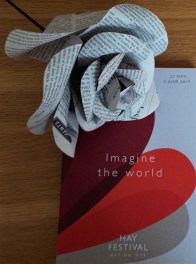
We’ve been blessed with another fantastic Hay Festival. Official photo’s in the Green Room, a larger, high-spec venue, (beautifully managed by a wonderful festival team), and an absolutely terrific, attentive, sell-out crowd!

Our audience were delighted by a wide variety of poetry, short stories and excerpts from novels.  Thoughtful, humorous and descriptive pieces easily gelled alongside fictional landscapes and characters, some pieces even celebrating our 40th year – there was literally something for everyone to enjoy.

peter florence by merv newton 2019

Photo by Merv Newton 2019

We were also extremely privileged to have an introduction by Hay Festival Director, Peter Florence. Describing, in his address how Hay-on-Wye is known the world over as “the town of books, but increasingly over the last 35 to 40 years, a town of writers as well.”  How our community, rich in so many things is “richest in its story telling (which) is incredibly important and dear”; and that enhancing a love of “language and stories is important to who we are.”

I have to say,  these wondrous words by Peter instilled a huge amount of honour and pride in each writer, and acted like a rousing call-to-(literary)-arms. I don’t think we ever performed as well as a group on that day and on that amazing Hay Festival stage.

If you’d like to hear the audio recording of our 2019 event or other Hay Festival events, why not subscribe to the Hay Player.

CLICK HERE

The Hay Player contains thousands of audio and video recordings from Hay Festivals from 1995 to the present day. An annual subscription of £10.00 allows you to play as much audio and video as you like.

DSCF1838 (3)


A huge thank you to Peter Florence and the whole team at Hay Festival for their unceasing, essential support enabling the Hay Writers and by giving us this valuable public platform on which to perform.

Finally, thank you to our audience who dodged the wind and rain for an hour and applauded in all the right places. Well done everyone!

Posted in Uncategorized | Tagged , , , , , , , , , , , , , , , , , , , , , , , , , , , , , , | Leave a comment

Why join a writers’ group?

Why join a writers’ group?

by Marianne Rosen

pen write image

As Hay Festival gets underway and the summer line up of literary festivals spread their temptations before us, there will be many aspiring writers as well as readers traipsing the lawned hallways in search of encouragement. Do you long to be one of those authors whose events you attend? Do you write but dread the thought of sharing? Do you wish you could talk to someone about your writing but lack confidence? Have you ever wondered what value there is in joining a writers’ group?

Writers are often introverted people who prefer their time alone, either writing or reading, and preferably doing both in peace and quiet. Hands up, that’s me, I have been known to growl at my family if they disturb me mid-sentence. So, it might seem illogical to join a group of similarly introverted folks, in fact, you might even say it sounds truly hideous, but trust me, it’s worth exploring.

The step between being in the audience and being behind the podium is not as huge as you might imagine. This week, this elusive, lesser-spotted, secretive writer will be performing at the world-famous Hay Festival alongside other members of The Hay Writers. Joining a writers’ group was one of five steps I took towards my goal of writing for a career, and it is 90% rewarding, 5% frustrating, 5% indifferent. As odds go, in anything, that’s pretty impressive. But what is a writer’s group? What does it do? How do you choose the right one? Let’s unpack this.

Two years ago, I sat down in the twilight realm between Christmas and New Year and wrote out a five-point strategy to get my writing dreams on track. In January of 2017 I rang three local writers’ groups and made enquiries about joining. Here’s my first piece of advice. Persist. Writer’s are not necessarily the most organised of people and voluntary groups are not the swiftest mechanisms in the universe. I tried all three I approached, and in the end chose to join The Hay Writers’ Circle. This was not the closest, but it ticked my needs in the critical areas I list below: it met twice a month, in the afternoons, had a clear committee policy and a wide approach to material. It also emphasised performance. Having spoken with the Chair and Vice Chair, outlined my writing interests and tried a few meetings as a guest, I paid up my membership fees in the March of 2017.

Since then I have become Secretary of the group, proxy chair of the WIP group, organise their workshops and had my work performed at Hay Festival as part of the group, who have strong links in the community, as most writing groups do. Last year I performed myself, (yes, terrifying and exhilarating in equal measure) and will be doing so again this year. During my time with them I have written my first novel to a fourth draft, sent it off for professional editing, am currently working on my next project whilst building an author website and seeking representation. This is just my story. I’m goal orientated as both a person and a writer. But not all writers are, and the great thing about a writing group is that it has allowed me to value all types of writing for all sorts of motivations, and I have been enriched by every single writer in our group.

Some of us come for a social gathering of like minded folk, some of us write to have a laugh, some of us write to exorcise ghosts, some of us write to challenge ourselves, to keep our brains focused and functioning, and some of us write with a strong ambition. Some writers join for a year, some come back every year.

One common factor that brings us together is how writing gets side-lined. As Libby Houston points out, unlike children who need feeding or bills that need paying, writing can be ignored. And all too often it is. One of the greatest complaints I hear from writers is how they struggle to find the time to write. You have to commit, you have to say no to other things, you have to carve out your right to write with fierce determination, and a writer’s group is full of people who think this is the sanest thing you will EVER do with your time.

Frances Copping, our founder and still current member, emphasises the need for the group. How it was formed because like-minded people needed support and space to pursue their writing and how it continues to grow in strength because we still need that space. Every writer needs support to tell them what they are doing is valuable, to encourage them through the stumbling blocks, to offer feedback they can learn from, to encourage their next step. For some writers this is their truest friend, nearest loved one, oldest penpal, or family dog. For the members of a group it is the other members.

In interview with a former Chair of the group, Lynn Trowbridge, I asked what she felt was the most important thing she took away from being part of the group. She believes it made the difference between her wanting to write and believing that she could write. Lynn was 91 when she published her first book, A Life Is What You Get, after stepping down from her duties as Chair, and credits her time with the group for giving her the conviction she could do it.

Still not sure? Well, I can understand your reservations, it is scary sharing your writing, it is scary being pushed to see how you can improve. But it is fun too, we laugh a lot, and we always have cake. I have heard horror stories from writers who have joined writing groups, hoping to make it their next step in the process of owning their dreams, and been given such personal criticism they have retreated to their sanctuary and never gone out again. It’s normally at this point that I begin my efforts to convince them to try again. If you have had a bad experience at a writing group, try another. They all have a very different flavour to them. If you are tempted, these are the questions I suggest you ask yourself:

pen list image

  1. How often do they meet?

Once a month, fortnightly, bi-monthly. What will fit in with you schedule?

  1. When do they meet?

Are you better in the mornings, afternoons, evenings or weekends?

  1. Where do they meet?

Do they meet in a neutral space such as the library or a meeting hall? Do they meet in member’s houses?

  1. How big is the group?

Do you want to hide in anonymity or are you brave enough to step into a small arena? Bigger groups can often be a good way to start if you are nervous. Plus, the size of the group will impact upon the diversity of age/experience/class/culture/genre etc of the writers available to you.

  1. What is their focus?

Do they focus on one genre? Do they emphasise longer projects or inspiration exercises? Do they have competitions, or include performance opportunities? Do they include a buddy system or a mentor system? Do they have a social aspect, and can you opt out of this is you prefer?

  1. Do they have a structural policy?

A written constitution, and regular rotation of committee staff, helps prevent the group from being overwhelmed by one or two individuals and their personal agendas. It also sets clear guidelines to how criticism is offered and accepted.

  1. What are the subscriptions fees?

Fees should be minimal and reasonable; pursuing your passion for writing should not involve spending a lot of money for validation. Make sure you know the cost implication before you join.

  1. What will you need to contribute?

Get an idea for what you will need to contribute back in terms of time and input.

Many writers will be nervous joining a new group, and there is nothing to prepare you for that stomach-plummeting, breath-stealing moment when you’ve innocently written your first shared exercise and realise you now need to read it. To a bunch of strangers. Like, out loud. Those raw, unpolished, straight from your heart and mind words. Like, right now. And there is no experience like getting to the end of that and knowing that the whole room has listened, really listened to what you wrote and shared. That other people have heard you, and you are not a fraud. This is one of the smallest, greatest, most oft-repeated, acts of affirmation that being in a writing group will give you.

It isn’t just emerging writers who can benefit from a writing group. Perhaps you have had some work published but been disappointed with its success and feel a little deflated? Perhaps you are a successful author who feels stuck in a rut of production and want to reawaken new writing avenues? Or a writer who has a project they can’t quite get off the ground. There are many reasons to consider joining a group as a way of revitalising your creativity. Now, let’s talk about cake.

slice-of-cake.jpg

Are there down-sides? Well, I said 90% rewarding, 5% frustrating, 5% indifferent at the start of this piece. Let’s think about that like a cake. 90% rewarding, absolutely. 5% frustrating? Every cake has a fat content. The bit you can’t avoid that sits on your waistline and messes with the harmony of your morning mirror. For a writer’s group this is the inevitability that you will not see eye to eye with everyone. This will be outweighed beyond compare by the strong friendships you do make. Friendships built across lifestyles, connecting you to people who value your writing life. 5% indifferent? The glace cherry on the top you leave on the side of the plate, still sticky with chocolate sauce. A group, any group, takes commitment, you have to attend, you have to contribute, you have to produce. And some days the intrusion of other aspects of life can make this difficult. Some days you fall flat, your work falls flat, the group falls flat. These are the days you wonder why you do it. Take a short break, miss a few sessions, refresh your life, and go back stronger.

If you’ve been thinking about joining a group there are so many options, do an internet search, find the ones nearest you, look at national organisations, and arrange a visit as a guest. I suggest you try between three and five groups before you settle on the right one for you. Groups will not expect you to share until you feel comfortable. Commit fully for twelve months and at the end of it decide how big a part you want the group to play as you move forward.

Twelve months from now you might realise the distance between your hopes and their realisation is only the ten feet between the audience and the podium.

Don’t forget to think about The Hay Writers’ if you live in or near Hay-on-Wye and look for the local writers’ groups performing at festivals near you. Oh, and if you were wondering what the other four points in my strategy were, I’ll be posting about it on my blog later this month, please email me at marianne@mariannerosen.com if you are interested.

Posted in Uncategorized | Tagged , , , , , , , , , , , , , , , , , , , , , , | Leave a comment

New Poet Laureate & Poetry Winners

New Poet Laureate Chosen

Simon Armitage C/O BBC Arts

Simon Armitage c/o BBC Arts

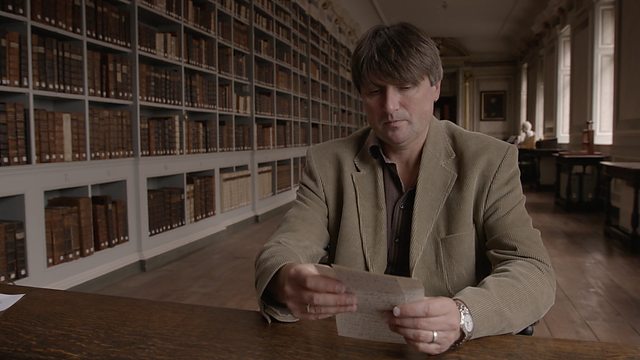
We are absolutely delighted to congratulate Simon Armitage on his appointment as Poet Laureate. Many of us Hay Writers have long admired his written work (heaving book shelves with signed copies are a testament to this), we also pay tribute to his approach to championing poetry too. A popular, well respected poet, his down-to-earth manner coupled with a breath taking ability to see and write on the endless wonder of the seemingly everyday will surely find an even greater appeal over the coming years.

Winners of the 2019 Hay Writers Poetry Competition

poetry comp winner typewritter

Congratulations to all the entrants to this years Poetry Competition. Our thanks also to our esteemed judge, Paul Henry  remarking that he enjoyed reading the poems which displayed both a keen eye and a keen ear.

(All the winning poems, along with a selection of short stories will be performed at our FREE event 233 at Hay Festival 2019 – Wednesday 29th May, 5.30pm in the Cube – for more information please go to our EVENTS page.

The results and judge’s comments are as follows:

Joint-first:  ‘Apple Moon’  by Emma van Woerkom  &  ‘Red Coat’ by Ange Grunsell

Second:      ‘Private Earthquake’ by Jean O’Donoghue

Third:         ‘Afternoon’ by Helen Wright

“Most works concerned themselves with natural landscapes and were tenderly observed. Some were reminiscent of the Imagist School which was at the forefront of Modernist poetry in the last century.

This Imagist influence was especially evident in ‘Apple Moon’, perhaps the most self-assured of all the poems here. Controlled, vivid, spare and perfectly paced, it reminds us of the enduring modernity of that movement. (Double-spacing of lines in a poem suggests a stanza-break, the convention being to single-space verse-lines. However, I read the poem’s form to be two, distinct stanzas).

The very different ‘Red Coat’ finds the universal in the personal. The detail of love and loss, especially in the prosaic first stanza, is striking and brought back to a lyrical base by the second verse’s refrain. The phrasing of the penultimate stanza is the poem’s only weakness and is forgiven by the startling closing line. ‘Red Coat’ wears its matter-of-fact stoicism lightly but the grief its first person conveys is heavy and resonant.

‘Private Earthquake’ was similarly striking, in the energy and pace of its anguish. It took risks, both in its metaphor and its diction. Stanzas two and three were particularly strong. I was less convinced by the broadcaster’s intrusion which felt forced, though it did inform the poem’s narrative. Really enjoyed this poem.

‘Afternoon’ was tonally even and sensual, its subject-matter closely observed. It was the purest poem of the thirteen, capturing a moment in time, in the tradition of lyric poetry. That “only he” (the third-person chaffinch in stanza 3) could see “the hawk hunting the hedgerows” I found less persuasive; but I could hear and smell and see the poem’s heady scene.

Other poems I recall liking were ‘How the land lies’, ‘Bridge’ and ‘Sunrise Vietnam Sea’. I may well have chosen differently, and from others not mentioned here, at a different time. Competitions come and go. Poems last. There is only the poem.”

                                                                                                 Paul Henry – April, 2019

Posted in Uncategorized | Tagged , , , , , , , , , , , , , , , , , , , , , , , , , , , , , , , , | Leave a comment

Going Batty by Kerry Hodges

Going Batty

by Kerry Hodges

For the past two springs, I have been host to a battery.

“What are you talking about?”

I rightly hear you ask.

“Finally lost your slippery grip?”

Well, no actually, not for the moment anyway . . .

I’m talking about a nursery for baby bats, ergo, a battery. Get it?!

On a warm spring day in 2016, I went to dry some laundry in my airing cupboard and noticed little black droppings.

‘John,’ I said, ‘Time to dig out the poison, we have mice again.’

(Not that I like killing mice, poor little blighters but they do multiply with frightening speed). So John did the necessary. Climbed into the loft and put down pots of poison.

However, I kept finding the oval shaped guano in the airing cupboard and now a mildly offensive pong developed too. Mystified, I asked John to check the loft for corpses. He found no dead mice and the poison remained untouched.

One afternoon as I was removing some pillowcases, I saw movement and jumped back fearing a marauding pack of angry mice trying to get their own back on our attempt to destroy them. Cautiously I moved some sheets to find increasing piles of faecal matter. More movement. Peering nervously, I spied the reddish brown fur of a little bat, stuck, or so it seemed, to the wall by the hot water tank.

I quietly replaced the sheets and retreated to my computer where I typed ‘bats’ into Google and learnt some intriguing facts.

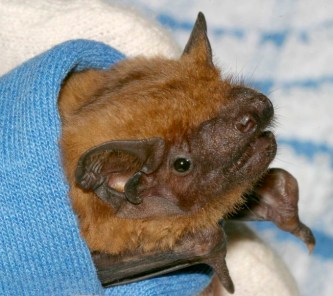
pipistrelle bat 1

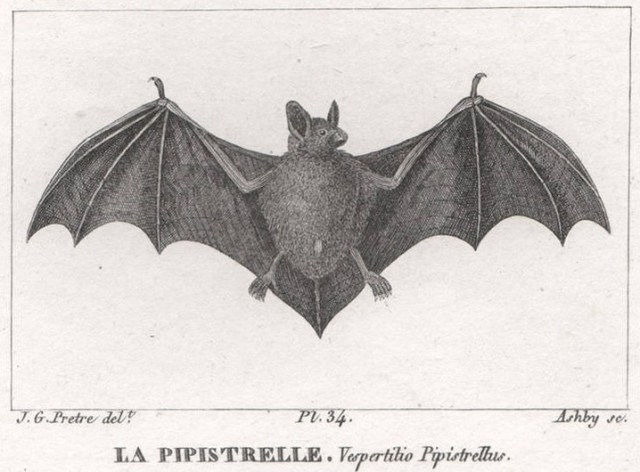
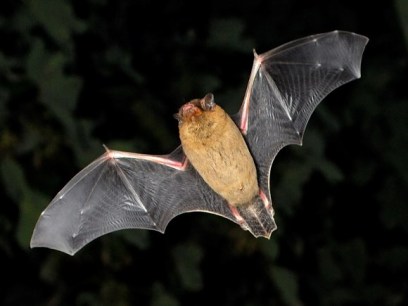
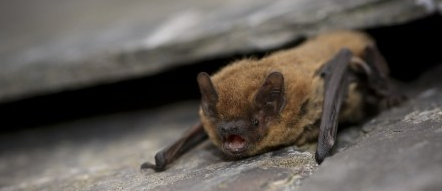
The species we have living under our roof is the pipistrelle (such a beautiful word), and it is Britain’s most common bat. They are typically three to five centimetres long (head and body) and their wingspan is between nineteen and 25 centimetres. They weigh between three and nine grams.

It is mid-June when I make my astonishing discovery and learn that this is the month baby pipistrelles or pups, are born. The gestation period is roughly six weeks and the females usually give birth to just one pup. They are tiny, hairless and blind during the first week of their lives. Warmth is crucial during this time; the warmer they are, the quicker they’ll grow. (No wonder my airing cupboard is a favoured spot. Clever creatures). At three weeks old, the pups are weaned and ready to fly independently.

I have frequently watched bats flying at dusk. They whizz, hurtle, scud, dart, swoop and flash. One moment ahead of me and the next behind. They are difficult to keep track of and impossible to count.

What amazes me about these creatures is that they use echolocation to track their prey. This they do by contracting their larynx; effectively using their voice as a boomerang.

PIPISTRELLE BAT 2

They may eat their body weight in gnats in a night.

When I learn this I wish we had many more airing cupboards housing endless numbers of pups so there might be fewer gnats around.  Gnats are at their terrible worst in June where I live and the bats seem to make little headway getting rid of them. The gnats still nibble my flesh, enjoying a feast with scary regularity. It can be no coincidence that this is the time of year when pups are venturing out for the first time.

What came first, the bat or the gnat?

Later that evening, I am sitting at my desk, trying to get into the writing zone when I hear a little scratching noise from one of the bedrooms. I ignore it and continue with my work. But I hear it again. It sounds desperate and I can no longer concentrate. I enter my daughter’s room (she is now living in Bristol) and find the source of the scratching. In the big metal bin I see the tiniest pipistrelle, scrabbling in vain at the deep sides, trying to escape. I can’t help but smile as I gently lift it out, carry it carefully to the airing cupboard and place it on a folded sheet hoping it’ll walk back to its nursery friends.

I try not to peek at the precious babies too often. It is tempting as they are totally enthralling. I feel honoured they have chosen to live with us.

One evening, quite late and again I am trying to write; I hear high pitched twittering and assume the bats are outside enjoying their freedom. It’s only when nature calls I find more nature in my bathroom. There is one bat hanging off the shower head, one sitting in the sink and another having a go at swimming in the loo. It appears to be drowning but it might be waving. I gingerly scoop the sodden creature out with a child’s plastic beaker (funny what you find on your shelves) and place it on a towel to dry.

I leave them to it, shutting the door to go and find another loo.

pipistrelle-bat-3.jpg
The following morning I return and see the shower and the sink bats have left the scene but the one at the pool party is lying on the towel, still wet and half dead. I gather its little body and cradle it to my chest as I hunt for the hair drier. Switching it to its quietest level, I let the warm air wash over the bat, hoping the sound won’t scare it to death. Once dry, I tuck it inside the airing cupboard and just hope.


It’s not there when I return some hours later.

There are many stories of our batty home that summer. Bats hiding in the curtains, waiting to fly out causing me to spill my tea as I try not to scream.

Bats dive bombing me as I sip a glass of Merlot. I can hear them laughing.

Bats floating lifeless in the dog’s bucket of water, like dead leaves.

One day, as I was looking for a teapot in my old Rayburn, now used for storage, I chanced upon the perfect body of a bat. The abiding memory is that of the fingers on its miniature hands. They were delicate as though painted with a fine brush, covered with a diaphanous glaze.

It’s June once again and they’re back. The familiar slightly earthy, somewhat disagreeable odour hovers on the staircase and I know that come the middle of July, I will have to empty the airing cupboard and wash every last sheet, duvet cover and towel.

That’s okay, I don’t mind. I’m thrilled the pups are there growing with each day that passes. I know they’ll be out there, on my side in the battle against the gnats within the month.

Reward enough I’d say.

pipistrelle 4

Posted in Uncategorized | Tagged , , , , , , , , , , , , , , , , , | Leave a comment

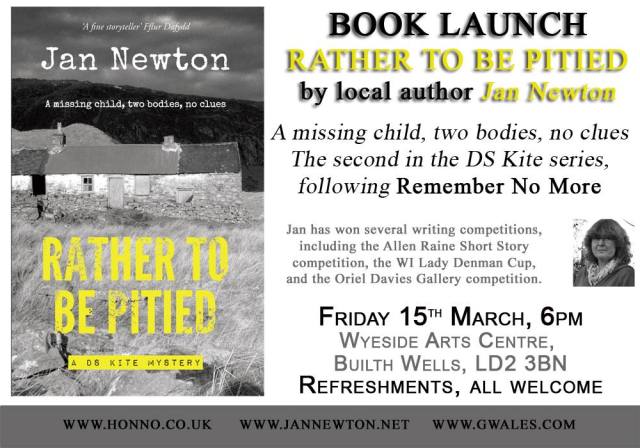
LAUNCH OF ‘RATHER TO BE PITIED’ by Jan Newton


LAUNCH OF ‘RATHER TO BE PITIED’, THE SECOND DS KITE MYSTERY

Article by Jan Newton, Photography by Merv Newton.

Two years ago, the publication by Honno of my first novel, ‘Remember No More’, was an absolutely amazing experience. From seeing the book with its beautiful cover for the very first time, to its unforgettable launch in Builth Wells, was a massive whirl of emotions.  There was apprehension – would people come to the launch, and then would they like the book? There was amazement that so many people did come, and gratitude for a fanfare from the brass band I play in, for surprise cake and wonderful flowers, and that people laughed in all the right places at what I had to say at my first engagement as an author.

In the weeks and months that followed, I was completely bowled over by the fantastic response. People from all over the UK and beyond, took the trouble to write reviews or send e-mails and letters to tell me how much they enjoyed it, and that they hoped I would write the second book in the series soon. I was invited to talk to groups and at library events, and the local people where the book is based, have been incredibly and generously supportive.

This year, two years more or less to the day, ‘Rather To Be Pitied’, the second DS Kite Mystery was to be launched. Would it be different this time? Would I be more confident, more blasé about the whole process? Well, no. I was just as nervous. Would people come to a second launch? Would they like the second book as much as the first?

The Wyeside Arts Centre did us proud for a second time. Amazingly, the band turned out for another fanfare. There were more flowers, wonderful cake – and even gin – and a huge turnout.  Three lovely ladies from Honno’s Committee came over from Aberystwyth to help us celebrate. There was an unexpected and amazingly kind introduction from Jane Aaron, the Chair of the committee, and an equally memorable introduction from Chris Kinsey, poet, nature writer, friend and brilliant creative writing tutor. All that was left was for me to read. I was less nervous than the first time – the book barely shook at all, and the audience was just as welcoming as they had been two years ago. It was, if anything, even more special, knowing that many of the people in the audience were those who had been such supportive fans of ‘Remember No More’.

‘Rather To Be Pitied’ has been out there for three weeks now, and the reviews have started to come in. It’s no less nerve racking, waiting to know what readers think, but I’m finally beginning to breathe a sigh of relief. I’ve had so many excellent responses, and requests to write the third book in the series. When someone says they didn’t want your book to end – that surely has to be the best feeling in the world…


Both of Jan’s books can be purchased direct through her publisher Honno Press where her Rather to be Pitied is currently the ‘Featured Title’ in their catalogue. (Don’t forget, the best way to support authors and publishers is by buying direct from the publisher.)

Remember No More and Rather to be Pitied are also available online at Amazon and in all good bookshops.

Rather to be Pitied is April 2019 Powys Libraries Recommended Read of the Month and the above article appears  in the News section of Crime Cymru – the Welsh Crime Writing Collective.

Posted in Uncategorized | Tagged , , , , , , , , , , , , , , , , , , , , , , , , , , | Leave a comment

Short Fiction – “Picky-up Thingy”

Picky-up Thingy by Alan Oberman

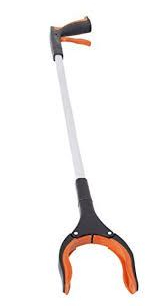
grabberGranny’s got this picky-up thingy. It’s black and silver and when you squeeze a handle at one end, two fingers come together at the other end. Granny can’t bend down because her knees hurt so she uses the picky-up thingy instead. We’re waiting for dinner when I see the picky-up thingy lying there shouting out, ‘Someone use me, someone use me.’ I first try picking up Ellie’s shoe. Oh that’s dead easy. Then a sheet of paper, and that’s more difficult. Then, even harder, a slippery crayon. This requires a lot of concentration, but I persist and I do it, lifting it high over the dinner table when it slips out of the picky-up thingy and lands in Ava’s glass of water. I’m now an expert ace at using the picky-up thingy.
Granny and Daddy are serving dinner. Because I’m vegetarian I’m having fish fingers with cabbage, which is OK except for the cabbage which I hate but Mummy says I’ve got to eat it because it’s good for you. Why is it that things that are good for you are yukkey while things that are bad for you are yummey?

Mummy is breast-feeding Baby. I call her Baby because Mummy and Daddy still aren’t certain about her name. They think it’s going to be Oonagh but might change their minds. Ava is being goody-goody-yuk-yuk. Grandad has told us it’s polite to wait until everybody has been served before stuffing your mouth. Ava is hungry but being a goody-goody-yuk-yuk sits and looks longingly at the food. Ellie’s sitting at the baby table. She’s already eating, the polite rule doesn’t apply to her so she’s goody-goody-yuk-yuk too. Nobody is paying any attention TO ME!

Ava asks for some tomato ketchup and Granny gives the bottle to me to give to her and I put it on the floor and pick it up with the picky-up thingy and lift it high over the table where it falls straight on top of Ava’s head. Nana says, ‘Deidre, please put that down and sit properly at the table.’ Well I do but don’t put down the picky-up thingy, I keep fiddling with it under the table. Grandad says, ‘Deidre, Nana has just asked you to put it down.’

Then something comes over me that I cannot explain and I WON’T put down the picky-up thingy. And Grandad says, in his “look out there’s trouble coming” voice, ‘Deidre, PUT IT DOWN!’ And now everybody is paying attention to me. I look at Grandad. He takes my plate away and says, ‘No food until you put it down.’ and Daddy sighs and says, ‘Oh come on now Deidre’ and he takes the picky-up thingy away from me. And this is horrible, horrible, horrible and I’m crying and I run upstairs to a bedroom.

Then Daddy comes up with my plate of food, ‘Would you like to eat it up here?’ ‘Yes,’ I say, ‘but I don’t want the cabbage.’ And Daddy dries my eyes and says, ‘That’s all right.’ And I say, ‘Can you bring up the ketchup?’

ketchup heart

Posted in Uncategorized | Tagged , , , , , , , , , , , , , | 1 Comment

Book Launch – The second in the DS Kite series from Honno Press.

jan newton book launch book 2

Congratulations to Hay Writers’ Circle member, Jan Newton on the forth coming launch of her crime novel, Rather To Be Pitied; the second book in the DS Kite series published by Honno Press.

jan newton book launch book 2bNewly promoted DS Julie Kite has been in sleepy mid-Wales for mere months when she’s faced with her second murder case. A man’s body has been found by school kids trekking the Monk’s Trod.

The trail takes her back north to her parents in Manchester and to a housing estate in Blackpool. It’s not a simple case – a young mother has disappeared, but so has her son and her next door neighbour’s wife. And the husband of the landlady of the B&B where the girl was staying. When Julie encounters an ex-serviceman farmhand with PTSD the case gets more complex still.

From the author of Remember No More, the first DS Kite novel:

… the calculated but believable plot with its parallel threads will keep you guessing right to the end.” John Cleal, Crime Review 

A rare treat from a fine storyteller. Elegantly written, meticulously paced” Fflur Dafydd, author of The Library Suicides

If you want to get ahead of the story before the book launch, here’s book 1.

remember-no-mmore

Title – Remember No More
Published – 2017 by Honno Welsh Womens Press
Paperback – 302 pages  ISBN – 978-1909983564  Price – £8.99 paperback – £2.78 kindle
Order – Via Amazon – CLICK HERE

DS Julie Kite’s husband’s new job takes her away from urban Manchester to a new life in tranquil mid-Wales. On her first day, Julie is thrust unexpectedly into the centre of a murder investigation in a remote farming community. At the same time, Stephen Collins is set free from HMP Strangeways. He immediately makes his way back to mid-Wales, the scene of his heinous crime, in order to confront those who had a hand in his incarceration. The twists and turns of the investigation into the death of a solicitor force DS Kite to confront her own demons alongside those of her community.

Posted in Uncategorized | Tagged , , , , , , , , , , , , , , , , , | Leave a comment

Celebrating 40 Years of Writing Together.


Hay Writers Circle logo 40 YEARS

The Hay Writers’ Circle celebrates forty years of writing together.

In 1979 our founder, Frances Copping, had moved to Hay from Wimbledon and wanted to find a writers’ group. Failing to do so she decided to start one herself and the Hay and District Writers’ Circle was formed. For forty years our group has gathered twice a month to challenge themselves with exercises and to share their writing. We have published magazines and pamphlets, organised competitions and performed our work at recitals, Christmas pageants and at the Hay Festival. This year we are proud to celebrate our fortieth anniversary with our Founder and President still an active member of our group.

cake and booksThe group enjoys writing in many forms. We practice our hand at poetry, fiction and non-fiction, and encourage writing for many reasons; to exercise an opinion, to amuse, to challenge, and to keep our minds and our pens sharp. Some of us aim for publication, and achieve it, some of us strive for competition success, and achieve it, and some of us write for the joy of writing and sharing it, with friends, over cake.

Our original meetings on Tuesday afternoons are now complemented by a Work in Progress sub-group that meets on Sundays, and with two workshops a year, Fiction in October and Poetry in February, both of which are open to non-members. We encourage interested prospective members to join us as Guests for a few sessions to get a feel for the group.

To commemorate our anniversary we are hosting a display in the new Hay Library this summer and will be running a competition to find a new writer to add their voice to our own. Every month we shall be sharing on our website what writing means to us, and what being part of a writing group adds to our experience.

write-on-image.jpg

Posted in Uncategorized | Tagged , , , , , , , , , , , , , , , , , , , , , , , , , | Leave a comment

Paul Henry To Judge 2019 Poetry Competition

The Hay Writers’ Circle 2019 Poetry Competition –
Judge Announced 

We are delighted to confirm that the poet Paul Henry will be our judge for the 2019 Poetry Competition.

Paul Henry, By Zed Nelson
Paul Henry
 is the author of nine books of verse. Originally a songwriter, he has performed his poems and songs at literary and music festivals in Europe, Asia and the USA. A popular Creative Writing tutor, he’s presented arts programmes for BBC Radio Wales, Radio 3 and Radio 4.

The Glass Aisle

Published by Seren in the early Spring

“This haunting, elegiac collection, about music, and made of music, leaves a reader’s mind full of phrases, in both senses – verbal, and tonal – and exactitudes that catch the heart and lodge in the memory” Gillian Clarke

www.serenbooks.com/productdisplay/glass-aisle

Boy Running

Shortlisted for ‘Wales Book of the Year 2016’ 

“Henry is working at the core of lyric poetry, with love and loss and the ‘deeper river’. The Poetry Review 

www.serenbooks.com/productdisplay/boy-running

The Brittle Sea

“Henry’s poems are often expressionistic, even symbolist … with formal skill and time and space-bending panache to boot. The new, previously unpublished poems… represent the best work of a lyric poet who deserves a wider readership.” The TLS

www.serenbooks.com/author/paul-henry

***STOP PRESS***

The Deadline for The Hay Writers’ Circle Poetry Competition 2019 is Tuesday 19th March.  Results will be announced in April.

The Poetry competition is sponsored by The Hay Writers’ Circle with prizes for first, second and third places.

Entry Requirements:

  1. Each poem should be a maximum of forty lines.
  2. Print your entry in Arial Font 12, double spaced.
  3. Put your title at the beginning of the entry.
  4. Number your pages and secure them together firmly.
  5. Your name must NOT appear on your entry.
  6. Each entry requires a booking form.
  7. Put your name, title and contact details on the booking form only.
  8. Each applicant may submit up to four poems.

Email and paper entries are accepted, email is preferred. Please attach your entry as a word doc to the email, not in the body of the email itself.

The results are final, and correspondence will not be entered into over the results. All applicants shall be informed of the results.

The winning pieces shall be published on our website with the author’s permission. Publication may prevent eligibility for future competitions. All rights remain with the author.

If paying by BACS payment please make sure your payment is received, with your name on the reference, before the 19th March. Cheques will be accepted on the 19th March but must clear to validate the entry.

Download your entry form here –  Poetry 2019 Competition booking form

Good Luck!

pens image

Posted in Uncategorized | Tagged , , , , , , , , , , , , , , , , , | Leave a comment

“Some years’ ago, a friend told me this rather strange tale…” by Ann Riviere

Long time Hay Writers’ Circle member, Ann Riviere pens an illusive short story for January 2019. 

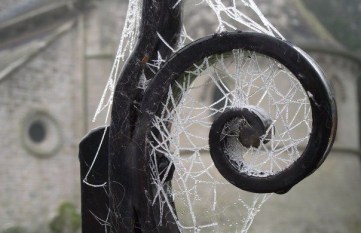
cobweb on hay church gate

Some years’ ago, a friend told me this rather strange tale.   She told me it was true, but I wonder?

“It was a bitterly cold morning, frost lay on the bare branches of the trees which lined the lane to the church.   It had fallen to her to prepare the monthly services but the one that started at 8.15am was the most arduous, particularly in the winter.    Owing to the frail state of the church’s electrical wiring, the six wall heaters had to be turned on one by one with an interval of several minutes in between.   This was the only way that would make it bearable for the small congregation who would, hopefully be stoic enough to attend the service so early in the morning.   The same timing had to be applied to the lights.

Thus it was, that day, as my friend approached the church, about 7.30, she noticed a bicycle propped up against the lych-gate.   She thought it odd as the only house further up the lane whose occupants she knew, would have had no need to leave a bicycle there.

She pushed open the heavy door – the church was never locked – and felt for the first of the switches, the light casting shadows over the interior.   At the same moment a head appeared  from about half way down the aisle.   She nearly jumped out of her skin.  Through the gloom a body rose up.    She managed to blurt out:
“Who are you, what do you think you are doing?”
A man’s voice answered:
“I’m so sorry, I didn’t mean to frighten you, I just needed somewhere to sleep for the night.   It’s so cold outside.”

She switched on two more of the lights, praying they wouldn’t overload the system, plunging them both in to total darkness.    Once she could see him more clearly, she realised he was not a tramp, in fact he was quite well-dressed, clean and with rather a beautiful smile.   He spoke with a soft, well-educated voice.
“That must be your bike at the gate?”
He nodded.   My friend suggested he might like to stay for the service and remain afterwards, if he wished.

Having recovered from her initial fright and realising he meant her no harm, she began to feel rather sorry for him.   What could have happened to have brought him to the state of having to ‘squat’ for the night.   He seemed to her that he was in need of a good meal and offered to bring him some food and a hot drink once she was free.   He refused, saying he would find some breakfast later.  She would liked to have talked with him,  perhaps found out something about himself but she had things to attend to.

She left him and went in to the Vestry to turn on the heaters and collect the items for the Communion.   By the time she had everything she needed and went out to the Chancel to prepare the altar, he was gone.    He had taken such belongings as he had, leaving behind only an unfamiliar smell which my friend thought must be a drug, of sorts.

She said she had thought about him sometimes and hoped he had managed to get his life back together.

Some months passed and while reading her newspaper, she noticed a piece about an elderly couple who had been brutally murdered in a village somewhere in the North.   It seemed their son had been arrested and was being held in custody.   When the case opened, the Court Artist’s illustration of the suspect looked uncannily like the man she had found that day in the church.   Yet it couldn’t have been him.

The drawing was of a scruffy looking individual, unshaven, gaunt with staring eyes.    She made a point of watching for the time when the case would be reported in full and when there would be a ”mug” shot. There was no doubt about it and the date when the killing had taken place was the day after my friend had found him asleep in the church.

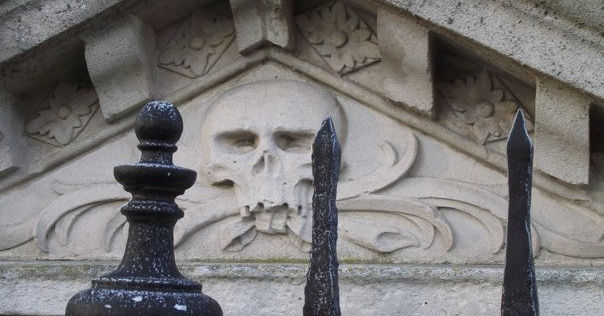
skull grave london

Posted in Uncategorized | Tagged , , , , , , , , , , , , , , , , , , , , | Leave a comment