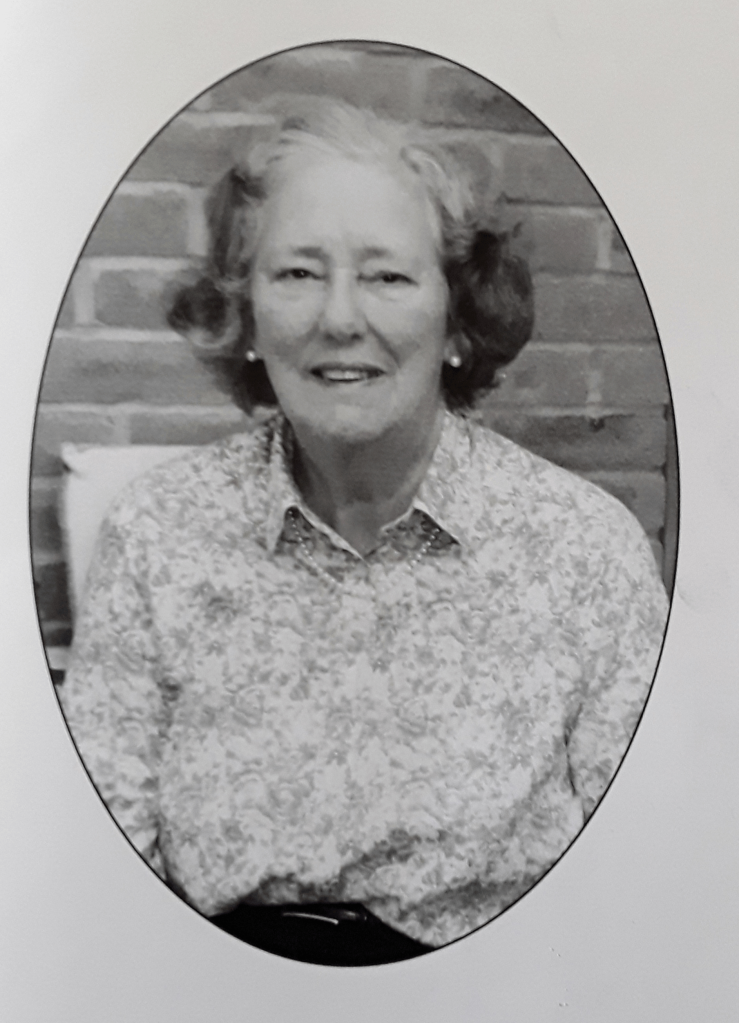
We are excited to announce the results of our Frances Copping Memorial Prize for Fiction Competition, named in fond remembrance of our Lifetime President who sadly passed away in 2020.
This popular competition again received a good number of entries from both inside and outside Hay Writers’ Circle and we very much welcome external interest in all our writing competitions.
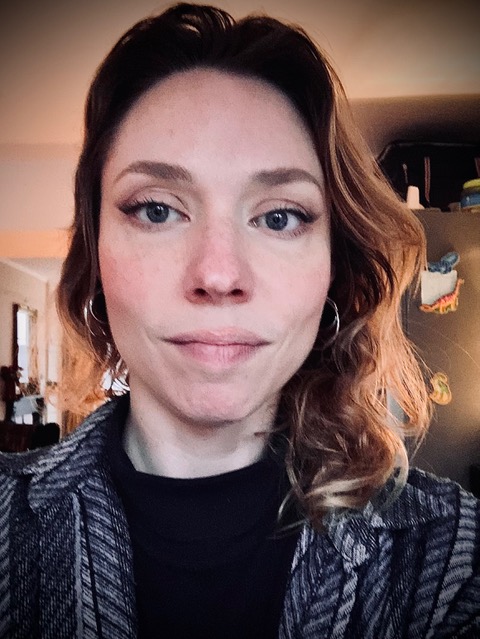
This year we were delighted to welcome Holly Müller as our judge.
Holly Müller is a writer and musician living in the Bannau Brycheiniog. Her short stories are published in Rarebit (Parthian Books, 2013) and New Welsh Fiction (Seren Books, 2015). Her debut novel My Own Dear Brother (Bloomsbury, 2016) was Waterstones’ Book of the Month and garnered positive reviews in the Guardian, Independent, Sunday Times, etc. Holly has performed at Cheltenham, Hay, Laugharne and Cardiff Literature Festivals. She taught creative writing at USW and ran Ty Newydd Writing Centre courses with Kate Hamer, as well as workshops at schools and festivals, before having a family.
We humbly acknowledge Holly for all her efforts in judging the entries of this competition, and extend our sincere gratitude for the accompanying notes. Thank you Holly.
Without further delay, here are the Results and Holly’s comments!
3rd place – Cully’s Collar
A story from a dog’s perspective, which succeeds in capturing the world of the family black lab on Christmas Eve, including an adventure to see off some poachers. What I liked about ‘Cully’s Collar’ was its focus on the dog’s world view, which led to some interesting ways of seeing and magical descriptions, for instance of the night sky: “tiny dots of silver lights high above and the huge pale plate hanging above the black mass of the wood”. A charming story, it lacks some clarity in the mid-section around the main drama and action. There is some great humour to be had from the perplexed commentary provided by the dog, watching the family doing all manner of bemusing things in preparation for Christmas. In anxiety about missing his evening walk, the dog decides: “I will lie on the kitchen floor and get in the way to remind them that I mustn’t be forgotten.” I feel the writer does a good job of keeping the dog’s own priorities firmly in view.
2nd place – The New Walk
‘The New Walk’ is an unusual, vivid and impressionistic story with playful and inventive use of language. I enjoyed the refreshing effect of defamiliarization, the sense that the storyteller is a watcher, looking at ordinary sights, sounds and happenings through a different lens: “I pass streamers of children, weaving and floating, blown from straight paths” and “the syncopated ‘pop’pop’pop’ of the mobiles sounded like a distant rifle range”. Very little happens in the story, we go to a museum, hear an underwhelming musical quartet performance, and overhear a conversation about a strange ‘phenomenon’ that causes an indentation to appear in the horizon, but it is intriguing regardless. I feel the story needs a dash more clarity of character and purpose, but it’s a strength that it leads me to wonder, Is the narrator character OK? I enjoyed the obscurity of the final lines, the sense of restlessness: “It was beginning to be apparent that the day was not a day at all but merely the shadow of the day before. I reached the bottom of the New Walk. Eyes intent on the horizon I searched for an indentation.”
1st place – The Interim
A spare and elegant dystopian future story, ‘The Interim’ offers an intriguing and unsettling vision of a future world in which individuals live in institutions, being extracted from, medicated, ‘shielded’ from too much knowledge, while farming the land inside an environmentally controlled dome. The story is full of sadness, pertinent indeed regarding the destruction of Earth’s natural beauties and systems. Claustrophobia crushes the spirit of the protagonist – free will no longer exists. The story raises more questions than it answers (is the old woman at the end her mother or a clone of herself?), which is a strength in my opinion. Reminiscent of Ishiguro’s Never Let Me Go, it explores the human need for connection and the terrifying potential impact of the climate emergency.
Many congratulations to the following :
1st Place: ‘The Interim’ by Amanda Ingram
2nd Place: ‘The New Walk’ by Catherine Smedley
3rd Place: ‘Cully’s Collar’ By Hilary Alcock

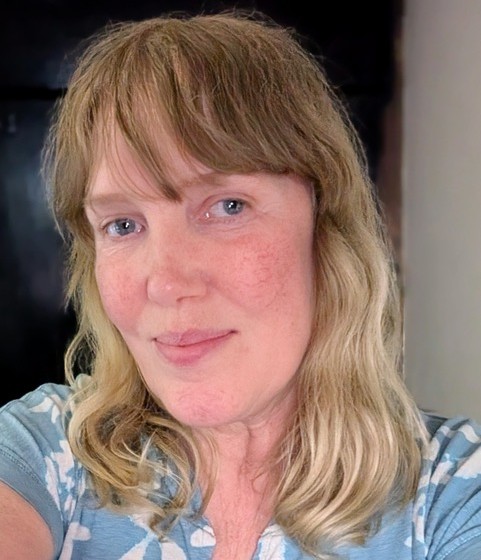
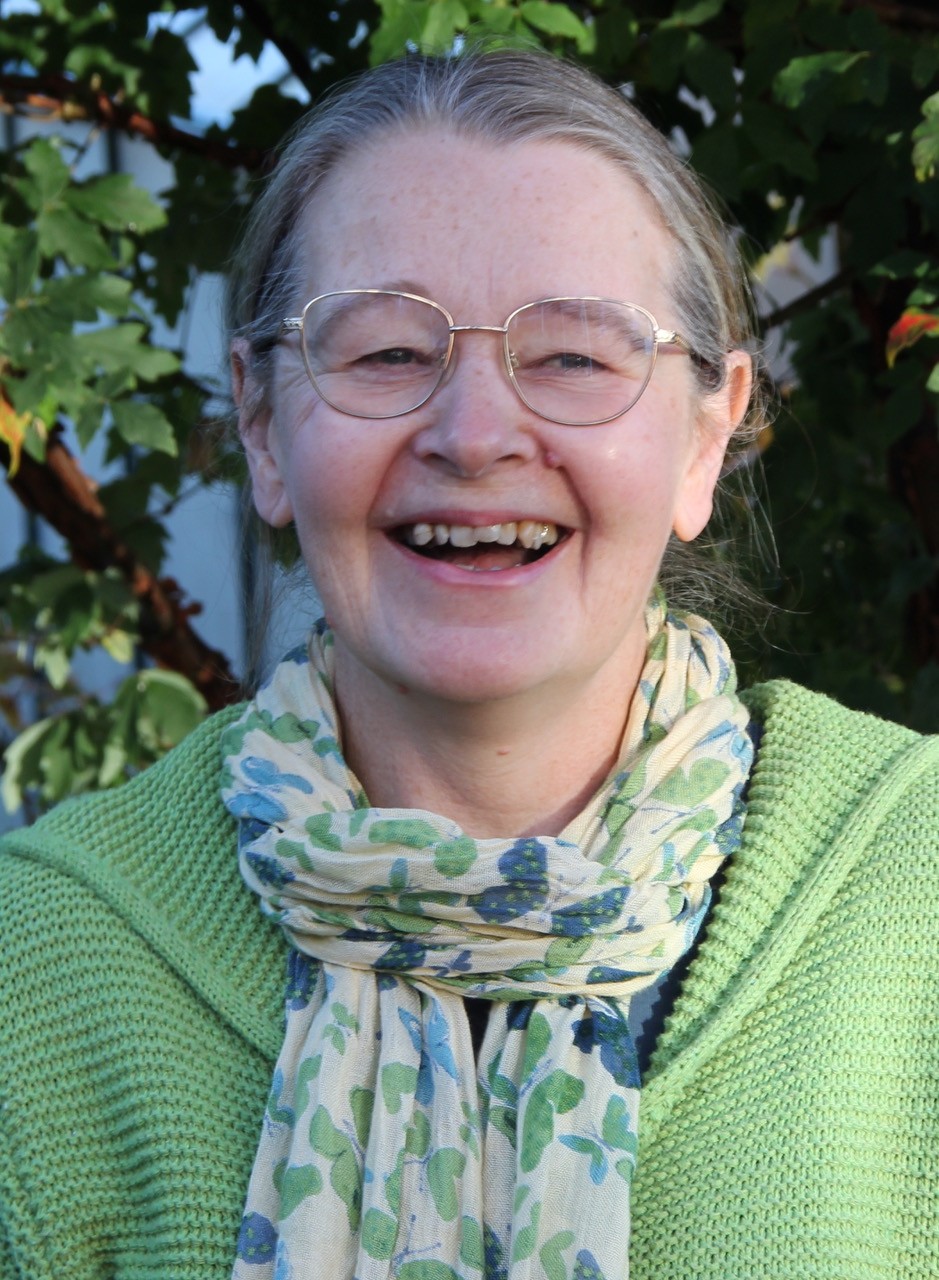
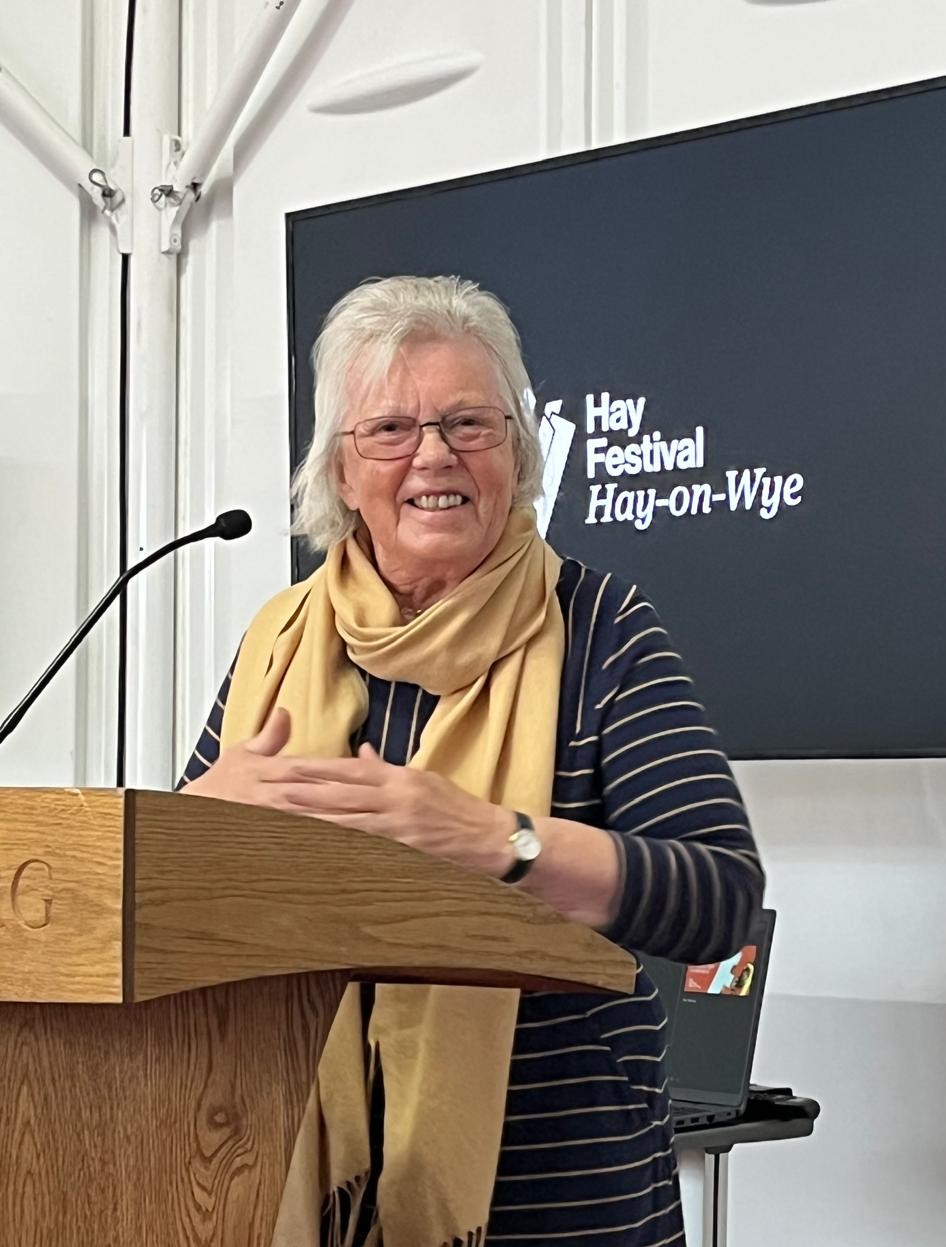
Many congratulations to all the prize winners, and to everyone who entered too. Well done!
Here is the winning entry by Amanda Ingram.
The interim
The day begins with the 6 a.m. alarm, followed by the buzzer, indicating that the
door to my room is now unlocked. I take a cold shower, which is beneficial for circulation
and is known to promote wellbeing. Once dressed I practice yoga before heading to the
communal dining area for breakfast.
Music plays at mealtimes, but talking is discouraged among residents. I swap
smiles with a girl opposite, who is about my age. She glances toward the white coats
and touches the pale flesh on the inside of her elbow, where a purple bruise blooms,
indicating that they came to her room last night and extracted blood. Blood taking is a
regular part of our routine, among other procedures.
Each day, we are weighed, and our food measured to ensure a stable body mass
index of twenty-one. “You need to be healthy,” the white coat says placing a scoop of
fermented mush in my bowl, next to vitamin supplements, green juice, and a carb
biscuit. The added enhancer does little to improve the eating experience.
After breakfast, there are enrichment activities. My favourite is working in the
garden in the heart of the complex. I love tending to the vegetables, fruit and flowers
that grow there. Orlo, the gardener, says that nature is more beautiful than anything
man ever created on earth. When I ask him about “earth,” he tells me about four-hundred-
year-old Great Oaks, delicate spider webs that sparkled like jewels in the sunshine, or
honeybees. He describes how they flew between plants and flowers, pollinating them.
I listen to his calming voice but cannot imagine the world he describes.
“Of course, crop pollination is carried out by drones now,” he sighs, “the ones hardy
enough to survive that is, or genetically modified to self-pollinate.” He shakes his head.
“How times have changed.” If I ask more questions, he finds me a job in the furthest
corner of the garden.
White coats come and go through stark white walls. I have begun studying the
entrance points, and when nobody is watching, I trace my fingertips across the surface,
feeling for hairline cracks that may indicate an opening. There is no way to the outside
world for us, but I know it exists because I listen to the white coats talking to each other
when they think I am not paying attention. I have become adept at gathering snippets of
information to roll around in my mind while I lie in bed each night, staring into the
darkness, waiting to disengage.
I ask one of the kinder white coats about going outside whenever I get the chance.
“Outside is too dangerous for you,” she tells me. “Your immunity is too low.”
The next time I ask about going out, I can see my words irritate even the kindest
white coat, and I watch as she whispers something to her colleague. And I do not know
if I am imagining it, but Orlo seems to be avoiding me and barely tells me stories
anymore. I feel like something is very wrong, and this feeling is growing stronger,
altering the beat of my heart. When the assistant checks my readings and observations,
I notice her frowning.
A white coat and an assistant enter my room before the alarm sounds and
instruct me to take oral medication. I ask why. They look at each other, ‘Hold out your
arm!’ demands the assistant.
The injection is given with unusual force, making me wince. Within seconds, I feel my
anxiety dissipating, and everything around me starts to fade away.
When I wake, I feel strange and do not know where I am. My throat is dry, and
my head hurts so much that I do not notice the pain in my back and side. Feeling for the
source of a dull ache, my fingers brush against a dressing.
I wait on the trolley, the smell of cleaning fluids irritating my nose, until an
assistant brings me boiled bone broth. “An added bonus,” she grins before instructing
me to finish it and rest.
The next day, I stay in bed feeling exhausted and weak, like the solitary
snowdrop that grows in the garden compost bin and makes Orlo smile every day.
However, the white coats force me to get up and take short walks so that I can “get
better quickly.”
I shuffle up and down the corridor, but my mind is full of darkness. I think about what it
would be like, not to be anymore. When the white coats ask how I am feeling, I smile
and tell them I am feeling fine. I no longer ask about going outside. When the scar
heals, I am returned to my room and think about the girl across the dining room table
and how I have missed her.
The girl is not at breakfast, or the evening restoration, and I do not see her in any
of the enrichment activities over the next few days. I press my lips tight to stop myself
from asking after her, but her absence leaves a void I want to fall into.
I shadow Orlo, in the garden, longing calming stories of old, but he has lost his
voice and with it all the wonderful words. In silence he prunes fruit trees while I rake the
black soil beneath my feet until it is as fine as sand, ready to plant spinach and kale and
other hardy plants. He seems unable to even look in my direction. So much has
changed. I gaze through the transparent roof at the vast yellow sky above and wonder
how far it stretches.
How I wish I could fly away like one of the butterflies, beetles, or birds he has told
me about. I implore him with a stare so intensely he cannot ignore it, but he just turns
away, looks down at the ground, and continues his work. That is when I feel the
moisture pool in the corner of my eye and trickle slowly down my face and drip off my
chin. It lands on the fine soil, leaving a tiny crater there.
I am meditating in my room when two white coats enter. They do not look at me
as they check my heart rate and blood pressure, before ordering me to have a hot
shower, and dress in a crisp gown. Despite the feeling of dread I ask, “am I having
another?” procedure not really expecting an answer.
“It’s your time,” says the younger one before his colleague shoots him a look that
renders him silent. Letting the hot water scald my skin, I imagine dissolving and
disappearing into the drain.
On the metal trolley, I squeeze my eyes tight, feeling like something inside me is
tearing at my chest to escape. I practice my breathing and cross my arms over my
chest, trying to quiet the thud of my heart and steady my hands. I picture the garden
and Orlo’s lined, kind face. Somewhere near there are whispered voices and the whir of
machinery. When I feel a firm grip on my arm, the pressure of the strap, I open my eyes
just before the needle pierces the flesh. “Just a sharp scratch,” the white coat says,
attaching the cannula.
The bright light stings my eyes for a moment. Above me hovers something that
resembles the microscope I use to study cells of decaying matter from the garden, only
much larger. Only when I twist my head to look around do I notice that there is someone
else.
The female lying there is an elder. Her eyes are bright but are full of sadness. Her
short silver-white hair gleams in the harsh light and her body wasted away I do not
recall seeing her before, but there is something vaguely familiar in the shape of her
face, the curve of her lips—that slightly protruding mole above her right brow. I lift my
hand and let my fingertips seek out the small, familiar bump beneath my own fringe.
She opens her mouth as if to speak but then seems devoid of words and closes it again.
Her skin is so pale it is as if she contains no blood. She reaches a wizened hand
towards me just as the pump releases icy liquid into my veins. The woman tries to
smile, but I see liquid forming in the corner of her eye. It runs down her cheek, leaving a
silver trail on her delicate skin, drips off her jaw and lands on the table where it leaves a
tiny pool.

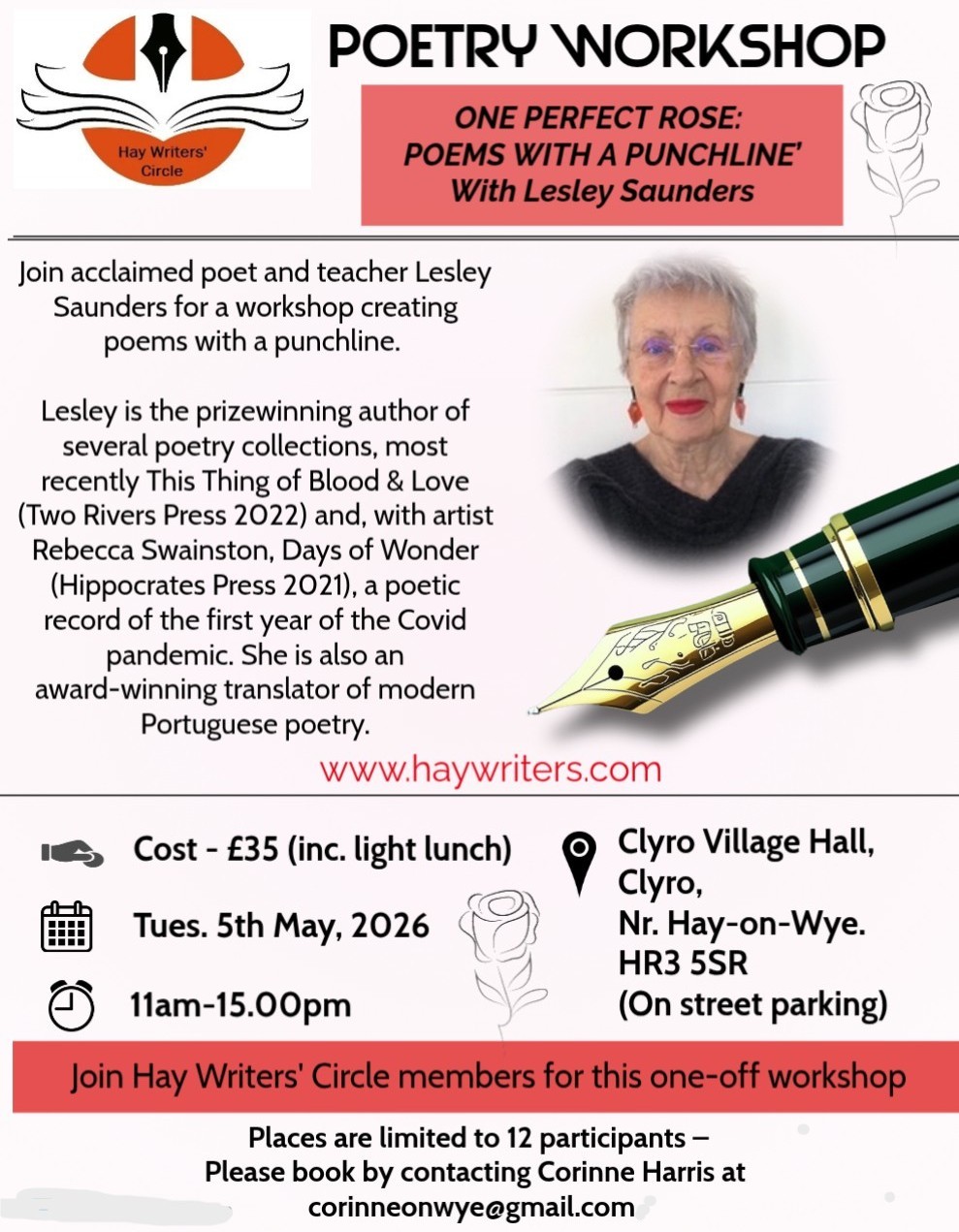
– New Poetry Workshop with Lesley Saunders Announced –
Please book your place via email to HWC Chair, Corinne Harris on : corinneonwye@gmail.com
– More HWC Competitions –
Don’t forget we are currently counting down to our Poetry Competition, deadline on Tuesday 7th April 2026, so there is still time to get your entry in.
All competition details are listed on our COMPETITIONS page.
In the mean time, keep on writing!
To keep up to date with all our competition and workshop news etc., why not subscribe with your email address in the box below.

 THE HAY WRITERS