
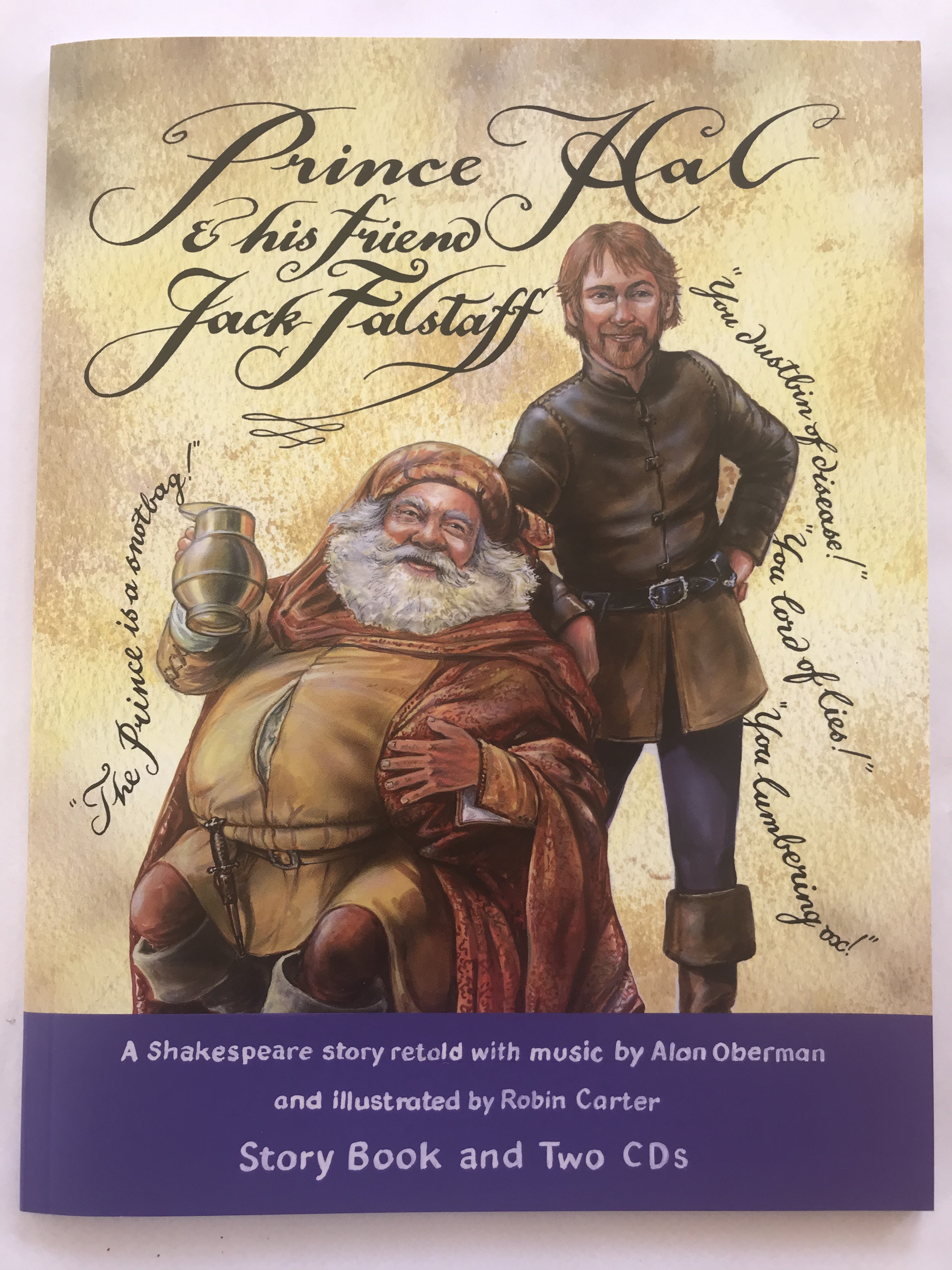
Hay Writers’ Circle Alumni, Alan Oberman, has enjoyed much success with his fine children’s Shakespearean adaptation, Prince Hal and his friend Falstaff. Aimed at Key Stage 3 pupils, this illustrated book is a superb gateway to Shakespeare for younger readers, and the publication comes with 2 CD’s of narration and music. “A real treat“, wrote Sir Richard Eyre.
The book can be purchased direct from Alan – please email : alan.oberman@gmail.com
(Copies are freely available from some library authorities too, please ask at your local public library.)
Not one to sit on his laurels, Alan has recently re-written for children Pyramus and Thisby. A short play to be enjoyed in drama classes, or enacted at home for fun. Some of the more difficult language has been cut and some lines skilfully rewritten by Alan in iambic pentameter.
Alan has kindly published the play below for everyone to enjoy. Thank you Alan.
Pyramus and Thisby
A Play for the Young
Duke Theseus of Athens is marrying the Princess Hippolyta. As part of the celebrations, there are singers and dancers performing to entertain the couple. A group of five workmen decide they would like to offer a play to entertain the Duke and his bride. They decide on the sad story of Pyramus and Thisby. Shakespeare has written a play called A Midsummer Night’s Dream, where the workmen rehearse the play and then perform it at the court. It’s a play inside a play.
In our Act One, the five workmen will be rehearsing the play, and in Act Two, performing the play to the Duke and his Court.
The story of Pyramus and Thisby
Pyramus and Tisby were two young people who lived next door to each other. They fell in love, but their parents wouldn’t allow them to marry or even be together. There was a small hole in the wall that separated their houses, and the two lovers secretly talked to each other through this hole. They decided they must marry, and the only way they could do that was to run away. Pyramus said, ‘Let’s meet at the tomb of King Ninus.’
Thisby put a veil over her head to hide her face and was the first to arrive at the tomb. As she waited for Pyramus, a lion came walking towards her. The lion had just killed a deer and had blood around its mouth. Thisby saw the lion and ran away as fast as she could. As she ran, her veil fell away from her head. The lion played with the veil, streaking it with blood.
Pyramus arrived at the tomb looking for Thisby. The lion had gone, but Pyramus saw the torn, bloodstained veil on the ground. He thought Thisby must have been killed and dragged away. Pyramus loved Thisby so much that he didn’t want to live without her. He pulled out his sword and stabbed himself, falling to the ground and dying. Thisby came back to the tomb and saw Pyramus. She, too, didn’t want to live without him, so she took his sword and, like Pyramus, she also killed herself.
The five workmen
Peter Quince, a Carpenter, directs the play.
Nick Bottom, a weaver (making cloth), plays the bold knight Pyramus.
Tom Snout, a tinker (selling saucepans), plays the wall with a hole in it where the two lovers talk to each other.
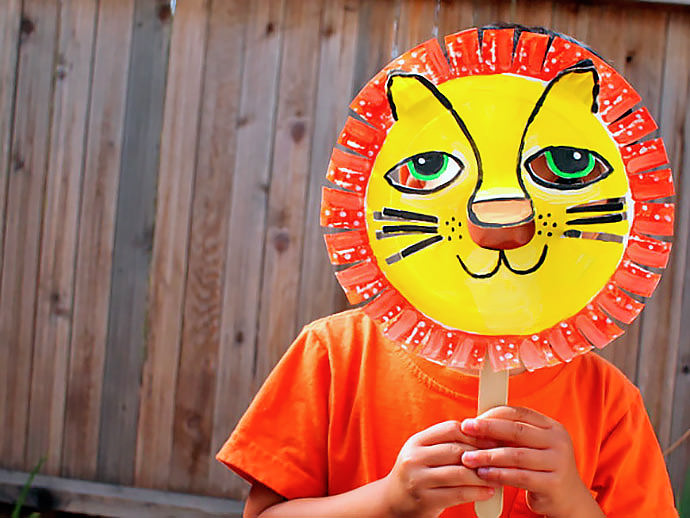
Snug, a joiner (making furniture), plays the lion.
Francis Flute, the bellows-mender, plays the young woman, Thisby, acted in Shakespeare’s day by a young man. Fun to be played by a dad.
The cast might like to paint posters, make programmes and sell tickets.
A wardrobe mistress, makeup artist and stage manager, music and lighting person might be useful.
It’s a tall order to ask the cast to memorise lines so, if needs be, read the parts.
The text of the play below is an adaptation of Shakespeare’s play, attempting to retain as much as possible of the original.
Peter Quince’s final words are taken from Puck’s final speech.
Most performances of Shakespeare’s comedies end with a dance.
THE PLAY
Act One takes place in Peter Quince’s house.
Saws and pieces of wood. Music – Mendelssohn?
Actors behind a screen
Peter Quince comes on first, carrying a file with parts to distribute, then the others one by one, chatting quietly to each other. Let the audience see your face but don’t look at the audience, as you must pretend they’re not there.
All go quiet looking at Peter Quince
PETER QUINCE
Is all our company here?
NICK BOTTOM
Best to call them, generally, man by man
PETER QUINCE (looks at Nick Bottom with a frown)
Here are the names chosen to be in our play
to be performed for the Duke and Duchess on their wedding day at night.
NICK BOTTOM
First Peter Quince say what the play treats on, then read the names of the actors.
PETER QUINCE (glares at Nick Bottom)
Marry, our play is The Most Lamentable Comedy, and Most Cruel Death of Pyramus and Thisbe.
NICK BOTTOM
And a very good play it is, and a merry. Now Peter Quince call out the names of the actors. Masters spread yourselves.
PETER QUINCE
Answer as I call you. Nick Bottom, the weaver.
NICK BOTTOM
Ready. Tell me what part I am and proceed.
PETER QUINCE
You, Nick Bottom, will play Pyramus.
NICK BOTTOM
What is Pyramus? A lover or a tyrant?
PETER QUINCE
A lover that kills himself for love.
NICK BOTTOM
I’d prefer to be a tyrant.
PETER QUINCE (ignoring Nick Bottom’s last remark)
Francis Flute, the bellows mender.
FRANCIS FLUTE
Here, Peter Quince.
PETER QUINCE
Flute, you take the part of Thisby.
FRANCIS FLUTE
What is Thisby? A might knight?
PETER QUINCE
It is the lady that Pyramus loves.
FRANCIS FLUTE
Please, let me not play a woman: I have a beard coming.
PETER QUINCE
You can play it in a mask and speak with a high voice.
NICK BOTTOM
If I can hide my face, let me play Thisby too. I’ll speak with a squeaky voice. ‘Ah Pyramus my dear lover.’
PETER QUINCE
No, no, you must play Pyramus; and Flute, you Thisby.
NICK BOTTOM
Alright, proceed.
PETER QUINCE
Snout, the tinker?
SNOUT
Here Peter Quince
PETER QUINCE
You will play the part of the wall that stands between the two lovers.
Snug, the joiner, you will play the part of the lion. And that’s everybody now.
SNUG
Have you got the lion’s part written down? If so, can I have it now because I’m slow to learn my part.
PETER QUINCE
You can do it how you like because it’s nothing but roaring.
NICK BOTTOM
Let me play the lion too. I will roar so they will love to hear me. And the Duke will say, ‘Let him roar again – let him roar again!’
PETER QUINCE
And you’ll do it terribly, frightening the Duchess and all the ladies.
NICK BOTTOM
I will aggravate my voice so that I will roar you as gently as any sucking dove: I will roar you like a nightingale.
PETER QUINCE
You can play no part but Pyramus: for Pyramus is a sweet-faced man; a most lovely gentleman-like man. So you must play Pyramus. Masters here are your parts, and I entreat you, request you and desire you to learn them by tomorrow night.
(The actors – except Peter Quince – go into a huddle, murmuring together)
NICK BOTTOM
Dear Peter Quince, please know there is no way
To learn our lines before the wedding day.
PETER QUINCE (ponders – then reluctantly)
So, if you cannot learn the words by heart,
Then take your lines on stage and read your part.
ACT 2
In the palace of Duke Theseus
The Duke and Duchess, together with the Court, make up the audience. You are performing to them, so look at them. The audience can ad lib comments about the acting.
PETER QUINCE
Gentles, for your delight, we act our play
Pyramus, and Thisby, who lived next door.
They hatched a secret plan to run away
And meet at Ninus Tomb. But now, no more
Because our first actor I now will call.
(Snout, Wall, doesn’t come – so repeat)
Because our first actor I now will call.
SNOUT (Wall)
I Snout by name present a wall
And my fingers make this hole you see
Through which the lovers whisper secretly.
DUKE
This is the best speaking wall I’ve ever heard.
DUCHESS
It’s such a very small wall, it hardly needs a chink at all.
NICK BOTTOM (Pyramus) (comes on)
We shall meet in the night when day is not
(looking around but can’t see Thisby)
I fear my Thisby’s promise is forgot
And thou O wall O sweet and lovely wall
That stands between her father’s ground and mine
Thou wall, O wall, O sweet and lovely wall,
Show me thy chink to blink through with mine eyne.
(Snout lifts up fingers to make the hole)
Thanks lovely wall whom Jove will surely bless
But what see I? No Thisby do I see
O wicked wall, to stop my happiness
Cursed be thy stones for thus deceiving me.
DUKE
Since the wall can speak, she should answer him back.
NICK BOTTOM (Pyramus) (speaking to Duke)
No, no, you see “deceiving me” is Thisby’s cue to come on.
(Francis Flute comes on)
FRANCIS FLUTE (Thisby)
O wall, full often hast thou heard my moans
For parting my fair Pyramus and me
My cherry lips have often kissed thy stones
Thy stones with lime and hair knit up in thee.
NICK BOTTOM (Pyramus)
I see a voice: now will I to the chink
To spy an I can hear my Thisby’s face.
Thisby?
FRANCIS FLUTE (Thisby)
My love! Thou art my love, I think.
NICK BOTTOM (Pyramus)
It is indeed your love who’s in this place.
O kiss me through the hole of this vile wall.
FRANCIS FLUTE (Thisby)
I kiss the wall’s hole, not your lips at all.
NICK BOTTOM (Pyramus)
Will thou at Ninny’s tomb meet me straightway?
FRANCIS FLUTE (Thisby)
‘Tide life, ‘tide death, I come without delay.
(Exit Nick Bottom (Pyramus) and Francis Flute (Thisby))
SNOUT (Wall)
I wall, having completed my part now
Have nothing more to do but take a bow.
(Exit Snout, (Wall))
DUCHESS
This is the silliest stuff that ever I heard.
(Enter Snug (Lion))
SNUG (Lion)
(Comes on with the lion mask, but takes it off to make this speech)
You ladies who are frightened and have fear
Of even the smallest mouse on the floor
May now perhaps both shake and tremble here
When lion rough in wildest rage doth roar
Then know that I am Snug the joiner here
Pretending to be lion so have no fear.
(Snug (Lion) puts the lion mask on again)
DUKE
This is a very gentle beast, a very caring lion.
(Enter Francis Flute (Thisby))
FRANCIS FLUTE (Thisby)
This is old Ninny’s tomb. Where is my love?
(Snug (Lion) roars. Francis Flute (Thisby) drops her veil and runs off. Snug (Lion) tears at the veil, leaving it red with blood, then leaves)
DUCHESS
Well roared lion
DUKE
Well run Thisby
(Enter Nick Bottom (Pyramus))
NICK BOTTOM (Pyramus)
Oh moon, now blazing, beaming, brilliant bright,
I thank thee moon for making all so clear
And with your gracious glittering golden light
Now guiding me to find my Thisby here.
All quiet in this empty place
But what’s this? A piece of lace.
Eyes do you see
How can it be?
Thisby’s veil she wore on her head
Torn and awfully bloody red
Does it mean my love is dead?
Oh no, no, no, Oh woe
What a blow!
It can’t be so.
DUKE
This passion would almost make one feel sad
NICK BOTTOM (Pyramus)
Why nature did you make a lion’s claws
To take my Thisby with it’s bloody jaws
Out sword, seek my heart
Pierce my breast like a dart
In the chest of Pyramus
Thus die I, Thus, thus, thus, thus.
(Nick Bottom (Pyramus) stabs himself)
Now I am dead
Now I am fled
My soul is in the sky
Now die, die, die, die, die.
DUKE
Who knows, with the help of a doctor, he might recover.
(Francis Flute (Thisby) comes on)
DUKE
Ah, here’s Thisby and with her passion comes the end of the play.
DUCHESS
I hope she doesn’t take as long about it as Pyramus.
(Francis Flute (Thisby) on seeing the dead Pyramus)
FRANCIS FLUTE (Thisby)
Asleep my love
What dead my dove
These lily lips
This cherry nose
These yellow cowslip cheeks
Are gone, are gone
Lovers make moan
His eyes were green as leeks
Tongue not a word
Come trusty sword
Come blade my breast imbrue
(Stabs herself)
And farewell friends
Thus Thisby ends
Adieu, adieu, adieu.
(Nick Bottom (Pyramus) and Francis Flute (Thisby) lie dead.)
DUKE
Oh dear, what a sad play.
DUCHESS
And this all upon our wedding day.
(Suddenly, Nick Bottom (Pyramus) gets up. Followed by Francis Flute (Thisby) more slowly)
NICK BOTTOM (Pyramus)
Gentles, don’t be so sad
You see we’re not really dead.
(Snug (Wall) and Snout (Lion) come on, followed by Peter Quince)
PETER QUINCE
If we shadows have offended,
Think but this and all is mended
That you have but slumbered here
While these visions did appear
And this weak and idle theme
No more yielding but a dream
And with your hands let us know
That you liked our little show
So Pyramus (Pyramus bows) Thisby (Thisby bows) Lion (Lion bows) and Wall (Wall bows)
Say goodnight unto you all.
ALL DANCE

Next Update – Details of our 2026 Poetry Competition.
If you want to read about all our up and coming news, events and competitions, don’t forget to subscribe with your email address in the box below

 THE HAY WRITERS