
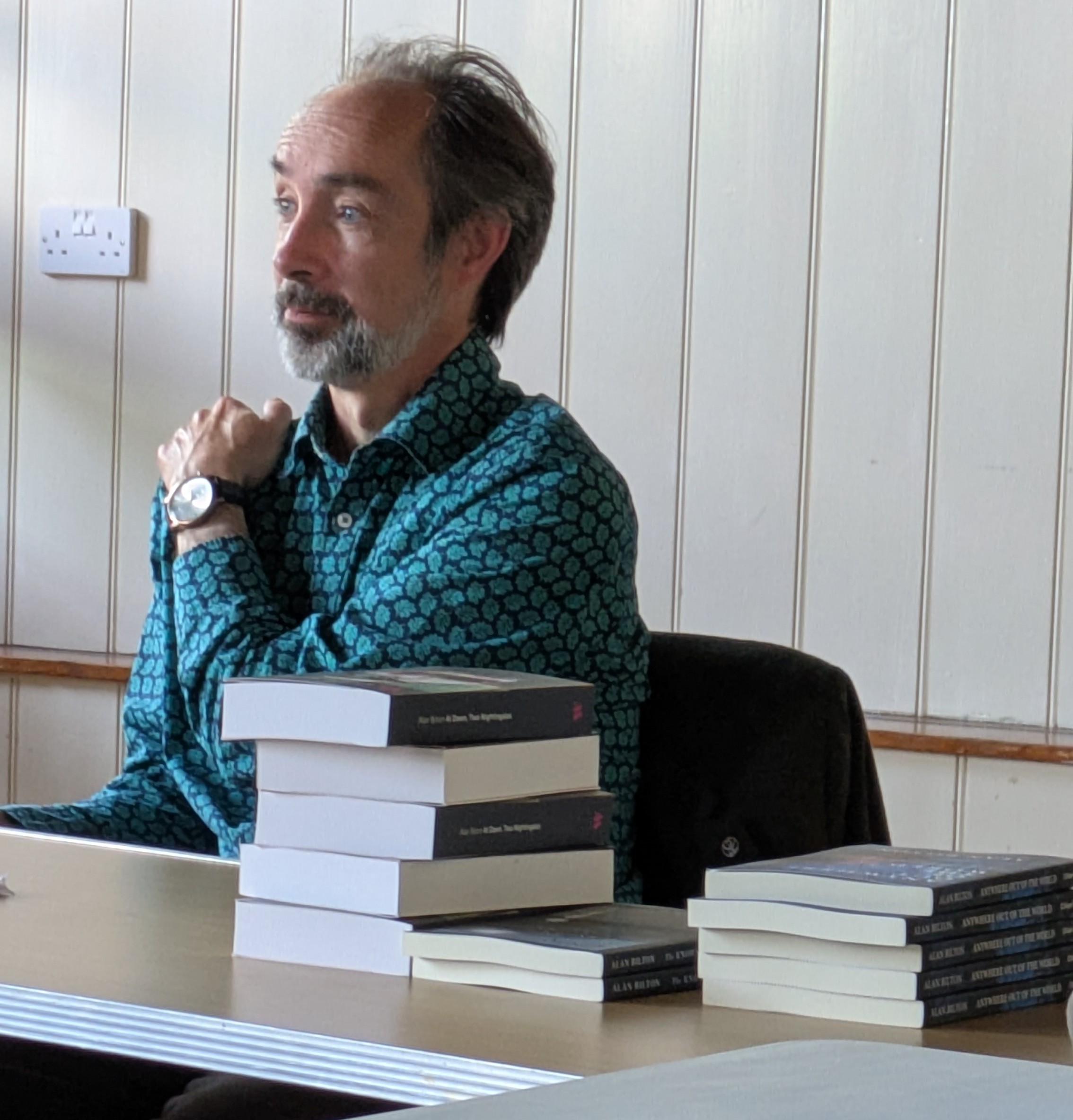

Breaking the rules of fiction – a workshop with Alan Bilton
Article written by HWC Chair, Corinne Harris.
Photos by Ange Grunsell
On Tuesday 17th June, fifteen of us met in Clyro Village Hall for this workshop. Alan started with a concise summary of the rules of fiction, and of the expectations readers have of work in a particular genre. He then, with a series of interactive exercises, encouraged us to break the rules he had just outlined.
We started with a realistic piece of writing and experimented with changing genres, time and place, and with introducing the author into the piece. The suggestions came rapidly and changing direction mid piece was challenging. When we came to share our work, the ingenuity displayed was impressive.
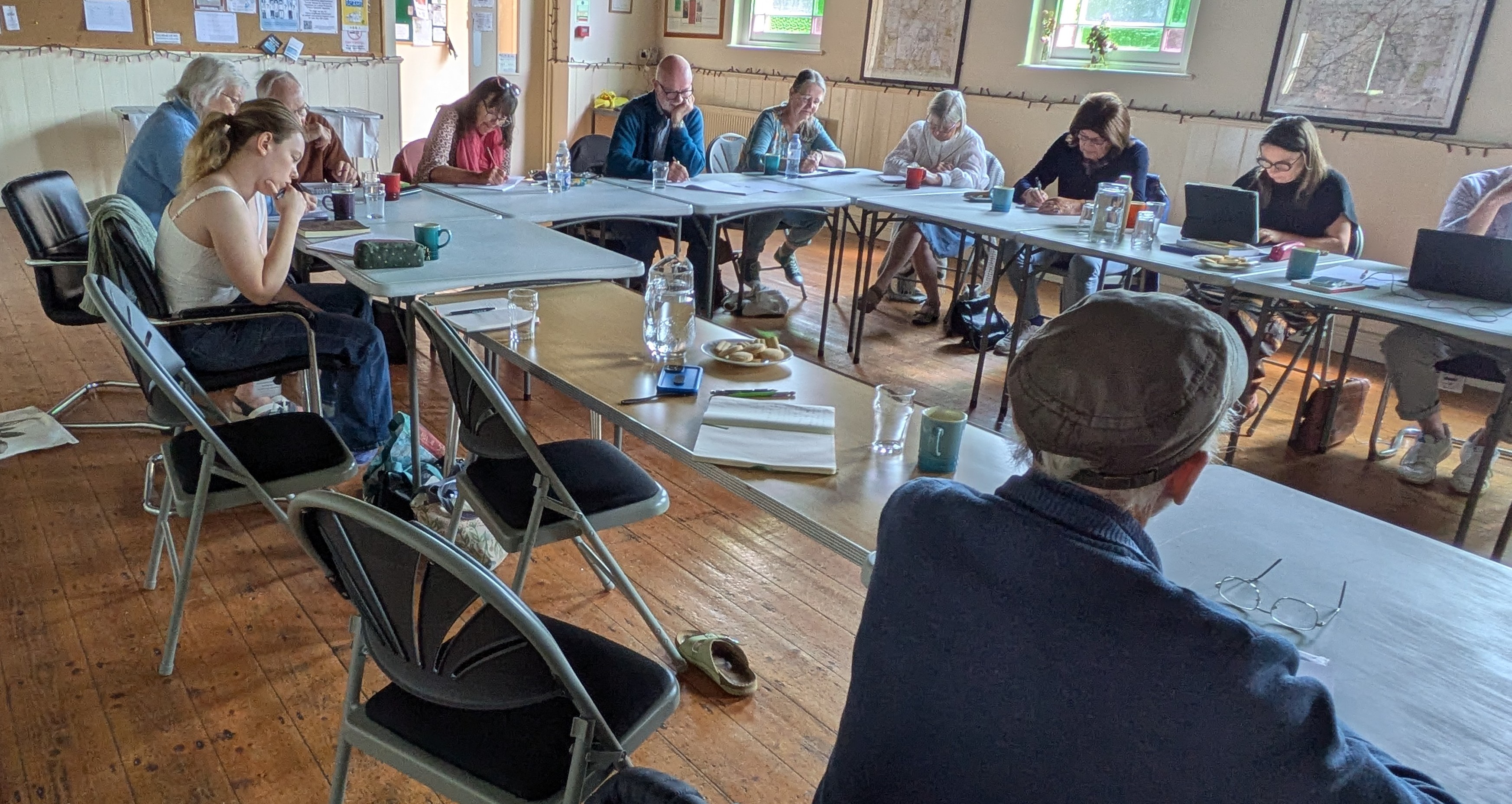
After lunch we worked in pairs. The exercise involved taking an anecdote our partner had told us and writing a story, initially following it quite closely. Alan then introduced a various interventions. Examples of these were: introducing a character unrelated to the story, shifting time, and finally shifting place. Again, it was fast-paced and we worked quite hard to integrate all the changes. We then shared with our partners. I was impressed by how my partner had managed to tie everything together so that it made sense. He was probably startled by the frivolity of mine but was too polite to say so. We concluded with a reflective piece on our day’s work, and we were given a free hand with which form this took.
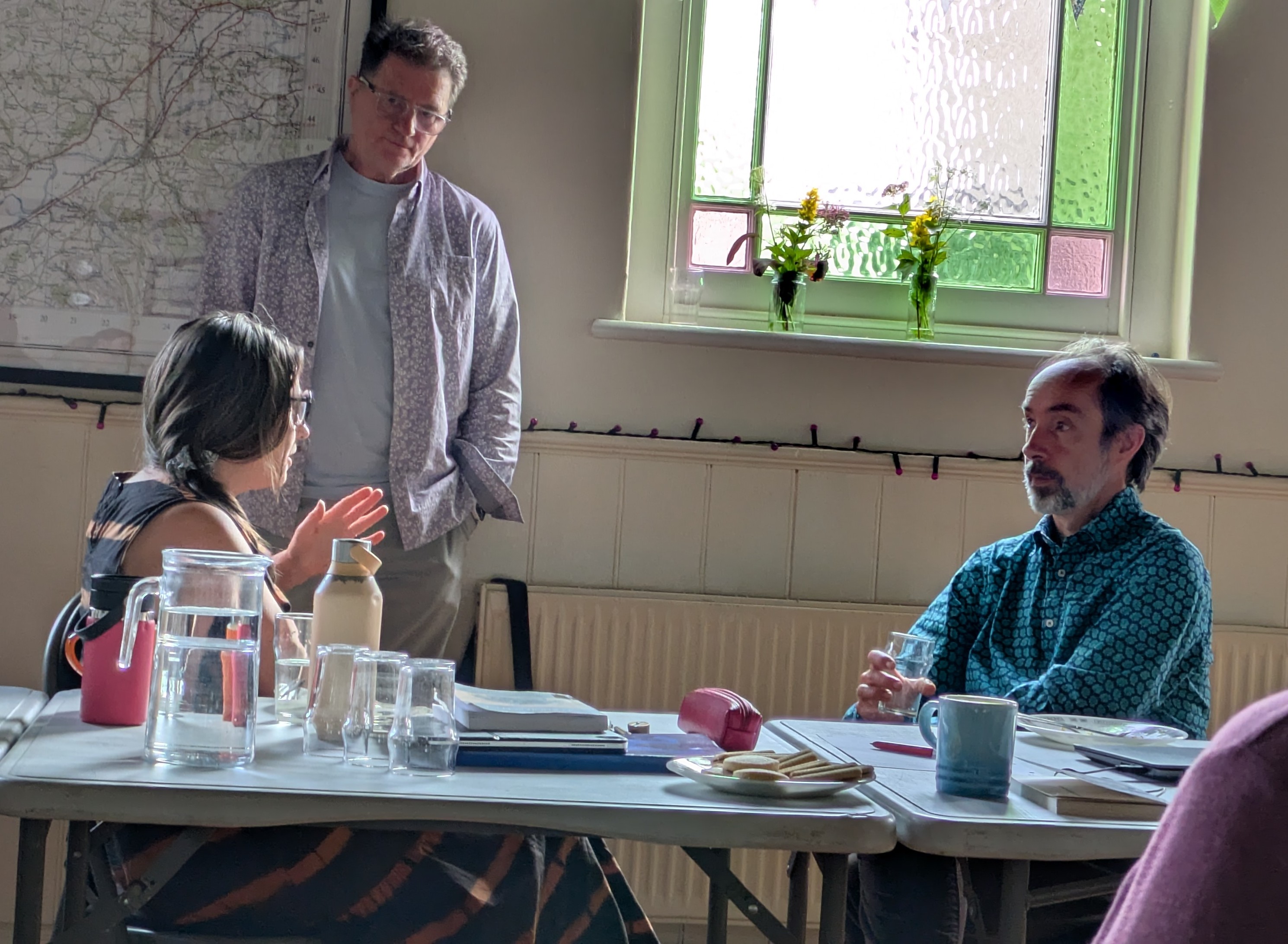
Mark Bayliss, (pictured above, centre) submitted his piece as an example of some of the work completed at the workshop. Each paragraph-brake indicates a change in direction.
In the 1970s, I was a fresh-faced, recently qualified solicitor in Cardiff, and I was going to my first day in court with my boss. I’d never been in a crown court before, and after a break, I came back into the courtroom – but I used a different door. I couldn’t see my boss, but the judge called us to order, so I took a seat immediately. Before the barristers could begin, the judge bellowed across the courtroom and pointed a finger at me – Who is that person? Who me? I thought to myself. It transpired that I had wandered in and sat directly next to the accused.
I forgot to mention that before I took my seat, an elegant woman, who I recall was oozing with far too much Chanel No. 5, approached me and gave me a note to pass to the man I was about to sit next to. “He might need this later,” she said, “don’t worry, it’s OK, but we mustn’t discuss it, court rules, etc, you know. So, mum’s the word.” I passed him the note. He beamed at me.
There’s something I forgot to tell you. My boss was the one who wandered off and told me which door to go back inside the courtroom, “It’ll be good for your development, different perspective on the proceedings,” he said. “I’ll be around, see you inside.” I’m convinced I saw him earlier in the day speaking with the same woman who handed me the note. I could be mistaken, of course.
Moments after the judge gave me his dressing down, there was a massive explosion. Alarms and water sprinklers came to life, and absolute pandemonium ensued. I coughed and spluttered, and made for the fire exit. My nose seemed to follow a distinctive smell. Perfume. As I came to my senses, I realised that the accused had vanished inside an ambulance driven by a woman wearing a paramedic outfit, but strangely for a paramedic, she oozed Chanel No.5.
Eighteen months later, when my court case came to trial, this was the story that my barrister presented to the jury.
This was a very thought-provoking workshop. It was also great fun. Alan is a genial and inclusive facilitator – he is always a Hay Writers’ favourite. The workshop was fully booked which was gratifying. Clyro Village Hall is a pleasant and well-equipped venue. Providing lunch was a new departure for us and proved to be popular.
We plan more workshops in the future. We are hoping to have a poetry workshop with Gareth Writer-Davies in August. All our workshops are advertised on our website and tickets are available through Eventbrite. We welcome people from outside our group and we hope this might inspire you to join us soon.

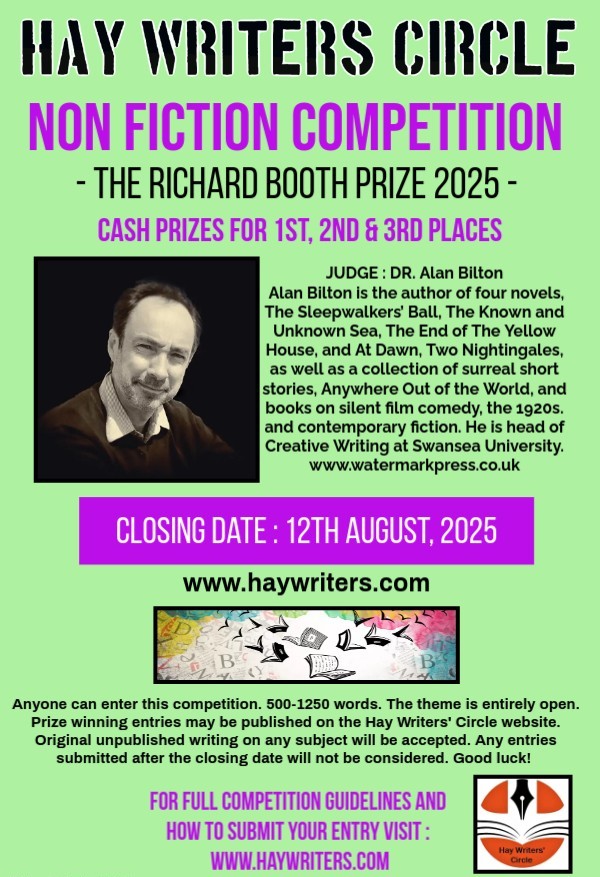
Non-Fiction Competition 2025 – The Richard Booth Prize
Here is a gentle reminder to all writers that we are now accepting entries into our non-fiction competition 2025. The closing date is 12th August, 2025, so there is still plenty of time to cast your eye over your notebook and edit that story.
This is an open competition meaning – ANYONE CAN ENTER
For full competition guidelines and to download your entry form please head over to our Competitions page – CLICK HERE
Want to keep up to date with all our news?
Don’t forget to subscribe with your email address in the box below.

 THE HAY WRITERS