
An interview with Alan Oberman – exclusive for Hay Writers’ Website

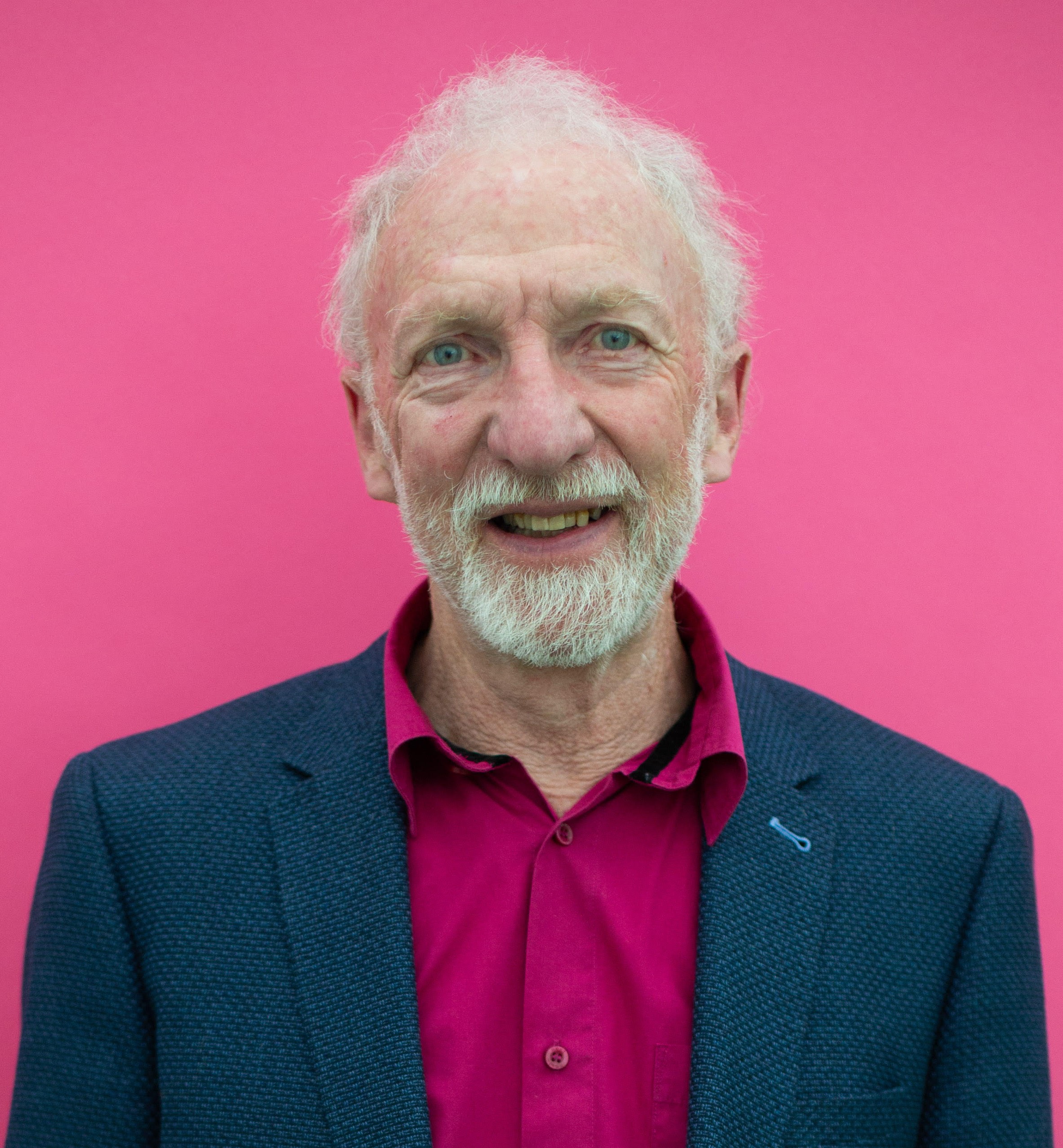
Alan is writing an account of British Prime Minister, Neville Chamberlain’s life between September 1938 and September 1939. In an exclusive for the Hay Writers’ Website, Alan Oberman is interviewed by himself on the progress of his book.
Oberman: Is your book a work of fiction or non-fiction?
Alan: There are over a hundred non-fiction history books examining Chamberlain’s actions in the year prior to the Second World War. Historians tend to join one of two contentious camps that can crudely be labelled by two questions: if Chamberlain had stood firm against Hitler in 1938 could the Second World War have been prevented? Alternatively, by appeasing Hitler and delaying the outbreak of war by a year, did Chamberlain ensure an allied victory?
I have no desire to jump into this historiographical bear pit. My intent is to bring to life the quandaries Chamberlain faced in his day-to-day decision-making. I imagine him living in Number Ten, I imagine his conversations with his wife, I imagine his dialogue with colleagues and adversaries. So, to the extent I’m surmising the words that might have been said, my writing is fiction. I endeavour, however, to keep as close as possible to the primary historical records.
Oberman: So are you writing him in the first person?
Alan: I did consider that, but I wanted the freedom to express his thoughts, and this is more easily achieved in the third person. The historian will tell you of a meeting between Chamberlain and Hitler. I do that, keeping as close to the historic record as possible, but then go beyond that, building on my understanding of Chamberlain, to imagine what he’s feeling at the receiving end of a Hitler tirade. I hope thereby to deepen the reader’s engagement.
Oberman: Chamberlain was elderly, white, traditionally-conservative with an unexceptional private life. Seemingly, a rather colourless politician. Not, one would think, an immediate choice for your protagonist.
Alan: I was led to Chamberlain indirectly. I was intrigued by how, in five months, British public opinion could swing round 180°. In September 1938, opinion was almost universally against becoming involved in another European war. By March 1939, the British people accepted that a stand had to be made even if it were to lead to war. My interest is the process by which that sea-change in opinion came about. Chamberlain was no populist politician, slavishly pandering to public opinion. To the contrary, he was rigid in the certainty of his opinions, but he too, in parallel with public opinion, was blown by the events of winter ’38 into a new direction for foreign policy. We can see the process of this change most clearly through his eyes.
It’s true his personality lacked the colour of, say, Winston Churchill, but the vision of a kindly, non-belligerent man battling with all his might to prevent a war which he believes would kill and maim millions, is, I think, compelling.
Oberman: If you tie yourself strictly to the biographical details of chamberlain’s life, are you not foregoing a narrative arc? You could end up with narrating one thing after another, saying this happened and then that happened, and so relinquishing a satisfying plot with its sense of beginning, middle and conclusion. Or, to ask the question in a different way, are you not tempted to bend, reshape the facts, to make for a more satisfying story?
Alan: When I first began writing this novel, I thought I had a built-in narrative arc – a person’s fall from the height of success to the deepest failure. In September 1938, Chamberlain was universally acclaimed as the man who had single-handedly saved the world from a devastating war. The declaration of war on the 3rd September 1939, proved to many that he had seemingly failed the pragmatic test. As the author of a policy that did lead to war, he was widely lambasted.
However, that was not how Chamberlain himself saw it. He believed, to the end of his life, that at each twist and turn of fate, he took the only sensible course available to him. To him, his story is not one of failure but tenacity – holding to his course of peace until there was no alternative but war. It’s the plot of many films – The Magnificent Seven to name but one – the farmers appeasing the bandits until there’s no other way but to pick up the gun. Aware of his increasingly belligerent detractors, Chamberlain believed that history would vindicate him. That to me is a satisfying narrative arc.
Oberman: And what is your conclusion? Do you vindicate him?
Alan: I do not wish to judge Chamberlain. I would rather the reader view the world through his eyes and come to their own conclusion. I will have succeeded if I divide my readers, some thinking him dangerously naive while others praising him for his wisdom and sound judgement.
Oberman: Does Chamberlain’s story have any relevance for us in today’s world? I’m particularly thinking of the war in Ukraine.
Alan: It would be most imprudent to attempt a forecast of the outcome of dealing with Putin based upon what happened in 1938/39, our world is so very different. But what is striking is the similarity in discourse today with that of 1938. How do you deal with a powerful aggressive dictator? Should we accept reality and make a deal with Putin to end a tragic war and save lives? Or will offering him territories of Eastern Ukraine serve to increase his appetite for further military adventures? This mirrors the dilemma faced by those in 1938 in how to deal with Hitler.
Oberman: I imagine writing such a novel as yours must involve a lot of research.
Alan: Research provides the materials from which to construct the novel, decorate it, and fill it with the furnishings of the period as well as peer into the minds of the people who inhabited it. Research is the pleasant downhill part of the writing journey before turning uphill to actually write the story. One is looking for the details of colour that historians leave out. Literally in my case. Historian Robert Self achieved remarkable success in publishing the hundreds of letters Chamberlain wrote to his sisters. He must have spent an excruciating number of hours transcribing Chamberlain’s illegible handwriting into print. However, Self left out what he called ephemera – family gossip of little interest to the historian. But it’s precisely this ephemera that’s important to me. So I spent a week in the Chamberlain Archive, housed in Birmingham University, examining Chamberlain’s letters to make notes of the bits that Self left out.
Oberman: And when do you think you will put the final full stop to your novel? Does it have a title?
Alan: It has taken me a year to move two weeks forward in Chamberlain’s year. Hopefully, my pace will speed up in this coming year.
As to the title, at the moment I’m toying with a choice of:
- Neville Chamberlain: striving for peace
- Neville and Anne Chamberlain: the year before war
- Neville Chamberlain: dear God let there not be another war.
- Chamberlain – Facing Hitler
Oberman: Thank you so much for this interview and best wishes for the completion of your novel.
Alan: Thank you. It’s been a pleasure.

Program: Hay Writers Live! at Hay Festival 2025
It’s full steam ahead for rehearsals for our Hay Writers Live! event at Hay Festival 2025. As we continue to hone our performance, we are delighted to release the full program of readers and pieces. All are new works enjoying their first public airing. We will be showcasing a variety of pieces including competition winners, novel extracts, poetry, short stories and more!
We are extremely grateful to Hay Festival for their enormous support of writers.
Thank you.
**At time of posting – tickets are limited with just a handful remaining.**
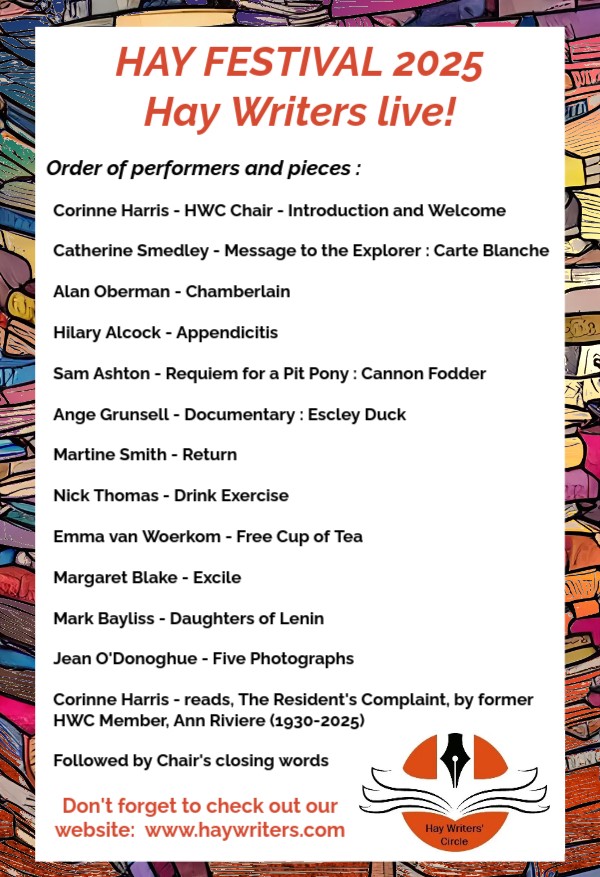
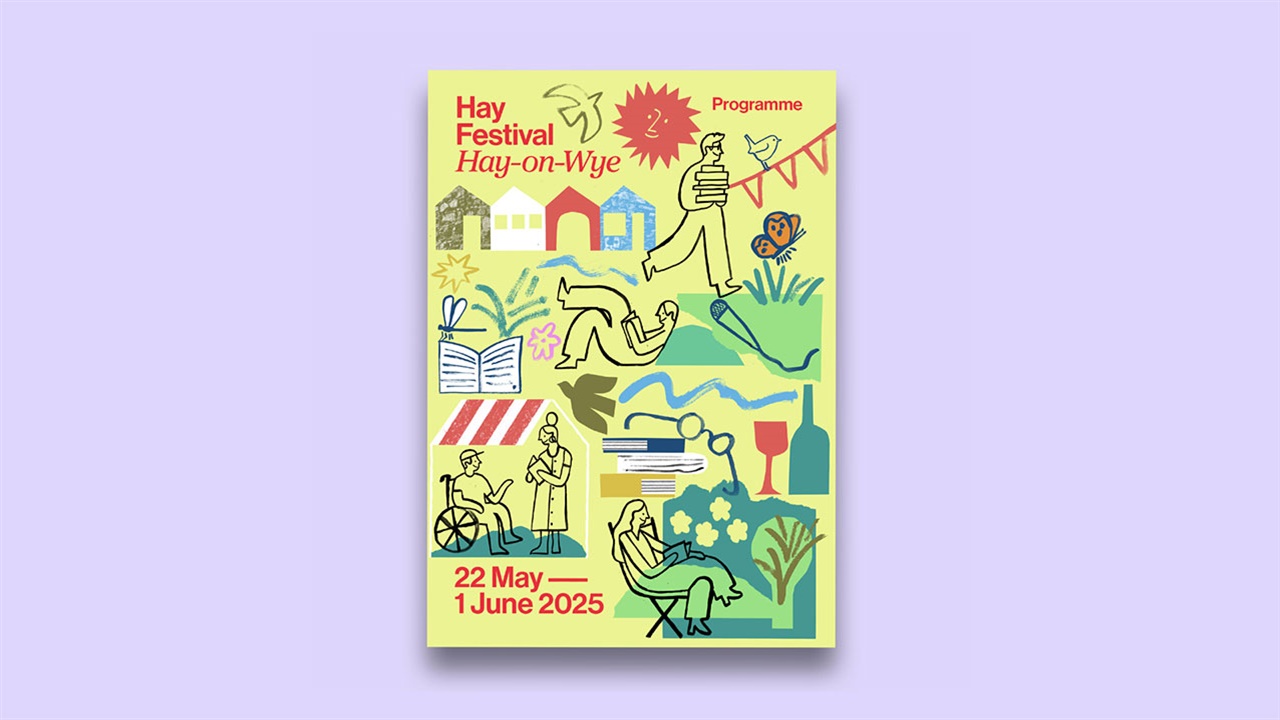
The Hay Writers Live! – Event 71
Date – Saturday 24 May 2025 Time – 7pm
Location – Writers at Work Hub – Hwb Awduron wrth eu Gwaith
Come and hear the writers share and discuss some of their recent work. The Hay Writers’ Circle is a dynamic group, active in Hay for more than 40 years. It offers three competitions annually for poetry, fiction and non-fiction, each of which is open to both members and non-members. There is an active work in progress group for those working on longer projects. The Circle has an ongoing, productive relationship with a local primary school.
Price: £5.00 – CLICK HERE for tickets

We hope to see you there!

 THE HAY WRITERS